
Shopping used to mean walking down an aisle. You saw the shelf. You saw the price tag. You knew instantly what was in stock. Today, comparison shopping happens quietly inside a chat window. Long before a product ever hits a digital cart, the names are filtered. Make the shortlist, and you get a second glance. Miss the cut, and you don’t even get a chance to state your case.
When Shopify’s engineering blog broke down the Universal Commerce Protocol (UCP), they used a simple analogy: it’s just like a standard web handshake. A merchant posts a digital profile outlining exactly what they can do—what extensions they run, what payment methods they take. The smart bot brings its own profile to the table. They compare notes. Where they overlap, they move forward. If there’s a gap, they skip it. If a human needs to step in, the buyer gets bounced back to the store’s actual website to finish the job.
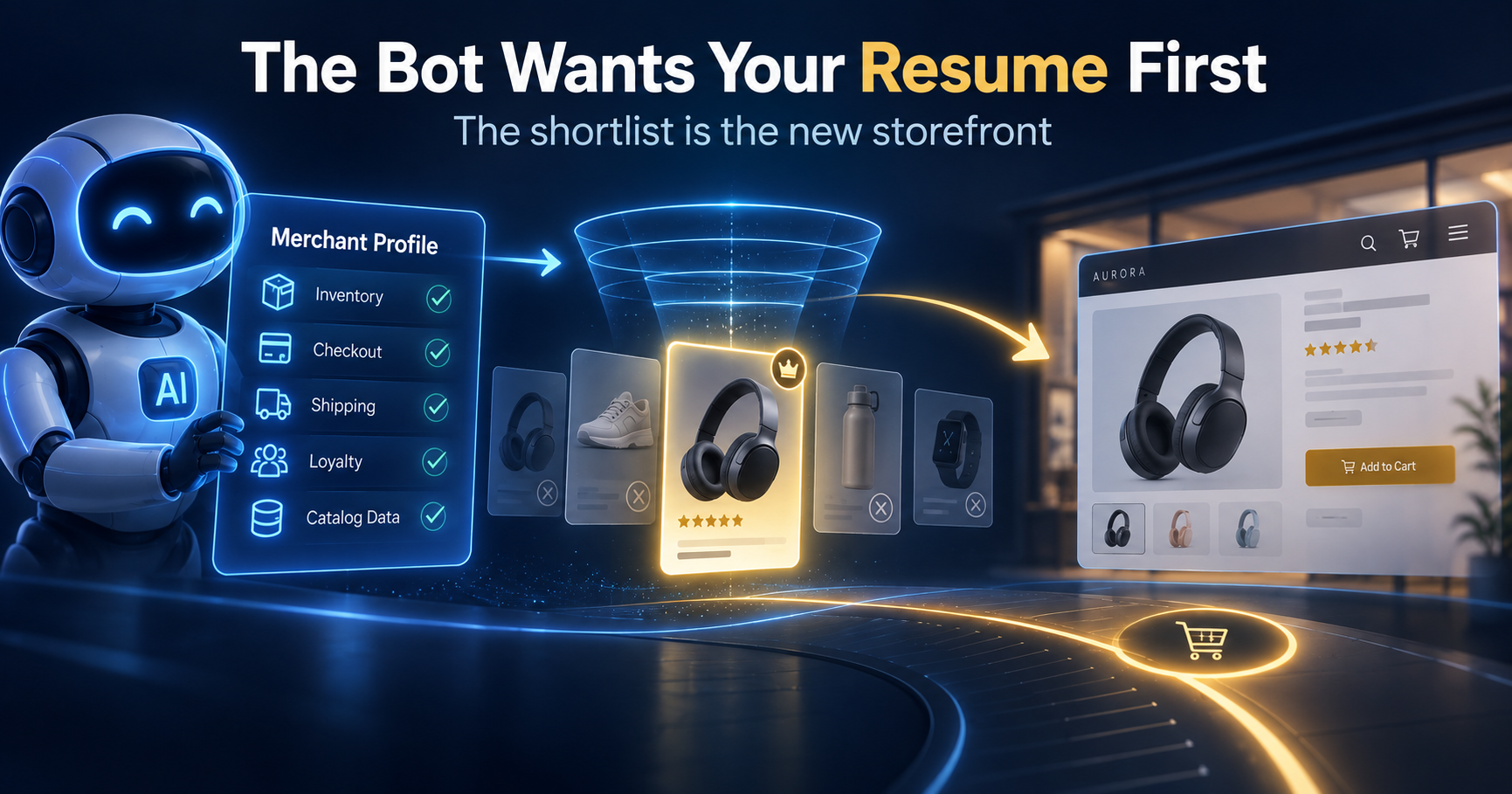
It sounds like dry backend plumbing. But for a business, it’s a harsh new reality. When an AI walks into your digital store, it doesn’t ask what you sell. It asks what you can do.
Voltaire famously advised, "If you wish to converse with me, define your terms." Your store’s digital profile is exactly that—a definition. You claim you can handle live inventory, seamless checkout, and loyalty points. The machine takes you at your word. Overstate your capabilities, and the deal falls apart. Be vague, and the conversation stalls. Leave outdated information up, and you'll step on a landmine. The protocol doesn’t guarantee your products are any good. It just makes sure both sides are speaking the same language.
At the same time, new research is exposing exactly how modern buyers behave. A recent study tracked 56 people running over 200 real shopping tasks using ChatGPT. The winning brands showed up in the chat’s answers twice as often as the losers. More importantly, by the end of 90% of these tasks, nobody was clicking outward links. Very few people actually bothered to visit a webpage to double-check a claim. The shortlist is the new shelf. If you aren't on it, a gorgeous landing page won't save you.
You have to look at these two shifts together. On one side, tech protocols are teaching machines how to negotiate capabilities. On the other, buyers are making their final decisions entirely inside the chat window—a space your traditional web traffic reports can't even see.
Getting name-dropped by AI is huge, but it isn't the finish line. Your ticket in is still a clean data feed and structured facts the machine can read. Once you make that final cut, the real test begins. Can your product hold its own? Can it answer a hyper-specific spec question? Will your price and stock hold up to scrutiny? If you lose a sale, was it because you were invisible, or were you just beaten by better, more verifiable data?
Think of the transaction in two steps. Step one is simply: "Can we talk?" Under the UCP rules, a store leaves its profile at the door. The bot arrives with its own demands. They find common ground. Payments work the same way—the store’s backend and the buyer’s digital wallet negotiate instantly to find a match.
Step two is: "What are we talking about?" If your catalog, prices, and return policies don't match your initial claims—like bragging about live inventory but serving up yesterday's snapshot—a smooth tech connection just means you serve up the wrong data faster.
The industry likes to dress this up with acronyms like AEO or GEO. Academics are figuring out how to boost a brand's chances using structured data to ensure their content gets cited in generated answers. For e-commerce, this is practical advice: turning your specs into hard, extractable facts beats writing catchy marketing slogans. But user behavior tells a cautionary tale. People trust the AI's shortlist blindly. If your brand gets cited, but the specs, prices, or stock are wrong, the buyer loses trust in both the bot and your brand. A bad recommendation hurts you far more than being ignored.
Open protocols—like ACP from OpenAI and Stripe, or UCP from Google and Shopify—are standardizing the entry ticket. Soon, the competitive edge won't go to whoever plugs in first. It will go to the brand whose data can survive a sudden interrogation.
Visibility scores are like a thermometer: they show you have a fever, but not what caused it. The actual disease is usually boring. A missing product trait. An expired promo code. A website that contradicts its own data feed. Making your page "look good for AI" and fixing "why we lost the bot's recommendation" are two totally different jobs. One is just window dressing. The other is proving you can take the heat. Brands chasing the former might look smart on paper, but they won't understand why their buyers vanished.
Let’s put it simply. A protocol is just a translation earpiece in a boardroom. Everyone finally understands the words "checkout" and "catalog." But the earpiece doesn't win the pitch. You win if the papers on your desk are real, fresh, and consistent. As the holiday rush nears, chat volume will spike. Mistakes will multiply. Rushing to set up a digital profile without cleaning up your catalog is a disaster. You're just funneling holiday shoppers straight into an outdated manual.
Abraham Lincoln once asked, "How many legs does a dog have if you call his tail a leg? Four. Calling a tail a leg doesn't make it a leg." Claiming a capability is just giving it a label. The actual product data is the reality. When the label matches the reality, a recommendation feels like a smart choice, not a lucky guess. If they don't match, a flawless tech handshake just pushes bad products in front of people faster.
This is exactly where a "Merchant OS" steps in. It doesn't fight the big protocols over who handles the handshake or the checkout. It sits above them, answering the questions the protocols ignore. Did the bot understand the product? Was the comparison fair? Can we measure our chances of being recommended? Intelligence, control, and observation are fancy words. In the real world, they mean three vital things: Are your claimed skills real? Do the facts on the digital shelf add up? If you lose a sale, can you see exactly where the chain broke?
Now that the shortlist is the new aisle, the smart players are quieting down. They are checking two lists. First, their capability profile—what they can actually do. Second, their product facts—whether the machine can trust what they sell. The loud players are still arguing about which protocol to install first. Tech standards will keep changing. But what sticks is the reason your name made that shortlist. You have to earn your spot.