
Mid-September, Google laid out its holiday updates for digital commerce. One crucial detail was easily buried under the hype of new visibility dashboards. The open commerce integration inside Merchant Center just got much simpler. Merchants no longer have to swallow an entire technical manual at once. They just need to select the checkout path they are ready to handle today. The official documents map out three clear routes. You can bounce the shopping cart back to your own website. You can let the buyer pay natively inside Google’s interface. And finally, you can turn on identity linking. The US gets this first, with Australia and Canada following next year.
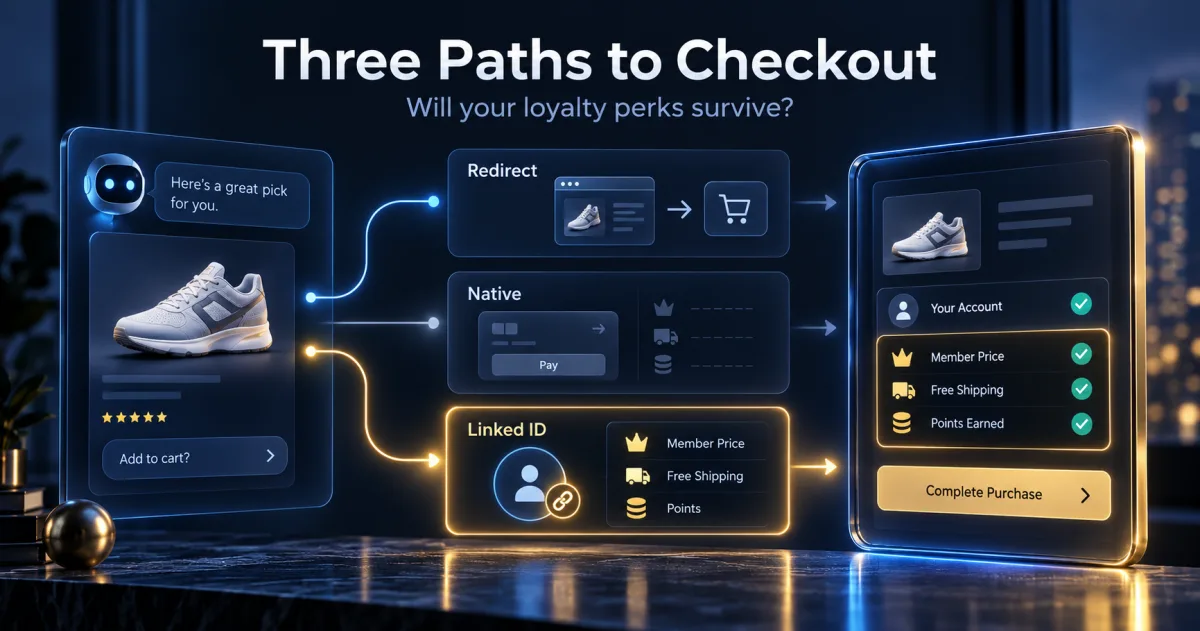
This might sound like a dry engineering menu. But for a retailer, these are three different answers to a massive business question. When a buyer makes a final decision inside a chat window, whose system actually processes the sale? And more importantly, does that system still recognize the buyer as your loyal customer?
Last time, we talked about the new digital mirrors. Platforms now show you exactly how loud your voice is during conversational discovery. That mirror tells you if you were mentioned. This update focuses on the next crucial step. After a bot picks your product, does the actual checkout process honor the special treatment you give your regular customers?
Let us look at the redirect option first. The protocol lets a buyer load up a cart inside Google, then carries that exact cart over to your website to finish paying. You remain the seller of record. Your system controls the final pricing, the stock, the shipping, and the customer service. This aligns perfectly with the current industry division of labor, where the bot handles the research and the store handles the sale. It is like letting shoppers browse a massive public courtyard, but making them walk into your physical store to reach the cash register.
Native checkout is a different beast. Buyers can pay directly inside Google, usually with a saved card in their digital wallet. You are still the official merchant, but you skip the step that bounces them to your website. It is incredibly fast. But that speed has a direct cost. If their accounts are not linked, they are treated as anonymous guests. Your member discounts, free shipping perks, and loyalty points might just vanish in the transaction.
That brings us to the third path: identity linking. The developer documents explain how to use standard authorization protocols to connect a buyer on a platform back to your own store’s account system. Once linked, the checkout request carries their identity. Member prices, personalized deals, and logged-in perks remain intact. Without this, you are stuck treating everyone like a stranger. Google noted that pulling loyalty data into Merchant Center allows you to show member pricing right inside the chat. Minted is already doing this, showing special prices to their members searching for holiday cards. Identity is not just a nice bonus. It is the watershed between keeping a loyal regular and losing them to a fast, anonymous transaction.
The philosopher Alfred Korzybski famously warned that the map is not the territory. The label of “identity” in a tech protocol works exactly the same way. The login status on a platform is just the map. If that map does not connect to the actual territory of your database—your loyalty tiers, your live promotions, your shipping rules—it is entirely empty. You might get a fast conversion on paper, but you leave your hard-earned customer relationship stranded outside the chat window.
Think of it in everyday terms. In the old days, a shop clerk recognized a regular’s face and knew exactly what discount to give them. Now, that regular compares products with a digital assistant before deciding where to pay. If they pay natively inside the platform without linking their identity, they are essentially walking up to a highly intelligent cashier who has absolutely no idea who they are. Bouncing the cart back to your website at least gives them a chance to log in. If you want native checkout to work without destroying relationships, recognizing the buyer must be a core technical capability, not an afterthought you hope the customer figures out on their own.
There is also a parallel story about payment security humming in the background. The protocol plays nicely with delegated payment standards. The industry is currently figuring out the boundaries of letting a bot pay on your behalf. If the human is present, they sign off once. If the human is absent, the bot carries a strict, limited authorization to finish the job. Merchants can leave the heavy lifting to their payment teams. The takeaway is simple. You can delegate the payment, but you must strictly verify the relationship and the fulfillment.
Plugging into a checkout protocol is never the finish line. These three paths remind us that connecting the plumbing just opens the door. Guests might rush in and out anonymously, or they might walk in with their VIP badge only to find your promotional data is a week out of date. The first scenario kills the relationship. The second kills the trust. When you lose both, a massive spike in holiday chat traffic just means you are finalizing the wrong sales much faster. Or worse, treating your best customers like total strangers.
You can break this down into two distinct steps. First, where does the money change hands? You can redirect them home, or you can take the money natively in the platform’s interface. Both are legal, compliant, and measurable. Second, are they still your customer? Without identity linking, the answer is usually no. Even with it, you still have to make sure your member rules, shipping thresholds, and point systems are actually readable during that split-second checkout request. The protocol only guarantees a clean handshake. What price you quote after that handshake is entirely up to your own ledger.
So before the holiday rush, retailers need to ask themselves three practical checkout questions. First, which path can you actually handle right now? Second, if you go native, is your identity linking ready, or will your loyalty pricing evaporate into the ether? Third, can your catalog survive a lightning-fast checkout? If your specs are wrong or an item is out of stock, speeding up the checkout just makes the failure louder. Connecting the protocol is just buying a ticket. Keeping your facts straight and your relationships intact is the actual daily grind. Building a seamless in-chat payment and ensuring you still recognize your regulars are two totally different jobs.
This is exactly where Hasmord sits as a Merchant OS for AI product discovery. We do not fight the big protocols over who processes the cart or logs the transaction. We sit above the plumbing to answer the harder, lingering questions. Was the product understood correctly? Was it compared fairly? Can we measure the real chances of a recommendation and a closed sale? Intelligence, control, and observation mean something very simple at checkout. Did you pick the right path? Did you recognize the buyer? Is the product actually in stock? And when you update a rule, did every sales channel actually get the memo? Dashboards tell you if you are loud. Technical manuals tell you which checkout path you picked. The genuinely hard work is stitching a bot mention, a verified identity, and an accurate price into a single, flawless transaction.
Having three checkout paths does not mean a merchant needs to rush down all three at once. It is about drawing clear boundaries. Product discovery can happen in a chat window. The transaction can happen on the platform or in the store. But if you want the relationship to survive, you have to hardcode identity into the transaction. The smart, quiet players will sit down and check three things. They will check their capability profile, ensure their loyalty system is wired up properly, and verify that their digital shelves can handle the speed of a native checkout. The loud players will keep arguing about whether checkout should live inside the chat window forever. Protocols will keep evolving. But the only thing that truly matters is what happens after the payment clears. You want the buyer to walk away feeling like they are still your valued customer.