
Six months ago, the tech industry thought it had the perfect answer. A digital assistant helps you pick an item, and you pay for it right there in the chat window. When OpenAI launched Instant Checkout, headlines screamed about the end of traditional e-commerce. It sounded incredibly clean. You could cram a massive retail operation into a single text prompt. Shoppers never had to leave the page. Merchants did not have to worry about abandoned carts. The platform held the final confirmation button. It felt like decades of online shopping friction could be erased with a single click.
Then, the traditional storefront made a comeback.
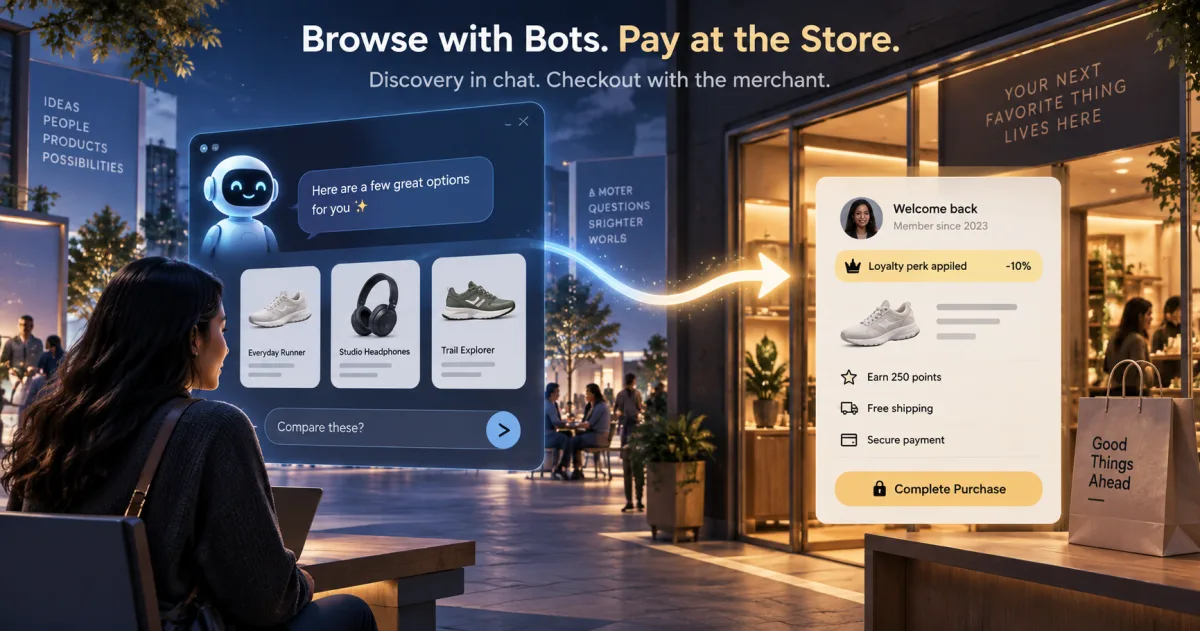
OpenAI quietly changed course. They pivoted back to helping people discover products, leaving the actual checkout process to the merchants. The official statement was polite, noting that the early checkout feature was simply not flexible enough. In plain English, that means a chat window is great for deciding what to buy, but terrible at handling the messy details. It struggles with applying loyalty discounts, splitting payments, calculating reward points, or handling returns. Those granular details naturally live inside the merchant’s own system. Product discovery is a public square. Customer relationships are a private ledger. The public square is great for crowds, but you cannot afford to throw away the ledger.
Around the same time, Walmart plugged its own shopping assistant, Sparky, directly into ChatGPT. When users log in, their shopping cart syncs seamlessly with Walmart’s website and app. The retailer handles the membership perks and the payment routing. Walmart executive Daniel Danker put it perfectly. He said the store should come to meet the customer, rather than tossing them into a totally unfamiliar checkout process. Google is mapping out a very similar strategy for Gemini. The takeaway is clear. The storefront did not vanish. It just opened a new entrance inside the chat window. The neon sign above the door remains exactly the same.
This is not a story about tech giants losing to retailers. It is an industry waking up to its own boundaries. They are actively separating the act of discovery from the act of closing the deal. This is not a step backward. It is an honest admission that finding an item and buying an item require totally different skills.
AI interfaces are brilliant at listening to intent, comparing specs, and shortening a list of options. A bot can ask about waterproofing, the intended recipient, and budget limits in thirty seconds. It takes a massive wall of inventory and shrinks it into three logical choices. Merchants, on the other hand, are brilliant at recognizing regulars. They know how to honor loyalty perks, ship boxes on time, and handle customer service. They remember your last order, your unused coupons, and the shipping address you prefer. Letting both sides do what they do best is a much more honest approach. When the process feels honest, shoppers are far more likely to actually buy.
The tech plumbing is evolving to support this split. Google is pushing the Universal Commerce Protocol. It acts as a shared language for the entire shopping journey, letting digital assistants and store servers talk smoothly from the first search to the final delivery. Meanwhile, the Agent Payments Protocol tackles a much thornier issue: authorization. If a piece of software is spending your money, it needs to leave a verifiable trail. It cannot just drain a wallet based on a casual text prompt. There is no single correct path here. Some people will pay in the chat, some will bounce back to the main website, and others will link their loyalty accounts first. What matters is that the product facts, the live inventory, the price, and the buyer’s identity all line up perfectly. If they do not, a beautiful checkout button is just a beautiful dead end. Every dead end bleeds consumer trust.
As the holiday shopping rush approaches, recent platform updates carry the same warning. Digital assistants are going to ask incredibly detailed questions, and they will rely heavily on the data you feed them. If your product feed is just a title and a price tag, a bot’s recommendation will feel like looking at a shelf through thick fog. You need rich details—materials, fit guides, common questions, and accessory pairings—to clear that fog. A noisy, busy discovery phase does not automatically lead to a smooth checkout. The vital middle ground still requires the retailer to do their homework.
Take it one step further. When multiple AI platforms act as the front door to your business, you are not just managing a single checkout button. You have to ensure your product data and customer recognition work flawlessly across every single entrance. If the data aligns, the buyer feels like they are in your specific store. If it breaks, it feels like dealing with a clerk who remembers your name on Tuesday but treats you like a total stranger on Wednesday. Conversational commerce magnifies these flaws because a chat window exposes structural cracks much faster than a standard search bar.
An old proverb says the grass is always greener on the other side of the fence. For a few months, conversational commerce felt a lot like that. Tech platforms wanted to pull the checkout into the chat to stop people from leaving. Merchants wanted to pull the transaction back to their websites so they could track data and recognize their shoppers. Now, both sides are easing up. The chat brings the shopper to the shelf. The store catches the money, assigns the loyalty points, and handles the order. The public square handles the introduction, and the cash register handles the handshake. It sounds like an ancient bazaar, but it is exactly what these cutting-edge protocols are reinventing. The old bazaar relied on a merchant’s sharp memory. The new bazaar relies on data streams recognizing the exact same person and the exact same product.
For sellers, the panic should not be about AI replacing their storefront. The real question is far more practical. When your front door opens inside a search result, a chat window, or next to a short video, does your system still recognize the person walking in? When a buyer types a question about their member discount, combined shipping, or past purchases, can your data feed answer instantly? If your system chokes, the transaction stalls. If a transaction stalls enough times, buyers learn to just go directly to the stores they already know. Familiarity is not just having a recognizable logo. Familiarity means proving to the customer that you actually remember them.
The next big lesson is not about installing a flashier checkout button. It is about building a rock-solid foundation for your store. It does not matter where the buyer discovers you, as long as your product specs are crystal clear. It does not matter where the payment happens, as long as the buyer’s identity and loyalty perks match up perfectly. Agent-driven shopping is not erasing the traditional store. It is forcing retailers to master the absolute basics of recognizing their products and recognizing their people. The human clerk is still there. They just happen to be standing right next to a chat prompt. The store did not go anywhere. The customer just found a new way to push open the door.