
AI visibility
AI share of voice is the share of AI answers, across a set of prompts, that mention your brand compared with your competitors. It is a popular headline number, and a useful one if you know what is underneath it: whose prompts, which assistants, and whether a mention means you were recommended. This guide explains how it is calculated, where it misleads, and how to turn it into something your team can act on.
Last updated October 15, 2026 · ~6 min read
The short answer: AI share of voice tells you how often assistants name you for the prompts someone chose to track. It doesn’t tell you whether those are your buyers’ questions, whether you were recommended or just mentioned, or whether the answer got your product right. Use it as a trend on a fixed set of real buyer questions, split into mentions, citations and recommendations, and read the answers behind it.
Tools differ, but most follow the same pattern: pick a set of prompts, ask one or more assistants, and count how often each brand appears.
Two reports can both say “share of voice” and mean different things. Before you compare numbers, check which formula and which prompt set each one uses.
| Measure | What it tells you | What it misses |
|---|---|---|
| Mention share | How often assistants name you for your tracked questions | Whether the mention was positive, a recommendation, or correct |
| Citation share | How often your own pages are used as a source | Answers that describe you from a retailer or reviewer page instead |
| Recommendation share | How often you are the product the answer suggests for the buyer’s conditions | Why you lost when you didn’t win |
| Answer accuracy | Whether the facts about your product were right | Nothing on its own about volume; pair it with the shares above |
More on the method in AEO tracking and AI visibility tools: what they measure.
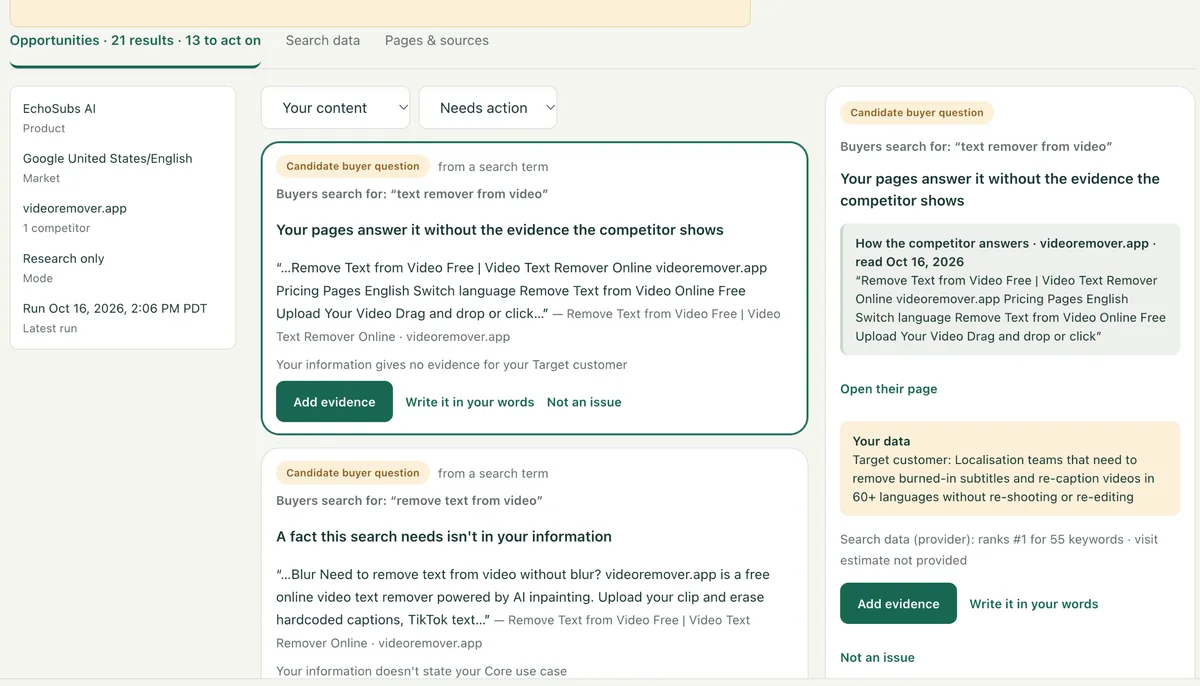
Hasmord asks AI assistants your buyers’ own questions in rounds through the Anthropic, Google, OpenAI and Perplexity APIs, and records whether each answer picks your product and what it weighed. Duplicate wordings of a question are merged, so one question isn’t counted twice. Citations shows whether assistants used your pages as a source, and Competitor Research shows what competitors answer well that you don’t. The work that follows is fixing the facts behind the questions you lose, with every change approved by your team. API answers can differ from what people see in an assistant’s app.
It is the share of AI answers, across a set of prompts, that mention your brand compared with competitors. Tools calculate it differently: some divide the answers that mention you by all answers, others divide your mentions by the mentions of every tracked brand.
It is reliable as a trend on a fixed, documented set of questions and assistants. It is unreliable as a market-wide number, because someone chose the prompts, answers vary from run to run, and a mention is not the same as a recommendation.
Share of voice counts mentions of your brand in the answer text. Citations count the pages an assistant used as sources. You can be mentioned without your page being cited, and cited without being recommended.
Find the buyer questions where a competitor is recommended instead of you, read what decided each answer, and fix the missing or unsupported facts on your pages. Then ask the same questions again. Chasing the percentage itself usually leads to content that doesn’t answer anyone.
Related: AI visibility tools · AEO tracking · ChatGPT citations · measuring AEO’s impact on sales · why AI doesn’t recommend my product.