
Find customers
What buying signals are, examples by type, how to tell a strong signal from noise, what happened when we skipped them, and how to act on one without spamming.
Last updated October 23, 2026 · ~7 min read
The short answer: a buying signal is something a person or company does or says that shows they are moving toward a purchase, like a question about price or a request for recommendations. The strongest signals are specific, recent, from the right person and repeated. Act on them by answering the question first, saying why you’re reaching out and sending one useful message, and record the signal on the lead.
A buying signal is something a person or a company does or says that shows they are moving toward a purchase: a question about price, a second visit to your pricing page, a public request for recommendations, a complaint about the tool they use now. One signal on its own rarely means much. Several, close together and specific to what you sell, usually do.
Buying signals overlap with intent data, but they are not the same. Intent data is usually company-level: an account reading a lot about a topic. A buying signal can be one person’s specific question, which is often more useful, because you know who asked and what they need.
| Type | Examples | How strong | What to do |
|---|---|---|---|
| In a conversation | Asks about price or contract terms; asks how long setup takes; asks whether it works with a system they already use; brings in a colleague or the person who signs; asks for a customer like them | Strong | Answer the exact question, then agree on a next step |
| On your website or in your product | Comes back to your pricing page; compares plans; starts a trial; reads a comparison or “alternatives” page; asks a question in your chat | Medium to strong | Follow up on what they looked at, not with a generic sequence |
| In public | Asks peers for a recommendation; asks how to solve the problem you solve; says they are leaving their current vendor; compares two named options | Medium; strong when specific and recent | Reply only where it helps, and answer the question first |
| Company events | New funding; hiring for a role your product supports; a new leader; expansion into a market you serve | Weak on its own | Use as context, not as a reason to pitch |
| In AI answers, before they reach you | A buyer asks an AI assistant which product fits. You don’t see the question, but it shows up later: they already know your price, name the competitor the assistant suggested, or say an assistant recommended you | Strong once it surfaces | Ask what they asked, and record it on the lead |
Four checks separate a signal worth acting on from noise:
A like or a follow tells you very little. A question tells you a lot, because it says what they need in their own words.
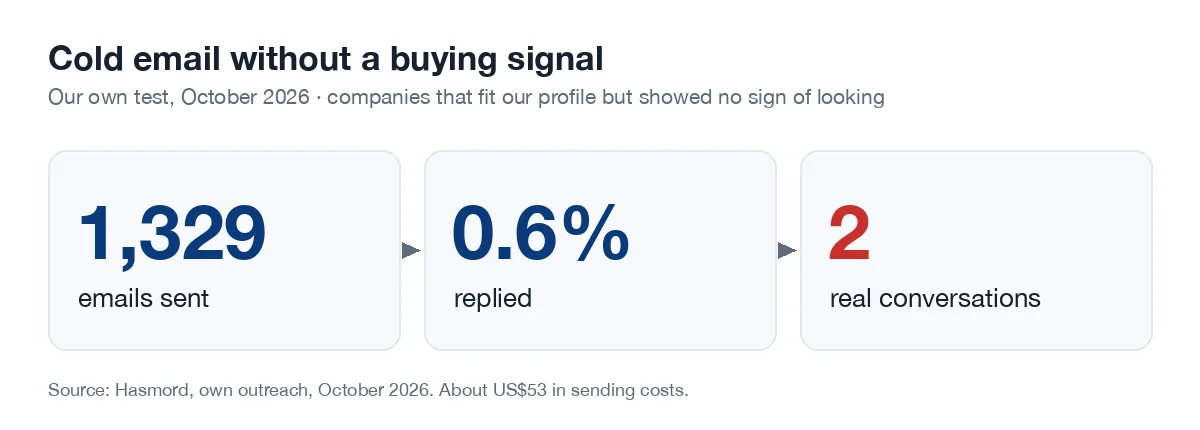
In October 2026 we ran a cold email test ourselves. We wrote to 1,329 people at companies that matched our customer profile but had shown no sign of looking. 0.6% replied, and 2 of those replies turned into real conversations, for about $53 in sending costs. We stopped it.
Fitting a profile is not the same as looking. Without a signal, outreach is a numbers game most people lose, and every unwanted email costs a little goodwill. One specific question from someone already looking is worth more than a thousand profile matches.
More buyers now ask an AI assistant before they visit your site. You won’t see that question in your analytics: AI referral visits only count the clicks, and many buyers read the answer and then search for you by name. So ask new leads what they asked and where, and keep it with the lead. Over time, those questions tell you what to fix in the answers AI assistants give about you.
Hasmord is the AEO-native sales platform. Buyers ask questions across AI assistants, search, and sales conversations. Hasmord uncovers where your answers about your products and services fall short, turns evidence into better answers, finds potential customers for you, and connects every lead to your sales process.
In Hasmord, finding customers is the third of four steps. It starts where buyers ask: AI answers shows what assistants tell buyers about your products and services, and evidence turns into better answers your team approves. Find customers then finds potential customers already showing interest around the competitors you watch and the buyer questions you track, each with the reason they fit. Only the people you verify join your CRM, and Hasmord never contacts anyone: your team decides whether and how to reach out.
In the CRM, each lead keeps the signal and the question that brought it, and what buyers ask in sales becomes the next gap to fix in your AI answers. See pricing.
Buying signals are things a person or company does or says that show they are moving toward a purchase, such as asking about price, returning to a pricing page, asking peers for a recommendation or complaining about their current tool.
Asking about price, contract terms or setup time; bringing in a decision maker; returning to your pricing or comparison pages; starting a trial; asking peers which tool to choose; saying they are leaving a current vendor; or arriving already knowing your price because an AI assistant told them.
Signals in a conversation, signals on your website or in your product, signals in public, company events, and questions buyers asked AI assistants before they reached you. Conversation signals are usually the strongest; company events are weak on their own.
Intent data usually shows company-level interest in a topic. A buying signal can be one person’s specific question, so you know who asked and what they need.
Only if the signal is specific and you can help. Answer the question first, say why you are reaching out, send one useful message and let them choose the next step.
Related: how to find customers · Find customers · AI visibility to leads · measuring AEO’s impact on sales · the AEO-native CRM.