
Find customers
How to calculate cost per lead, what counts as a lead, 2026 averages by channel and industry, what makes a cost per lead good, and how to lower yours.
Last updated October 24, 2026 · ~8 min read
The short answer: cost per lead is total cost divided by the number of leads. Search ads on Google and Microsoft averaged $66.69 per lead in 2026 (WordStream by LocaliQ), and First Page Sage’s average across channels and 30 industries was $400, but each counts a different thing as a lead. A good cost per lead is below what a lead is worth to you: the value of a customer times the share of leads that become customers.
Cost per lead (CPL) is what you spend to get one lead. The formula is simple:
Cost per lead = total cost ÷ number of leads
If you spend $3,000 on a campaign in a month and it brings in 40 leads, your cost per lead is $3,000 ÷ 40 = $75.
Decide up front what goes into “total cost” and keep it the same every month. Ad spend alone gives a lower number than ad spend plus tools, agency fees and the time your team spends. Neither is wrong, but you can only compare months, channels or vendors that count the same costs.
For paid search there is a shortcut: cost per lead = cost per click ÷ conversion rate. At $5 a click and a 5% click-to-lead rate, each lead costs $100.
Every report says “cost per lead”, but they count different things. A form fill is not the same as a phone call, and neither is the same as a lead your sales team has qualified. Before you compare your number with a benchmark, check what the benchmark counted.
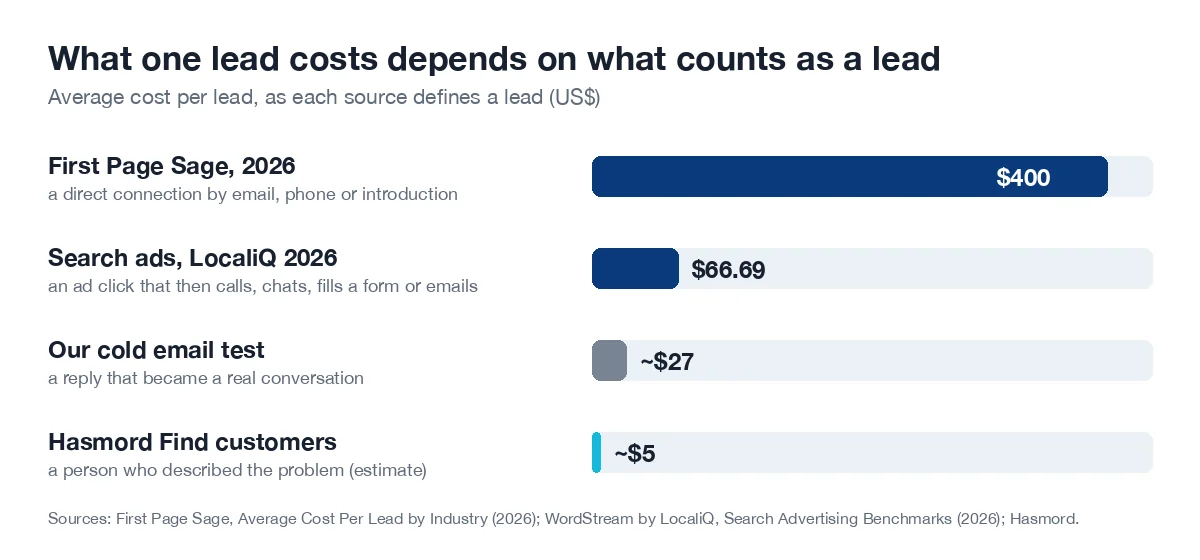
| Source | What counts as a lead | Average cost per lead |
|---|---|---|
| Search ads on Google and Microsoft (WordStream by LocaliQ, 2026) | Someone who clicks an ad and then contacts you by phone, chat, form or email | $66.69 across industries; Industrial & Commercial $75.19; Business Services $93.69 |
| All channels, 30 industries (First Page Sage, 2026) | A direct connection with a prospect interested in buying, by email, phone or in-person introduction | $400 blended; eCommerce $96; B2B SaaS $249; Manufacturing $547 |
| Our own cold email test (Hasmord, October 2026) | A reply that turned into a real conversation | About $27: $53 in sending costs, 2 conversations |
| Hasmord Find customers (estimate) | A person who described the problem in their own words: they want to fix it, or it bothers them | About $5 on average, based on what we know so far; it varies by industry and by the search terms you use |
First Page Sage is an SEO firm and its figures come from its own lead data (January 2022 to August 2026). The LocaliQ figures come from its customers’ search campaigns. Our cold email cost counts sending costs only.
A good cost per lead is one below what a lead is worth to you. Work it out from your own numbers:
Break-even cost per lead = value of a customer × share of leads that become customers
If a new customer is worth $6,000 in the first year and 1 in 20 leads becomes a customer (5%), a lead is worth $300 to you. Paying $150 per lead is good; paying $400 loses money, however good the benchmark makes it look.
That is why a low cost per lead can still be expensive. A thousand cheap leads that never buy cost more than ten expensive ones that do. Track cost per customer next to cost per lead, by channel.
Hasmord is the AEO-native sales platform. Buyers ask questions across AI assistants, search, and sales conversations. Hasmord uncovers where your answers about your products and services fall short, turns evidence into better answers, finds potential customers for you, and connects every lead to your sales process.
In Hasmord, finding customers is the third of four steps. It starts where buyers ask: AI answers shows what assistants tell buyers about your products and services, and evidence turns into better answers your team approves. Find customers then finds people who described the problem in their own words, around the competitors you watch and the buyer questions you track, each with the reason they fit. Before a search starts you see what a lead typically costs, and you set a daily limit. Hasmord never contacts anyone: only the people you verify join your CRM, and your team decides whether and how to reach out.
In the CRM, each lead keeps the question that brought it, so you can see which leads became customers and what a customer really cost. See pricing.
One below what a lead is worth to you: the value of a customer multiplied by the share of leads that become customers. If a customer is worth $6,000 and 5% of leads buy, anything under $300 per lead pays for itself.
Divide the total cost of a channel or campaign by the number of leads it produced in the same period. Decide what counts as a cost and what counts as a lead first, and keep both the same over time.
Google charges per click, not per lead. Your cost per lead is your cost per click divided by the share of clicks that become leads. Across industries, search ads on Google and Microsoft averaged $66.69 per lead in 2026, according to WordStream by LocaliQ.
No. Cost per lead counts every lead, whether or not it buys. Cost per acquisition usually counts a customer or a sale, so it is higher. Track both.
Based on what we know so far, a person who described the problem in their own words costs about $5 on average. It varies by industry and by the search terms you use, and you see the typical cost before a search starts.
Related: buying signals · how to find customers · Find customers · AI visibility to leads · the AEO-native CRM.