
Product pages
What product page SEO covers now that AI assistants read your pages too, what our tests caught AI getting wrong, a 12-point checklist, B2B product pages, and how to check a page.
Last updated October 25, 2026 · ~8 min read
The short answer: product page SEO means making each product page easy for search engines, AI assistants and buyers to understand: a clear title and opening, specs as text, each variant with its own name, price and stock, Product structured data that matches the page, and answers to buyers’ questions. In our tests, AI answers got prices and stock wrong mostly where the page itself was unclear.
Product page SEO is the work of making each product page easy to find and easy to understand: for search engines, for the AI assistants that now answer buyers’ questions, and for the buyer who lands on it. It covers the page title and URL, the copy, the specs, prices and stock for every variant, the structured data, the images and the reviews.
The second reader is new. When a buyer asks an assistant “where can I buy this, and how much is it?” or “which one fits my use?”, the answer is built from pages like yours. In our tests a brand’s own site was cited in 49% of Google AI Overviews and 57% of ChatGPT answers to the same 60 shopping questions. So the product page is now one of the sources the answer is assembled from, as well as the page the buyer clicks through to.
In October 2026 we asked ChatGPT, Perplexity and Google where to buy eight specific products and how much they cost, three times each, and checked every answer against the store’s live price and stock.
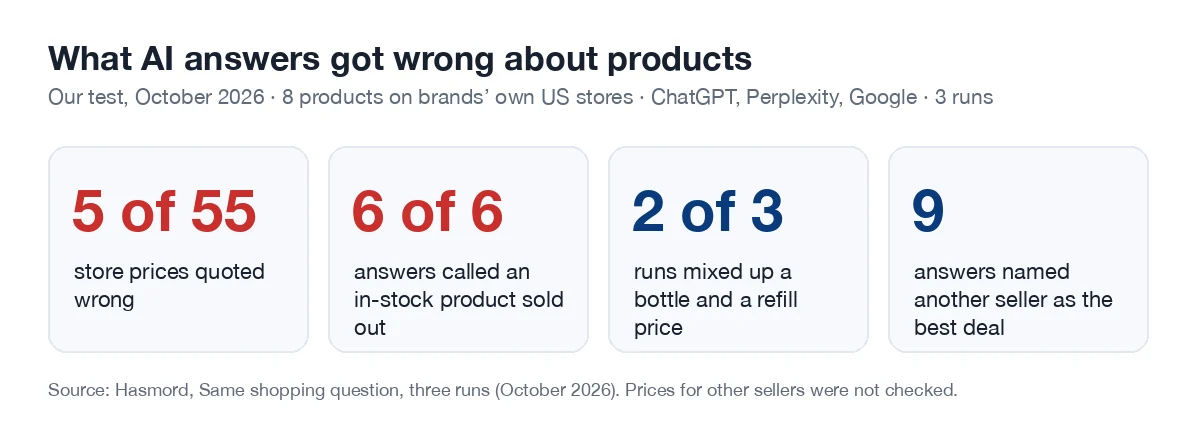
Most errors trace back to how a fact is stated on the page. A bottle and a refill with similar names got their prices swapped. A sale price was quoted as the regular price. And the product that every ChatGPT and Perplexity answer called sold out had a hidden “Sold out” label next to its price, as many store themes do, while its structured data said in stock. Two other stores had the same hidden label and were not called sold out, so treat that as something to check, not a proven cause.
Comparisons are the other gap. When buyers asked “X vs Y”, ChatGPT cited one of the compared brands’ own sites in only 5 of 12 answers, Perplexity in 2 of 12 and Google in 1 of 11. If your page doesn’t say how you compare, review sites say it for you.
| Element | What to do | Why it matters for AI answers |
|---|---|---|
| Title tag and H1 | Product name, the attribute buyers search for (size, material, use) and your brand. Keep the title under about 60 characters. | Assistants match the buyer’s wording to your product name and attributes. |
| First lines of the page | Say what it is, who it’s for and the one spec that decides the purchase, in plain text above the fold. | The opening is what gets quoted. Vague openings get replaced by a review site’s summary. |
| Specs | A text table with units, not only an image or a PDF. Same names and values as your catalog and datasheet. | Specs in images or PDFs are easy to miss; specs that disagree across pages get mixed. |
| Variants | Each size, pack or model with its own name, SKU and price, named the same way everywhere. | Look-alike variant names are how a bottle and a refill price get swapped. |
| Price | One current price per variant. Show a sale price next to the regular price, with an end date. | A sale price without context gets quoted as the regular price, or the other way round. |
| Stock | One clear stock state per variant. Remove hidden “Sold out” text left by the theme. | An answer that says “sold out” ends the purchase before the buyer visits. |
| Structured data | Product schema with brand, SKU (and GTIN if you have one), and an offer per variant: price, currency and availability that match the visible page. | Search engines read it directly; a mismatch with the visible page leaves the reader guessing which is right. |
| Where to buy | Say whether you sell direct and list your authorised sellers. | Otherwise the answer picks the sellers, and often names another one as the best deal. |
| Comparisons | A short, honest “how it compares” section, or a comparison page for the alternatives buyers name. | “X vs Y” answers rarely cite the brands’ own sites. |
| Reviews and questions | Real reviews, and answers to the questions buyers ask before they buy, on the page. | They answer the “is it good for…” questions in buyers’ own words. |
| Images | Descriptive file names and alt text; compress large files. | Alt text is read; a slow page is a worse landing for the buyer who clicks through. |
| Duplicate text | Write your own description instead of the manufacturer’s; keep one canonical URL per product. | Identical text on many sites gives no reason to cite yours. |
If buyers check specs before they call, the product page is part of the sales conversation. Put the facts they need to shortlist you on the page, as text: dimensions, tolerances and materials; certifications and standards; lead times and minimum order; the industries or uses it’s for; and how to get a quote. Keep the same facts on your distributor listings and in your datasheets, because assistants read those too and the answer blends them. See Hasmord for manufacturers and distributors.
Hasmord is the AEO-native sales platform. Buyers ask questions across AI assistants, search, and sales conversations. Hasmord uncovers where your answers about your products and services fall short, turns evidence into better answers, finds potential customers for you, and connects every lead to your sales process.
In Hasmord, product pages are where the first two of four steps happen. AI answers shows what ChatGPT, Claude, Gemini, Perplexity and Google’s AI Overviews tell buyers about each of your products: whether they name you, where they send buyers and what they say the price is. Hasmord compares those answers with your product facts and prepares fixes, product by product, for your team to approve. Then Find customers finds people already showing interest around the competitors you watch and the buyer questions you track, and the CRM keeps each lead’s question with it through to the order.
Start with one product and see what the assistants say about it. See pricing.
Making each product page easy for search engines, AI assistants and buyers to find and understand: the title and URL, the copy, specs, prices and stock for every variant, structured data, images and reviews.
Put the product name and the attribute buyers search for in the title and H1, say what it is and who it is for in the first lines, list specs as text, give each variant its own name, price and stock state, add Product structured data that matches the visible page, and answer buyers’ questions on the page.
Yes. Product structured data with brand, SKU and an offer per variant (price, currency and availability) helps search engines read the page. Keep it identical to what the page shows; a mismatch is worse than none.
Usually not. One canonical page per product with every variant listed, each with its own name, SKU, price and stock, is easier to keep consistent. Give a variant its own page only when buyers search for it as a separate product.
As sources. In our tests a brand’s own site was cited in 49% of Google AI Overviews and 57% of ChatGPT answers to shopping questions, but rarely in comparisons, where review sites dominate. Errors in answers often trace back to unclear variants, sale prices or stock labels on the page.
Related: product data audit · AI shopping product data checklist · same question, three runs (study) · how to rank in Google AI Overviews · Hasmord for manufacturers.