
We asked the 60 shopping questions from our earlier studies again, three times in one day, in Google, ChatGPT and Perplexity. Then we asked “where can I buy it, and how much is it?” about eight specific products, three times each, and checked every answer against the store’s live price and stock.
Published October 22, 2026 · Data collected October 22, 2026 (three runs, one hour apart) and October 17, 2026
Share of answers that cited at least one site of each type, as the mean of the three runs on October 22 with the lowest and highest run in brackets, and the single run on October 17 below.
| Source type | Google AI Overviews | ChatGPT | Perplexity |
|---|---|---|---|
| Brand site | 53% (52–54) Oct 17: 49% | 57% (49–64) Oct 17: 57% | 50% (50–50) Oct 17: 53% |
| Retailer | 31% (29–33) Oct 17: 27% | 53% (50–57) Oct 17: 53% | 28% (28–28) Oct 17: 32% |
| Review site or media | 84% (81–85) Oct 17: 89% | 82% (76–88) Oct 17: 78% | 99% (98–100) Oct 17: 98% |
| Forum or social | 67% (60–73) Oct 17: 67% | 0% (0–0) Oct 17: 0% | 10% (10–10) Oct 17: 8% |
| Video (YouTube) | 83% (81–85) Oct 17: 86% | 0% (0–0) Oct 17: 0% | 0% (0–0) Oct 17: 0% |
How much the cited sites moved within the day:
| Engine | Sites cited in all three runs | Average overlap between two runs | October 17 sites cited again on October 22 |
|---|---|---|---|
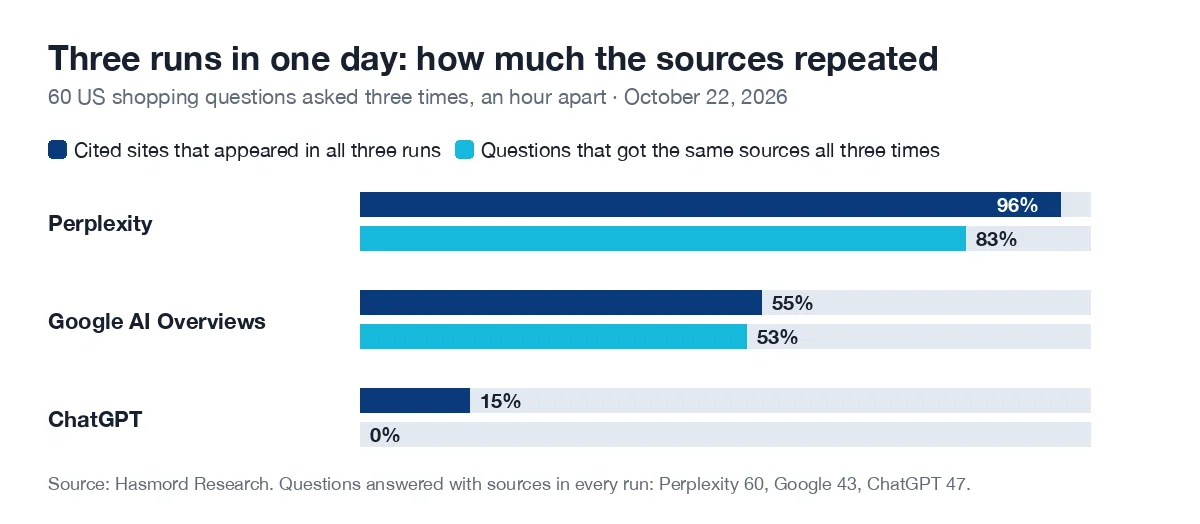
| Google AI Overviews | 55% | 74% | 74% |
| ChatGPT | 15% | 32% | 70% |
| Perplexity | 96% | 98% | 77% |
Two examples of how much one answer can move in an hour:
Share of answers citing a brand’s own site, by the typical price of the product in the question (software questions left out), as the mean of the three runs.
| Typical price | Google AI Overviews | ChatGPT | Perplexity |
|---|---|---|---|
| under $100 | 81% (~8 answers) | 29% (~10 answers) | 46% (~11 answers) |
| $100–399 | 47% (~29 answers) | 55% (~28 answers) | 52% (~33 answers) |
| $400+ | 31% (~9 answers) | 75% (~8 answers) | 27% (~11 answers) |
Eight specific products sold on their brands’ own US stores, from a kitchen tool to a hard cooler, asked three times in each engine. At the start of each run we saved the store’s live price and stock; none changed during the day. Google showed an AI Overview for only 9 of the 24 questions, so its column is small.
| Engine | Answers | Named the brand’s own store | Own-store price wrong | Said an in-stock product was sold out | Named a cheaper seller as the best deal |
|---|---|---|---|---|---|
| Google AI Overviews | 9 of 24 | 7 | 1 of 7 | 0 | 1 |
| ChatGPT | 24 of 24 | 24 | 3 of 24 | 3 | 5 |
| Perplexity | 24 of 24 | 24 | 1 of 24 | 3 | 3 |
What went wrong, run by run:
We cannot tell why the stock error stuck. One thing we noticed: the product page carries a hidden “Sold out” label next to the price, as many store themes do, while its structured data says in stock. Two other stores in the test had the same hidden label and were not called sold out, so this is something to check, not an explanation.
Part 1: the same 60 shopping questions as our Google study and assistant study, asked three times on October 22, 2026, at 9:45, 10:45 and 11:45 Pacific time, with the same settings: Google US desktop with the AI Overview loaded; ChatGPT through chatgpt.com search for a US location (DataForSEO LLM Scraper); Perplexity through the Sonar API with US web search (DataForSEO). Citations are counted as in those studies, and site types use the same scheme, assigned by one person. Percentages use answers that cited at least one source; for Google, questions where an overview appeared. Overlap compares cited sites by domain.
Part 2: eight products on the brands’ own US stores that publish their prices, asked as “Where can I buy [product], and how much is it?” in the same three runs. We saved each store’s price and stock at the start of each run and labelled every answer by hand: whether it named the brand’s store, whether the price it gave for that store was right, what it said about stock, and whether it named a cheaper seller as the best deal. Prices given for other sellers were not checked. A price counts as right if it matches any current variant, or the lowest one when the answer says “from”. We do not name the products, because several belong to brands we work with or talk to.
Limits: one day, three runs, one market; the products are a small convenience sample, not representative of all stores. The question lists are written, not sampled from real searches. API and scraper results can differ from what a logged-in user sees. The raw rows are in the CSVs: Part 1 and Part 2.
Hasmord is the AEO-native sales platform. Buyers ask questions across AI assistants, search, and sales conversations. Hasmord uncovers where your answers about your products and services fall short, turns evidence into better answers, finds potential customers for you, and connects every lead to your sales process.
It asks your buyers’ questions in ChatGPT, Claude, Gemini and Perplexity, reads a question’s Google AI Overview every day for a week with Question Monitors, and shows which sources and facts each answer relied on. See the AEO/GEO platform.
Mostly, in our test. ChatGPT gave the brand store’s price correctly in 21 of 24 answers. The misses were one wrong sale price and, twice, a bottle and its refill mixed up. It also said one in-stock product was sold out in all three runs.
Yes, and how much depends on the engine. Only 15% of the sites ChatGPT cited appeared in all three runs on the same day, against 55% for Google AI Overviews and 96% for Perplexity. The share of answers citing each type of site moved much less.
We cannot see inside the engines. In our test the error repeated on every run for one product, so it is worth checking what your product page shows to software that reads its text: hidden stock labels, out-of-stock variants and structured data.
More than once. A single run can be unrepresentative, especially in ChatGPT. Ask the same buyer question several times, track the share of answers that cite or recommend you, and check prices and stock on the questions closest to a sale.
Related: who ChatGPT and Perplexity cite · who Google’s AI Overviews cite · AI Overviews tracker · ChatGPT shopping.