
AI visibility
What an AI visibility checker measures, the four layers of AI visibility, why a mention count misses wrong prices and sellers, and how to check your own products in AI assistants.
Last updated October 21, 2026 · ~7 min read
The short answer: an AI visibility checker measures how AI assistants such as ChatGPT, Gemini, Claude and Perplexity treat your brand. Most count how often you are named. That misses whether you are recommended, whether the price and seller in the answer are right, and which sources the answer used. For products, check each one with your buyers’ real questions, on every assistant, more than once.
AI visibility is how your brand and your products show up when buyers ask AI assistants such as ChatGPT, Gemini, Claude and Perplexity, or read a Google AI Overview. It has four layers, and each one is a separate question:
A fifth number sits outside the answer: the visits AI assistants send to your site.
Most checkers cover one or two of those layers. The type tells you which.
| Type of check | What it tells you | Where it stops |
|---|---|---|
| Prompt-based mention check | How often assistants name your brand for a set of prompts, often as a share of voice against competitors | Usually brand level and a single run; it counts the name, not whether the facts are right |
| On-site readiness check | Whether AI crawlers can reach and read your pages: robots.txt, structured data, page structure | Says whether AI can read your page, not what assistants actually say |
| Citation check | Which pages assistants cite when they answer, and whether yours is among them | A citation is not a recommendation; a cited page can still lose the pick |
| Product-level answer check | For one product and one buyer question: named, recommended, the price and seller given, and the sources | Takes more questions and repeated runs, so it costs more time than a brand score |
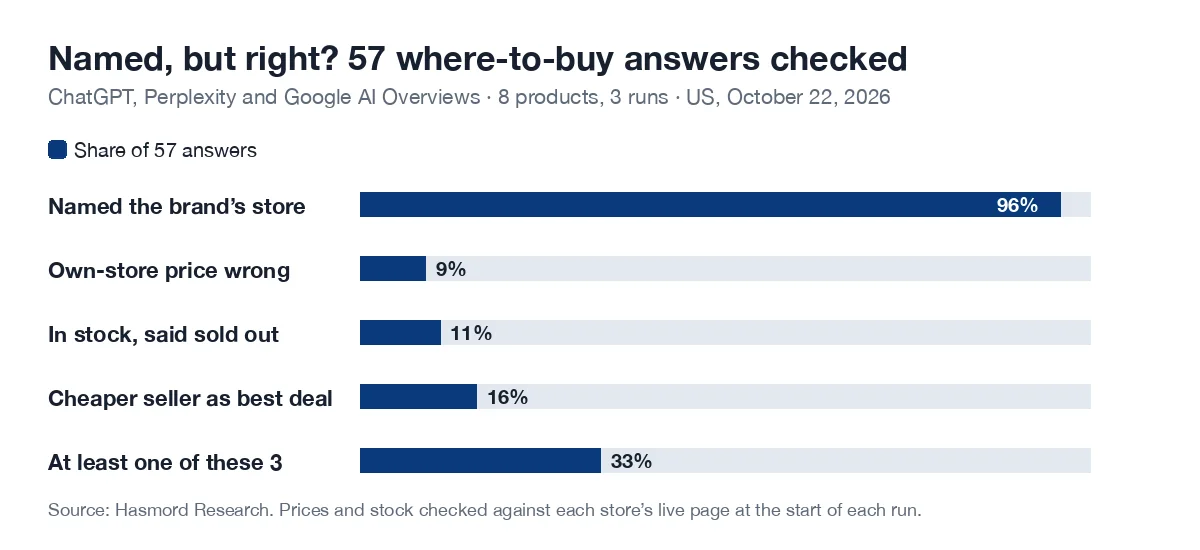
We asked ChatGPT, Claude, Gemini and Perplexity, through their APIs with web search on, where to buy two exact products and what they cost, then compared every answer with the seller’s own page that day. Two products, one run each, so treat it as an example, not a study.
A mention checker would score both products four out of four. Yet on the question closest to the sale, each assistant picked its own seller and its own price, and two prices quoted for a specific seller didn’t match that seller’s page. Whether sending buyers to a retailer is a problem depends on how you sell; a wrong price is wrong either way.
Each assistant builds its answer from different sources. In our study of 60 shopping questions, 64% of the sites Google’s AI Overviews cited were outside the organic top 10 for that question. In the follow-up, only 8% of the sites ChatGPT cited, and 13% of those Perplexity cited, were also cited by Google’s AI Overview for the same question. A good result in one engine says little about the others, and the same question can get a different answer next week.
Five products, three questions, four assistants and two runs is 120 answers. By hand that is an afternoon and a long spreadsheet, which is why teams that keep doing it automate it.
Many checkers roll everything into one AI visibility score. A score is useful for a trend line, but it averages away the detail you act on: which product, which question, which assistant, and which fact was missing or wrong. Before you trust a score, ask to see the answers behind it.
Hasmord is the AEO-native sales platform. Buyers ask questions across AI assistants, search, and sales conversations. Hasmord uncovers where your answers about your products and services fall short, turns evidence into better answers, finds potential customers for you, and connects every lead to your sales process.
In Hasmord, the check is the first of four steps. It uncovers where your answers about your products and services fall short: AI answers asks ChatGPT, Claude, Gemini and Perplexity your buyers’ questions about each product and keeps every answer, including who was named and recommended and the facts given. Citations shows the sources behind each answer, and Website traffic counts the visits AI assistants send you. The free product check on our homepage scores one product page on six AI-readiness signals, with no signup, once a day.
It then turns evidence into better answers your team approves, and the consistency report catches facts that contradict each other across your pages and listings, such as two different prices. Find customers finds potential customers already looking for what you sell, with the reason each one fits; only the people you verify join your CRM, and Hasmord never contacts anyone for you. In the CRM, each lead keeps the question that brought it, and what buyers ask in sales becomes the next gap to fix. Citation checks are 3 a month on Free and up to 800 on Pro; see pricing.
How your brand and products show up when buyers ask AI assistants such as ChatGPT, Gemini, Claude and Perplexity: whether you are named, whether you are recommended, whether the price, specs and seller are right, and which sources the answer relied on.
Depending on the type: how often assistants mention your brand, whether AI crawlers can read your pages, which sources assistants cite, or, at product level, whether each answer names and recommends your product with the right price and seller.
Yes. Many tools offer a free brand-level check, and you can check by hand by asking each assistant your buyers’ questions with web search on. Hasmord’s free product check scores one product page on six AI-readiness signals, with no signup, once a day.
Answers change between runs and between assistants, so check the same questions at least monthly, ask each one more than once, and check again after every change to your product pages.
A checker gives a snapshot: one round of questions on one day. A tracker asks the same questions again over time and keeps the answers, so you can see what changed and whether a fix worked.
Related: AI visibility tools · AEO tracking · AI share of voice · which sources each AI engine cites · how ChatGPT citations work · appearing in Claude · appearing in Microsoft Copilot.