
Bot shopping is making headlines again. Meta just launched "Muse," a personal assistant that buys clothes, books flights, and answers emails. Anthropic is pushing its open-source commerce blueprints even further. Silicon Valley is also obsessing over "Instinct," a startup promising to outsource your online shopping through a few simple text messages. The spotlight is blinding. But backstage? A fresh industry report lays it out flat. Assistant-driven shopping makes up less than one percent of the entire e-commerce market.
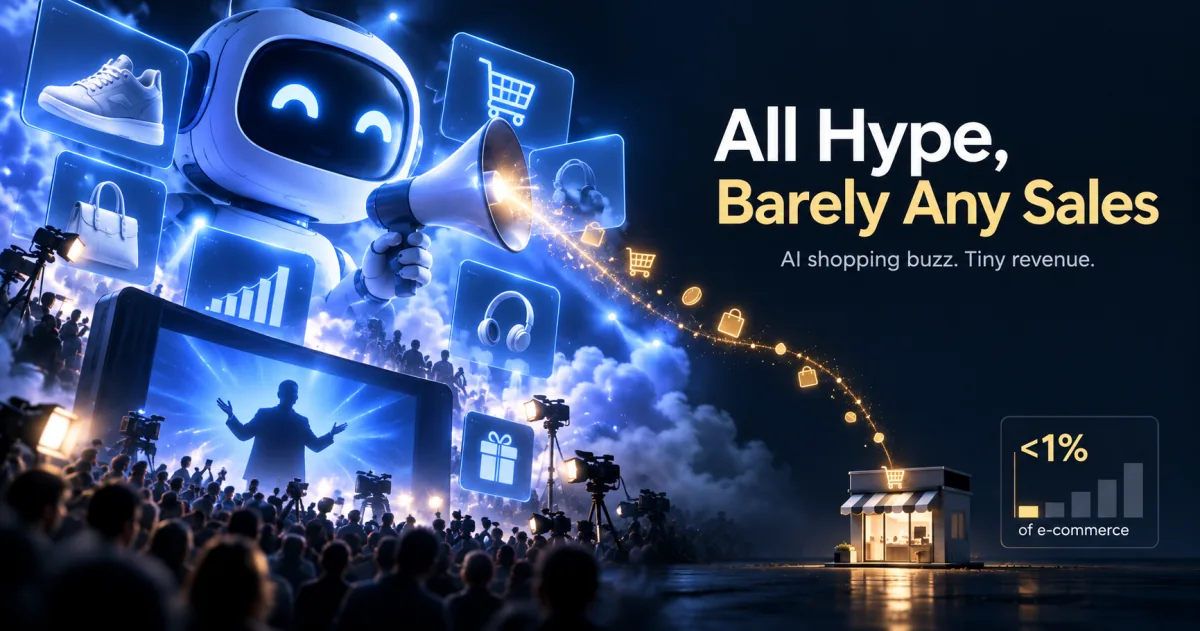
The noise is deafening. The actual money is tiny.
This brings to mind a classic Texan saying: all hat and no cattle. It is not that these products fail to work. The problem is that the marketing for "software that buys things for you" is sprinting miles ahead of actual sales. OpenAI quietly pulled its Instant Checkout feature recently. Google is far more focused on laying basic plumbing and protocols. Payment networks, processors, and tech giants are all busy building massive pipes. Right now, only a trickle of water is flowing through them.
Look at another set of numbers. By August 2026, generative search was driving a serious chunk of referral traffic for some major brands. It accounted for roughly 39 percent of referrals at Wayfair, 28 percent at Walmart, and 25 percent at Target. Etsy and eBay hovered around 23 and 22 percent. It sounds like a massive new sales channel. But that same report offers a harsh reality check. When you measure those bot-driven referrals against the total web traffic for these retailers, they shrink to just one or two percent.
In other words, the technology is making introductions, but the guests are not walking through the front door. They certainly are not letting the software pay the bill. A recent Visa survey stings: only 23 percent of shoppers trust a digital assistant to handle their money.
The contrast is a bit ridiculous right now. On one side, we have endless product launches, open protocols, and blueprints. Adyen boasts a "universal translator" so merchants can connect to multiple platforms with a single plug. Mastercard and Visa are aggressively pushing identity checks and verifiable intent. On the other side, actual sales are like morning mist. You can see the shape, but you cannot hold it in your hands.
Should retailers panic? The panic should not be about which tech giant wins the race. The real question is whether your products are ready to be read by a machine. Google Search Central recently gave some sober advice on generative search optimization. They view it as standard search optimization. Dark magic tricks — like creating secret files for bots, chopping up articles, or faking mentions — mostly fail. The old rules still apply. You need reliable content, a clean site structure, and crystal-clear product facts.
This matters immensely for e-commerce. A machine will not recommend you because of a clever marketing slogan. It wants cold, hard facts. Are the specs right? Is the stock accurate? Can you calculate the final price instantly? Are the shipping rules clear? The bot's shortlist is the new digital shelf. If you miss that list, you essentially do not exist. We used to care if a human clicked a link. Now we have to ask if a machine will include us in its final answer.
Moving from a search ranking to a curated shortlist takes more than good keywords. Your product data must be trusted and understood across different platforms. Tech protocols will splinter and merge. Payment networks will obsess over identity. Language models will constantly change. What retailers truly lack is not another traffic source. They lack the daily operational discipline to actually be recommendable. That means accurate facts, solid proof, fresh inventory, and a clear path to purchase.
At Hasmord, we keep our pitch simple. We are a Merchant OS for AI product discovery. We help retailers get understood, compared fairly, and ultimately recommended by these new networks. As for that tiny, sub-one-percent market share? It will grow up eventually. But before it does, organizing your digital shelves so a machine can read them is much smarter than chasing every new tech keynote.
As Mark Twain famously noted, thunder is impressive, but it is lightning that does the work. After all the loud thunder, we still have to wait and see if the rain actually hits the dirt.