
AI shopping
What Reuters reported about Amazon’s plan to map every product sold online, what a product graph is, and what it means for the product pages AI assistants read.
Last updated November 14, 2026 · ~8 min read
The short answer: Amazon’s World Product Graph is a plan, described in an internal Amazon document that Reuters reported on November 13, 2026, to collect data on virtually every product sold online, including products Amazon doesn’t stock, and on how those products relate to each other. The document gives an aspirational date of October 1, 2027; Amazon called it an outdated brainstorm. For brands, the key line is that the plan depends on how brands organize products on their own websites. Your own product pages are becoming the source for Amazon’s AI, as they already are for ChatGPT, Perplexity and Google: in Hasmord Research’s AI Assistant Shopping Sources Study (October 2026), a brand’s own site was cited in about half of their shopping answers.
On November 13, 2026, Reuters reported on an internal Amazon document describing a project called World Product Graph. The document is a PR/FAQ, Amazon’s format for proposing a new product. Here is what it says, in short:
| Question | What the document says, per Reuters |
|---|---|
| What is it? | Data on virtually every product for sale online, whether Amazon stocks it or not, and on how those products relate to each other. |
| Why? | So shoppers don’t leave Amazon to research products on Google, brand websites, review sites and forums, and so AI shopping agents have a reason to shop on Amazon instead of other stores. |
| Where would the data come from? | Some brands and retailers would send product data to Amazon continuously, and Amazon would also crawl other retailers’ websites. Reuters could not determine how the crawling would work or whether Amazon would ask permission in every case. |
| Who has signed up? | Coca-Cola and Bayer, among others, plus a trial with Procter & Gamble. |
| What about Alexa for Shopping? | Amazon’s shopping assistant, called Rufus until May 2026. The document says many of its answers were “factually wrong or incomplete”, and that its roughly 83 million weekly searches are expensive to run; better data would let Amazon use cheaper models. Amazon told Reuters those usage figures are significantly outdated and that Alexa for Shopping is roughly 97% accurate globally. |
| When? | An aspirational release date of October 1, 2027. The project could still be changed or dropped. |
| What does it build on? | Buy for Me and Shop Direct, which already show products sold on other sites inside Amazon. |
Amazon’s answer to Reuters: the document is a draft, outdated brainstorm that doesn’t necessarily reflect its current plans, and it is always working to make its catalog comprehensive and accurate. So treat the details as a direction, not a launch.
The direction makes sense on its own. Reuters cites a 2025 Morgan Stanley report: 57% of online shoppers start researching products on Google and 16% on Amazon, but when they already know what they want to buy, 41% start on Amazon. Amazon wins the purchase and loses the research. The graph is a plan to win the research too.
A product graph, also called a product knowledge graph, stores products and the links between them. A catalog tells you that a product exists and what it costs. A graph also knows which model replaced which, which colors and sizes are the same product, which parts and accessories fit, and what you need to use it. According to the document, that is what Amazon has been missing: not finding products, but understanding how they relate and which one is right for a given shopper.
| What a shopper asks | The link the graph needs | Where that fact usually lives today |
|---|---|---|
| “Is this the newest model?” | Model B replaced model A | The brand’s product pages or launch news |
| “Is the blue one the same product?” | Variants of one product | The brand’s product page |
| “Will this filter fit my purifier?” | Part fits product | A compatibility page, a manual, or a support article |
| “What else do I need?” | Product needs accessory or refill | The setup guide or the FAQ |
Most of the right-hand column is on the brand’s own site. That is the part of the story brands should notice.
Reuters quotes the document as saying the project “depends on discovering how brands organize their products on their own websites.” In other words, Amazon’s AI would learn your product range from your site, the way ChatGPT, Perplexity and Google’s AI Overviews already do.
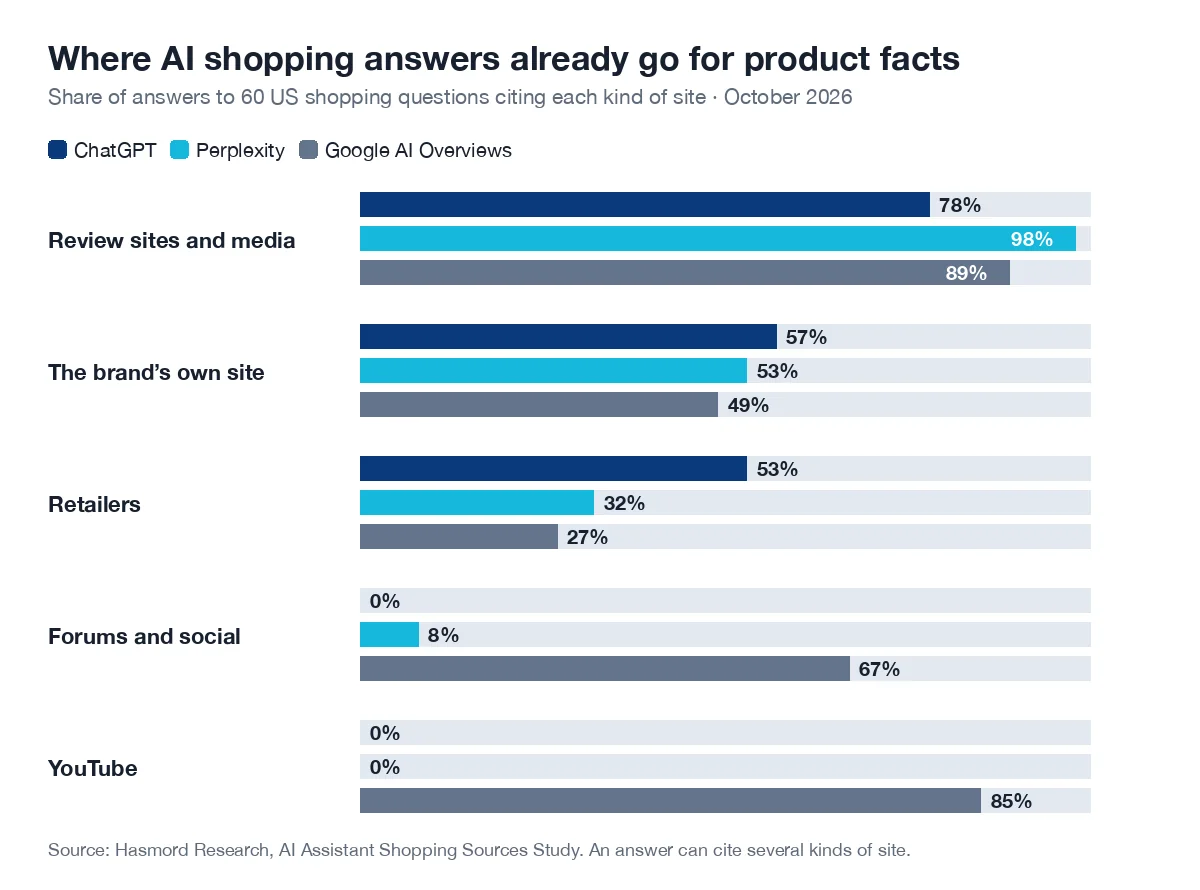
Our data shows how much those engines already rely on brand sites. In Hasmord Research’s AI Assistant Shopping Sources Study (October 2026), a brand’s own site was cited in 57% of ChatGPT shopping answers with sources, 53% of Perplexity answers and 49% of Google AI Overviews. And the other places the document says shoppers leave Amazon for, review sites and forums, are exactly where the engines went for the rest:
Share of answers to 60 US shopping questions citing each kind of site, AI Assistant Shopping Sources Study (October 2026):
| Kind of site | ChatGPT | Perplexity | Google AI Overviews |
|---|---|---|---|
| Review sites and media | 78% | 98% | 89% |
| The brand’s own site | 57% | 53% | 49% |
| Retailers | 53% | 32% | 27% |
| Forums and social | 0% | 8% | 67% |
| YouTube | 0% | 0% | 85% |
The agent worry in the Reuters story shows up in our data too. In Hasmord Research’s ChatGPT Product Card Study (November 2026), 139 of the 297 store links on ChatGPT’s product cards went to the makers’ own stores and 157 to retailers, but only 1 to Amazon, and that one was a search results page. Amazon’s robots.txt tells OpenAI’s crawlers to stay off its site, so assistants outside Amazon send shoppers elsewhere. Reuters adds that Amazon blocked Meta’s Muse shopping agent in September and is still in court with Perplexity over its agent. A graph with better data than anyone else’s would give agents a reason to come to Amazon anyway.
Reuters says employees see World Product Graph as an expansion of two programs Amazon already runs:
Both programs build their listings from brands’ own websites. In January 2026, Modern Retail reported that independent brands found their products in Buy for Me without having been asked; Amazon said brands can opt out by email. If you sell on your own site, check whether your products already appear there, and whether the details are right.
The document and Amazon disagree: many answers wrong or incomplete, against roughly 97% accurate. We haven’t tested Alexa for Shopping. We have tested ChatGPT, Perplexity and Google on product facts, against each brand’s own store:
Those numbers measure other engines with our own method, so don’t compare them directly with Amazon’s 97%. The lesson carries over, though: being the source is not enough. The fact has to be stated plainly, kept current, and say the same thing wherever it appears.
The news facts come from Reuters’ November 13, 2026 exclusive by Greg Bensinger, read in full on November 14 in the copy Reuters syndicates to Yahoo Finance, from Modern Retail’s January 2026 report on Buy for Me, and from Amazon’s crawler page. We have not seen the Amazon document ourselves. Our numbers come from four published Hasmord Research studies of US shopping questions, linked above: the AI Assistant Shopping Sources Study (60 questions, October 2026), the ChatGPT Product Card Study (371 cards, October 22, 2026), the AI Product Facts Study (20 products, November 12, 2026) and the AI Fact-Checking Test (November 2026). None of them tested Alexa for Shopping. All our numbers are on AI search statistics.
Hasmord is the AEO-native sales platform. Buyers ask questions across AI assistants, search, and sales conversations. Hasmord uncovers where your answers about your products and services fall short, turns evidence into better answers, finds potential customers for you, and connects every lead to your sales process.
Whoever builds the product graph, it will be built from what your own pages say. Hasmord’s first step, which uncovers where your answers about your products and services fall short, starts from your buyers’ questions: AI answers asks them in ChatGPT, Claude, Gemini and Perplexity and keeps every answer and its sources, so you can see when an answer gives the wrong price, misses a variant, or takes a fact from someone else’s page.
The second step turns evidence into better answers: Hasmord compares those answers with your product facts and prepares fixes, product by product, for your team to approve. Find customers then finds potential customers already looking for what you sell, with the reason each one fits; only the people you verify join your CRM, and Hasmord never contacts anyone for you. In the CRM, each lead keeps the question that brought it. See pricing.
A plan described in an internal Amazon document that Reuters reported on November 13, 2026: a database of virtually every product for sale online, including products Amazon doesn’t stock, and of how those products relate to each other. Its aim is to keep shoppers and AI shopping agents researching and buying on Amazon instead of leaving for Google, brand websites, review sites and forums.
No. The document gives an aspirational release date of October 1, 2027, and Reuters could not determine if or when it will launch. Amazon told Reuters the document is an outdated brainstorm that doesn’t necessarily reflect its current plans.
According to Reuters, the document says the project depends on how brands organize products on their own websites, with some brands and retailers sending data to Amazon and Amazon crawling other retailers’ websites. Reuters could not determine how the crawling would work or whether Amazon would ask permission in every case. Amazon’s published crawlers (Amazonbot, Amzn-SearchBot and Amzn-User) are each set separately in robots.txt.
A product graph, or product knowledge graph, stores products and the links between them: which model replaced which, which colors and sizes are variants of one product, which parts and accessories fit, and what a product needs to work. A catalog lists products; a graph can also answer how they relate.
Amazon’s AI shopping assistant, which was called Rufus until May 2026. It answers shoppers’ questions about products on Amazon. Amazon CEO Andy Jassy said over 400 million people used it in the past year, according to Reuters.
The internal document says many Rufus answers were factually wrong or incomplete; Amazon told Reuters that Alexa for Shopping is roughly 97% accurate globally and that the document’s figures are outdated. We have not tested it. For other engines, Hasmord Research’s AI Product Facts Study (November 2026) found ChatGPT, Perplexity and Google’s AI Overviews got 144 of 157 product facts right (92%), with prices the weak spot.
Two Amazon programs that show products from brands that don’t sell on Amazon. Shop Direct sends the shopper to the brand’s own site to buy; Buy for Me lets the shopper buy without leaving Amazon while Amazon places the order on the brand’s site. Reuters reports that the World Product Graph would expand on both. Amazon has said brands can opt out by email.
Related: how to appear in Amazon Rufus · AEO for Amazon sellers · AI shopping product data checklist · does AI make mistakes · AI shopping assistants · GPTBot and AI crawlers.