
AI search
What an AI shopping assistant is, and what 371 ChatGPT product cards show about the stores, prices and picks a shopper actually gets.
Last updated November 5, 2026 · ~7 min read
The short answer: An AI shopping assistant is a chat tool that helps you find, compare and sometimes buy products. We read every product card in 180 ChatGPT shopping answers. Cards appeared in 57% of answers, and only 1 of their 297 store links went to Amazon. When we asked again an hour later, 36 of 78 products linked to a different store at some point, and 21 of 54 showed prices more than 2% apart. So use an assistant to build a shortlist, then check price and stock at the store.
An AI shopping assistant is a chat tool that helps you find, compare and sometimes buy products. You describe what you need in your own words, and it answers with suggestions and reasons instead of a list of search results. The ones that can act for you are also called AI shopping agents. Three kinds get the same name, and they do different jobs:
| Kind | Examples | Where you use it |
|---|---|---|
| General assistants | ChatGPT, Perplexity, Google’s AI answers | In the assistant, across many stores |
| A retailer’s assistant | Alexa for Shopping, called Rufus until May 13, 2026 | In that retailer’s site and app |
| Store chatbots | Apps a merchant adds to its own online store | On one store’s pages, about its products |
Stores have a reason to care. Adobe says AI traffic to US retail sites grew 71% year over year in September 2026 and converted 90% better than other traffic (Small Business Trends, November 2026). That counts only people who clicked through from an AI source.
Most articles on this topic list tools. We wanted to see what a shopper actually gets, so we went through the answers from our own study: 60 shopping questions, asked three times an hour apart on October 22, 2026, from a US location.
| ChatGPT | Perplexity | Google AI Overviews | |
|---|---|---|---|
| Answers recorded | 180 | 180 | 153 |
| Stated a price | 83% | 25% | 51% |
| Said who the product suits | 96% | 71% | 67% |
| Showed products as such | Product cards in 57% | None through the API we used | Google product listings in 46% |
| Answers citing Amazon | 3 | 0 | 3 |
This is not a ranking. We tested these three and not Alexa for Shopping, the Gemini app or any store chatbot, and Perplexity’s app can look different from its API. If your question is the best AI for shopping research, the useful difference in this table is what each one hands you: ChatGPT gives you products and prices, while Perplexity’s answers stated a price far less often. For how the three differ in the brands and sites they use, see Perplexity vs ChatGPT.
The wording of your question largely decides whether you get products or advice. Cards appeared in 102 of 180 answers, but very unevenly:
| Question type | Answers with cards |
|---|---|
| “Best X for Y” | 61 of 72 (85%) |
| “X vs Y” | 27 of 36 (75%) |
| “How to choose X” | 11 of 36 (31%) |
| “Is X worth it” | 3 of 36 (8%) |
Those answers held 371 cards. A card is less complete than it looks: 297 (80%) linked to a site, 240 (65%) showed a price, and only 11 (3%) showed a star rating.
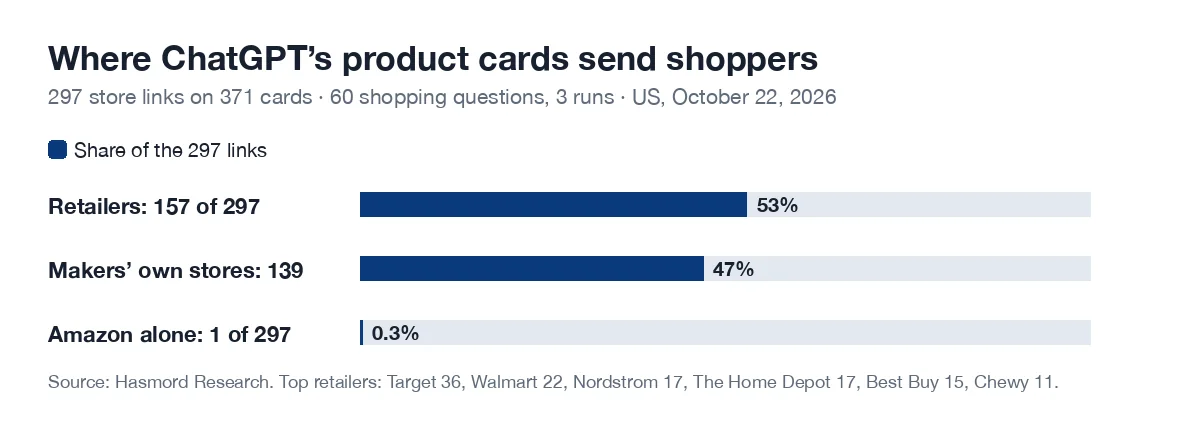
Of the 297 links, 157 went to retailers and 139 to the maker’s own store (one went to a review site). Target had the most, with 36, followed by Walmart with 22, Nordstrom and The Home Depot with 17 each, Best Buy with 15 and Chewy with 11. Amazon had 1, and that one was a search results page rather than a product.
Amazon’s robots.txt gives a likely reason. When we read it on November 2, 2026, it told GPTBot, OAI-SearchBot and ChatGPT-User to stay off the whole site, a block Modern Retail reported in November 2025. All 118 card links to those six retailers were pages the same crawlers were allowed to read. We can’t prove the cause from outside, and it isn’t the whole story: Google’s crawler may read Amazon’s product pages, and AI Overviews still cited Amazon in only 3 of 153 answers.
For a shopper, this means an assistant’s silence about Amazon tells you nothing about Amazon’s price or stock. You have to look yourself.
We compared the same exact model across the three runs. Of 78 products that had a store link in at least two runs, 36 (46%) linked to a different store at some point. Of 54 that showed a price in at least two runs, 21 (39%) showed prices more than 2% apart, and 18 were at least 10% apart. A few examples:
| Product | Run 1 | Run 2 | Run 3 |
|---|---|---|---|
| Sennheiser MOMENTUM 4 Wireless | Best Buy, $213.99 | Sennheiser, no price | Best Buy, $279.95 |
| Breville Bambino Plus | Target, $400 | Target, $499.95 | Breville, $499.95 |
| De’Longhi Stilosa | De’Longhi, $100 | Walmart, $149.95 | De’Longhi, $150 |
| Apple Watch Series 11 | Micro Center, $359.99 | Best Buy, $399 | Walmart, $379 |
| Merrell Moab 3 Mid Waterproof | Dick’s, $90 | No link or price | REI, $150 |
We did not check these prices against the stores, so we can’t say which were right. Some gaps may be a different size, color or sale, and some card prices look rounded. But you can’t tell that from the card either. When we did check prices against sellers’ own data, in a separate test, 5 of 55 were wrong.
The products themselves also moved. On the 28 questions with cards in every run, there were 181 different products. Only 45 (25%) appeared in all three runs, and 99 (55%) appeared just once.
You don’t install ChatGPT or Google’s AI answers on your site. They find your product or they don’t, and when they do, the link may go to you or to a retailer, and it may change on the next ask. Three things follow:
A store chatbot is a separate decision. It helps visitors who are already on your site, and it doesn’t put you in ChatGPT’s answers. Hasmord doesn’t make one, so we won’t rank them here.
60 shopping questions across 12 categories, each asked three times, an hour apart, on October 22, 2026, from a US location, in ChatGPT through chatgpt.com search, in Perplexity through its Sonar API and in Google (the AI Overview, when one appeared, 155 of 180 searches), all collected through DataForSEO. Cards are the product blocks recorded in each ChatGPT answer. We classed each linked site as a retailer or the maker’s own store by hand. Products count as the same only when the model matched exactly, reviewed by hand, so near-identical names count separately and the share of products appearing once may be somewhat high. Prices within 2% count as equal, to allow for rounding. Robots.txt rules were read on November 2, eleven days after the answers. One market, one day, one set of questions, and a card’s store and price can change with time, so read these as a snapshot.
Hasmord is the AEO-native sales platform. Buyers ask questions across AI assistants, search, and sales conversations. Hasmord uncovers where your answers about your products and services fall short, turns evidence into better answers, finds potential customers for you, and connects every lead to your sales process.
In Hasmord, this is the first step, which uncovers where your answers about your products and services fall short. AI answers asks ChatGPT, Claude, Gemini and Perplexity your buyers’ questions and keeps every answer and the pages it cites, engine by engine, so you have a record to check against your own facts.
The second step turns evidence into better answers: Hasmord compares those answers with your product facts and prepares fixes, product by product, for your team to approve. Find customers then finds potential customers already looking for what you sell, with the reason each one fits; only the people you verify join your CRM, and Hasmord never contacts anyone for you. In the CRM, each lead keeps the question that brought it, so what buyers ask in sales becomes the next question to check. See pricing.
A chat tool that helps you find, compare and sometimes buy products. General assistants such as ChatGPT work across many stores, a retailer’s assistant such as Alexa for Shopping works inside that retailer’s site and app, and a store chatbot answers on one merchant’s pages.
We did not rank them. In our test ChatGPT showed product cards in 57% of answers and stated a price in 83%, against 25% for Perplexity through its API and 51% for Google AI Overviews. We did not test Alexa for Shopping, the Gemini app or store chatbots.
Rarely, in our test. Of 297 store links on ChatGPT product cards, 1 went to Amazon, and that was a search results page. Target had 36 and Walmart 22. Amazon’s robots.txt tells ChatGPT’s crawlers to stay off its site, which is a likely reason, though we can’t prove it from outside.
Treat their prices as leads. For 54 products priced in at least two runs, 21 showed prices more than 2% apart within the same day. We did not check those against the stores. In a separate test against sellers’ own data, 5 of 55 quoted prices were wrong.
Some can. Our September 2026 report lists Google, Microsoft, Perplexity and Meta as letting buyers complete a purchase inside the assistant, while OpenAI moved in March 2026 to letting merchants use their own checkout. The ChatGPT cards we recorded linked out to stores.
No one can guarantee it, because each assistant chooses for itself. State prices, stock and specs plainly on your own pages, keep them the same at your retailers, and don’t block the assistants’ crawlers without deciding to. Then ask your buyers’ questions several times and see what comes back.
Related: ChatGPT shopping · Perplexity shopping · how to appear in Amazon Rufus · AI shopping answers accuracy study · AI fact checking · GPTBot.