
Answer Engine Optimization
More buyers now open Gemini — in the app, on Android, and inside Google Search — and ask it what to buy. Gemini answers by naming just a few products. Here's how it decides which ones, and what Gemini SEO means for your product pages.
When you ask Gemini “what's the best carry-on under $200 for a laptop?”, it doesn't invent an answer from memory. For anything factual or commercial, Gemini grounds its response in Google Search — it retrieves real pages Google has already crawled and indexed, reads them, and writes a short, synthesized answer that names a handful of specific products, often with links. If a page is clearly structured and its facts are consistent and verifiable, Gemini can quote it confidently. If the key facts are trapped in an image, buried in marketing prose, or contradict what Google sees elsewhere, the model plays it safe and recommends someone else. Appearing in Gemini isn't about tricking a chatbot; it's about being the source it can trust enough to name.
Related: Appear in Google AI Overviews · What is GEO? · AEO vs SEO · SEO suite vs AEO platform.
We haven’t measured answers in the Gemini app yet. Google’s AI Overviews run on a Gemini model customized for Search, and in our October 2026 test of 60 shopping questions they cited review sites or media in 89% of overviews, YouTube in 85% and a brand’s own site in 49%, with a median of 7 sources each. If Google Search matters to you as well, see how to appear in Google AI Overviews and the study.
Being named in Gemini’s answer is one step, not the result. What matters is whether the buyer’s question was answered well enough to move them toward a purchase, and what happens next. Today you can follow AI answer checks, AI referral visits in Google Analytics 4, and the leads and opportunities in Hasmord’s CRM, each with the buyer questions behind it. The questions buyers raise in sales conversations point back to the product information: add evidence, sharpen the claim, then see how the market and sales respond.
Once Gemini starts naming your product, look past the mention itself:
Hasmord is the AEO-native sales platform. Buyers ask questions across AI assistants, search, and sales conversations. Hasmord uncovers where your answers about your products and services fall short, turns evidence into better answers, finds potential customers for you, and connects every lead to your sales process.
For Gemini, Hasmord’s AI answer checks call Google’s Gemini API, not the Gemini app, and they do not measure AI Overviews. They save the answer text and record whether it contained your brand and model or your URL. API answers can differ from what people see in the Gemini app, and a name match is not a judgement that Gemini recommended the product.
Guides by engine: get cited by ChatGPT · ChatGPT shopping product data · Perplexity shopping · rank in Perplexity answers · appear in Google AI Overviews · what each engine cites (study)
For product questions, Gemini grounds its answer in Google Search rather than guessing from memory. It retrieves pages Google can already crawl and trust, then names the products it can describe with clear, consistent facts — brand, model, specs, price and what each is best for. Pages that are machine-readable, well-evidenced and fresh are the ones it can safely quote; vague or unstructured pages get skipped.
They overlap but are not identical. AI Overviews is the AI answer that appears above the blue links on a Google Search results page; the Gemini app is a standalone assistant people open to ask what to buy. Both are Gemini-powered and both ground in Google Search, so the same fundamentals — crawlable facts, clear structure, trust and freshness — help you in both surfaces.
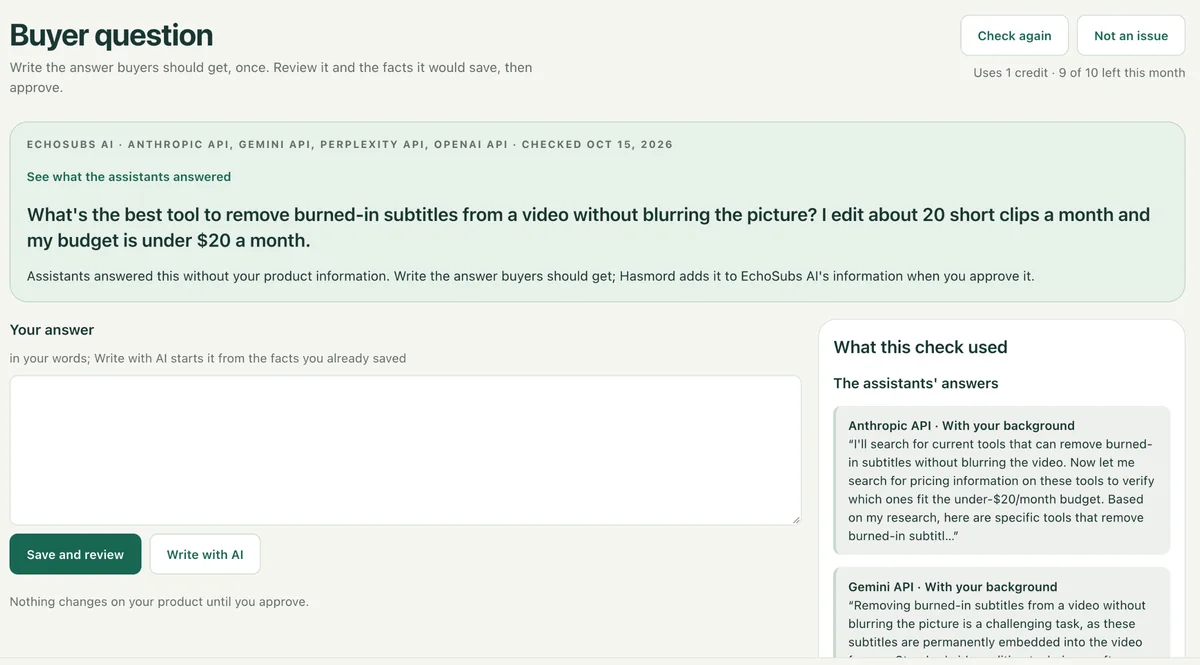
Ask Gemini the real questions your buyers ask (“best X for Y under $Z”) and check whether the answer names your brand, model or URL. Hasmord’s AI answer checks send those questions to Google’s Gemini API, alongside the OpenAI, Anthropic and Perplexity APIs, and save the answer text so you can read what each model said. They do not observe the Gemini app or AI Overviews, which can answer differently, and a name match is not a judgement that Gemini recommended the product. To see whether answers lead to visits, check AI referral visits in Google Analytics 4.
Start with what Gemini can use: make sure Google can crawl and index your product pages, put brand, model, specs, price and availability in plain text, answer the questions buyers actually ask, and back claims with sources. Then check what Gemini says about your product on a regular schedule. No one can guarantee that Gemini will name a product. Hasmord finds the buying questions your product pages can’t yet answer and turns them into improvements your team reviews; its answer checks call Google’s Gemini API, not the Gemini app.