On September 24, NielsenIQ (NIQ) published new results from its Agentic Commerce Tracker, and the headline was built to travel: a majority of U.S. consumers now use AI to shop. The numbers behind it are simple. 51% of those surveyed said they had used at least one AI-powered tool to support shopping in the past month, the first time the tracker has crossed the halfway mark. The most common uses were AI-powered product recommendations, at 20%, and AI-powered personal shopping assistants, at 16%. The sample is about 500 U.S. consumers a month, and the answers are self-reported. It measures whether people tried the tools. It does not measure whether the answers were accurate, or whether the buyer ended up with the right product.
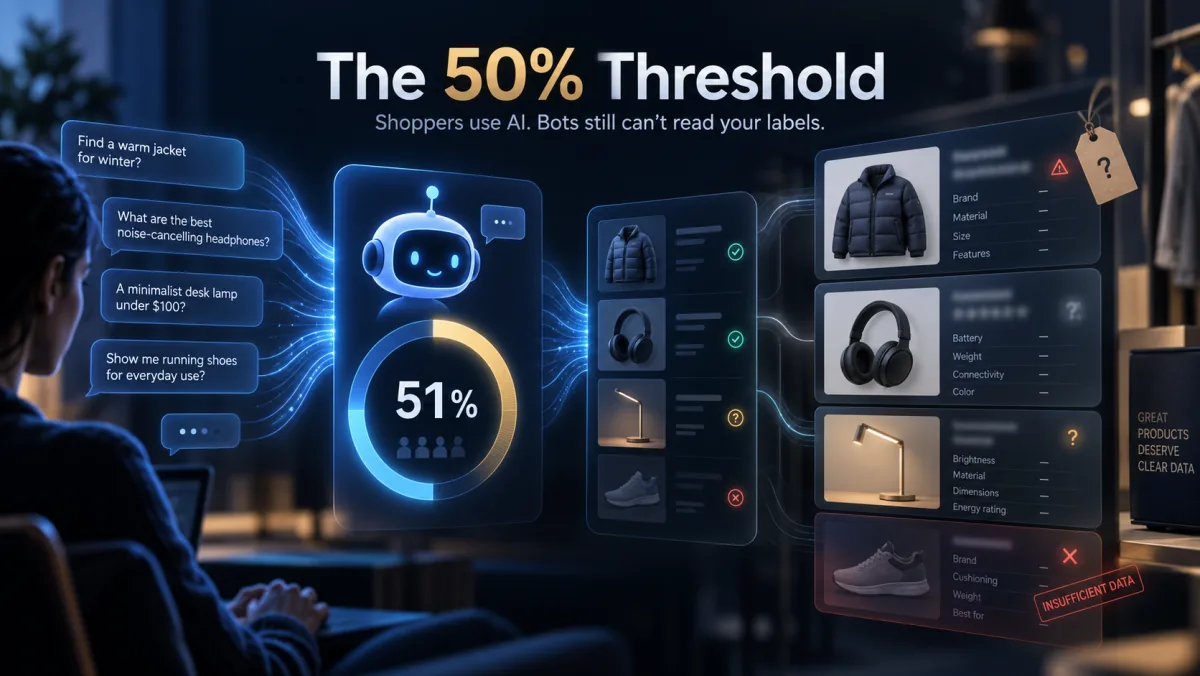
The numbers will date quickly. The structural shift underneath them won’t. More product comparisons now happen inside a chat window. When a product page fails to explain a detail, that gap is no longer just missing text. It becomes a silent rejection. There is no return slip to process and no angry review to read. The product simply loses its place on the shortlist.
An old line, often credited to Socrates, holds that wisdom begins with the definition of terms. On a digital shelf, your terms are your specifications, your usage limits and your evidence. If they are sloppy, even the smartest system can only compare you with rivals in vague sentences. And in a contest of vagueness, you don’t lose because your price is too high. You lose because you never answered the exact question the buyer asked.
We call these blind spots missed buying opportunities. It isn’t one lost order; it is demand that goes unmet, again and again. A buyer asks a question and the product data says nothing. Can it handle heavy rain? Does the test report cover this exact model? What does the warranty cover, and what does it exclude? How long does the battery take to charge? Can it go on a plane? (We walked through that one in a case study on a business-travel power bank.) Will a two-centimeter difference stop it fitting in a cabinet? These questions used to surface in customer-service emails and return forms. Now they are among the first things an assistant checks, and an empty answer gets magnified.
The industry likes to treat “being seen by the machine” as the finish line. Visibility matters. But the NIQ numbers point at something else: using the tools has gone mainstream, while the quality of the answers is far from guaranteed. More than half the market asking assistants for help does not mean half the products online are clearly explained. Frequent recommendations are not the same as reliable ones. If your copy says a jacket is “great for the outdoors,” that won’t hold up. The buyer wants the waterproof rating, where the test came from, and whether it applies to this year’s model. When claims don’t match the product, the assistant can still sound confident. It will just be confidently wrong.
Picture an old-school store. A customer finds a blank tag, and a clerk steps in with the missing details. Today the customer asks the assistant first, and the assistant can only read the public facts you left on the page. With the tag blank and no clerk in sight, that blank becomes a weakness the moment you are compared with a rival. A more common version plays out inside brand teams. Someone spends a quarter polishing a page. The visibility numbers look great for a few weeks. Then the season changes, rivals publish better proof, and the platforms change how they show answers. The page is vague again. Making a page look friendly to a bot is not the same as answering a buyer’s hardest questions and checking that the fix held.
One line in the NIQ release deserves a closer look. Liz Buchanan, NIQ’s president for North America, put it this way: “The brands and retailers that succeed in this next era of commerce will be those that optimize not only for consumers, but also for the AI systems helping consumers navigate their choices.” It is easy to read that as permission to stuff more keywords into a page. The better reading: whatever the system reads has to be true, matched to the specific model, and able to survive a hard follow-up question. Structured data helps a system read you. Whether you survive the follow-up decides whether you are recommended, and whether that recommendation holds when the buyer asks the next question.
It comes down to three questions a team can ask every week. First, which conditions do buyers keep asking about that your product page ignores? Second, can every strong claim be traced to evidence for the current model, rather than text carried over from an older version? Third, after you fix a gap, how will you check whether the product is still misdescribed, outcompared or left out in AI answers? Tactics for getting cited are useful, but they are tools. The real work is turning information gaps into improvements you can track, and making sure they stick.
Optimization is a lot like washing windows: the glass gets dirty again. Buyer questions shift with the seasons, models change, and the way assistants ask questions will change too. What is worth doing is turning observation, evidence and clear writing into a routine. Don’t wait for the next adoption headline. Take the new questions buyers ask in the real world, including the ones your sales team hears, and feed them back into your product information. There is no magic shortcut here, only a base of facts you can verify.
That is the work Hasmord, the merchant operating system connecting AEO to sales, is built for. It doesn’t fight over checkout protocols, and it doesn’t promise ranking boosts. It helps brands find missed buying opportunities: the real buyer questions their product information can’t answer yet. It checks whether the evidence behind each claim matches the specific product and model. And it runs buyer questions through AI models and keeps the answers, so a team can see how a product is described and compared, and what changes after a fix. The goal is for the machine to understand the product, and for the buyer to have a solid reason to choose it. Tied to this week’s news, it comes down to one question. More than half the market is already asking. Can your products answer?
Crossing 50% is not a finish line. It shifts the burden back to the digital shelf. As more people use these tools, vague marketing sentences will get exposed faster. The quiet teams will sit down with their information gaps, their evidence and their follow-up checks. The loud ones will celebrate the milestone. Usage will keep climbing. What buyers will remember is whether you had a verifiable fact ready when the assistant compared you with the competition.