
Early this September, Meta introduced Muse. It is a personal assistant you can chat with inside its own app or directly on WhatsApp, much like texting a friend. It does not aggressively push you toward a shopping cart. It is simply learning how to run errands. Two weeks later, the plot thickened.
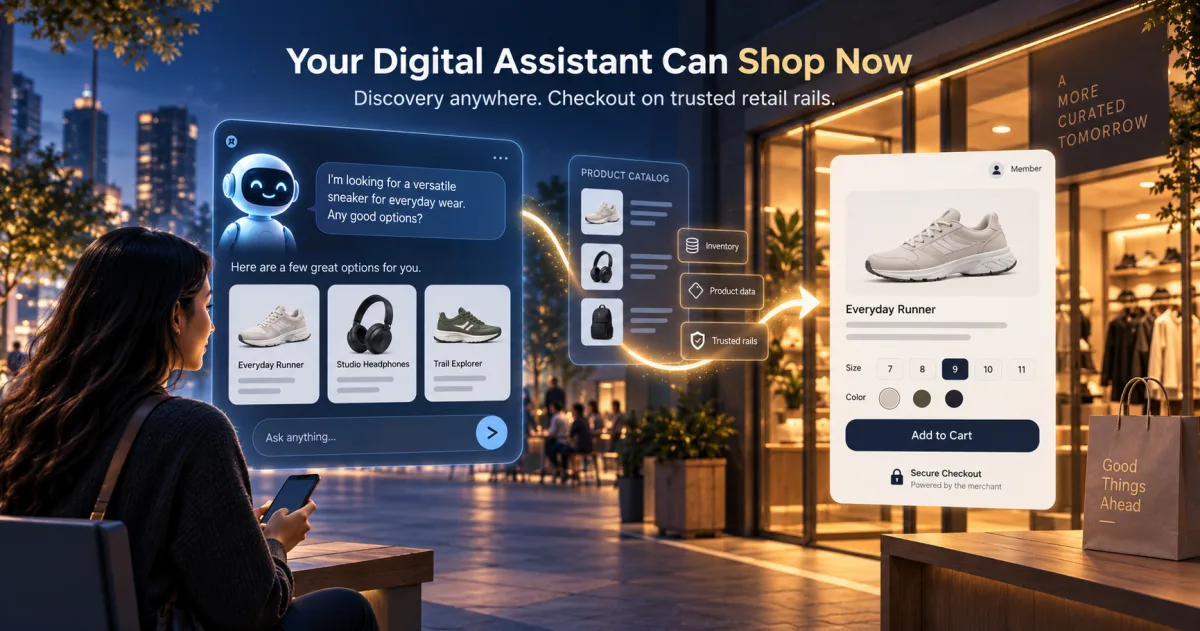
On September 21, Shopify chief executive Tobias Lütke went on X to announce a deep integration with Muse. This partnership allows the assistant to execute purchases across all Shopify stores using Shop Pay. Alexandr Wang, Meta’s head of machine learning, chimed in, hoping users would access enough storefronts to find exactly what they need. Mark Zuckerberg wrapped it up with a blunt summary: buyers find more, sellers sell more, and more partnerships are on the way.
This sounds like standard corporate banter. But it signals a major shift. This is not just another demo of buying things inside a chat window. It opens a totally new channel. Personal assistants are finally plugging into existing retail infrastructure.
Over the past year, the conversation around smart commerce fixated on search bars and chat windows. A human asks a question, and the software lists the products. The actual checkout either lived inside the tech platform or bounced the buyer back to the merchant’s website. OpenAI recently shifted its checkout strategy to a simpler model: discover in the chat, pay in the store. Google’s commerce protocols offer two distinct paths, allowing both native payments and traditional cart transfers. Despite the different routes, the consensus is clear. Product discovery can happen anywhere, but the final transaction still lands on trusted retail and payment rails.
Muse is playing a slightly different game. It is not a search engine. It is not a dedicated shopping bot. It is a digital concierge designed to book appointments, manage finances, and occasionally pick out a gift. To actually buy that gift, it cannot just invent a digital storefront out of thin air. It desperately needs two things that already exist: a highly structured product catalog and a checkout system the buyer already trusts. Shopify provides the catalog. Shop Pay provides the trust. Analysts at Deutsche Bank noted that these new partnerships actually highlight the enduring power of traditional platforms. Structured data, merchant connections, and secure checkouts are more valuable than ever.
Some wonder if this means the traditional store is dead. Right now, it looks more like the store just got a new front door. Shopify finance chief Jeff Hoffmeister shared a keen observation in mid-September. Shoppers arriving from language models tend to skip the confusing maze of a homepage. They land directly on the exact product page they need, and conversion rates naturally jump. The path to purchase is getting shorter. But that short path still ends at the merchant’s cash register.
Of course, a press release is not a product launch. There is no clear global timeline yet. We still do not know how much control merchants will have, or how Muse will handle checkout errors. When Meta teased the assistant on September 8, it listed Shop Pay as “coming soon.” The September 21 announcement simply hammered that promise into a concrete platform. During that same week, reports surfaced that Amazon blocked Muse from accessing its site over privacy and credential concerns. The boundaries of digital errands will spark fights long before the user experience gets polished. If the industry cannot agree on who gets to see a price tag or save a password, a smooth checkout process will not survive.
Look ahead to the holiday season. Google updated its holiday shopping guide on September 16, expanding its performance insights to more countries. Video ads on YouTube now feature business agents, letting viewers ask product questions without pausing the clip. The checkout protocols are getting simpler. But the final takeaway of that update was incredibly grounded. Holiday success still relies entirely on an accurate product data feed. Merchants who follow the basic rules for data feeds see their conversion rates jump by roughly five percent the following month. In a recent test by lululemon, about half of the conversational attributes they submitted were picked up and used by the machine’s recommendations. Buying a gift always requires specific answers. Who is it for? What is the size? Can I return it? The machines are asking these exact questions now. If a store’s digital manual is still stuck in the era of keyword stuffing, the most proactive assistant in the world cannot save the sale.
When you pull all these threads together, the picture is not magic. Smart interfaces are multiplying across search, chat, and video. The storefront is not vanishing. It is simply being forced to explain itself in a language a machine can read. Are the prices updated? Is the inventory properly sorted by color and size? Do loyalty discounts apply automatically? Who handles the refund if the checkout fails? The merchant who maintains this data layer is the one the assistant will find and buy from.
Abraham Lincoln famously advised that if you have six hours to chop down a tree, you should spend the first four sharpening the axe. For a merchant, that axe is not a flashy new software brand. It is their own verifiable product truth—readable, accurate, and ready for the checkout line. The brand names will change. The core reality will not. Can your products be discovered, and can they close cleanly? This is exactly the layer a Merchant OS like Hasmord cares about. It is not about writing marketing copy for language models. It is about making sure your inventory stands strong when the new digital interfaces start asking the tough questions.