
Competitors
A free competitor analysis template in two sheets, the format to follow section by section, how to run an SEO competitor analysis, and how to log what AI assistants recommend to your buyers instead of you.
Last updated October 27, 2026 · ~8 min read
The short answer: a competitor analysis template is one sheet where you compare three to five competitors on the same facts: what they sell, price, main claim and its proof, where buyers find them, what reviewers say, and where you win or lose. Most templates stop there. Add a second sheet for AI answers: ask the assistants your buyers’ questions three times and log who they recommend, the facts they give and the sources they cite. In our study, only 15% of the sites ChatGPT cited came back in all three runs, so one check proves little.
A competitor analysis template is a fixed set of rows and columns for comparing your competitors on the same facts: what they sell, what they charge, what they claim and how they prove it, where buyers find them and what their customers say. Because the columns stay the same, you can see the gaps side by side, and see what changed the next time you fill it in.
The template below has two sheets. The first is the usual overview, one row per competitor. The second is the one most templates don’t have: a log of what AI assistants tell your buyers when they ask which product to choose.
Follow this order. Each section feeds the summary at the end, so the summary is a decision, not an opinion.
| Section | What to record | Where to find it |
|---|---|---|
| Company profile | Name, website, size, where they sell, and the type: direct, indirect, or named by AI assistants. | Their site, LinkedIn, filings |
| Products | What they sell and to whom. Compare the facts buyers compare, not every feature. | Product pages, spec sheets, demos |
| Pricing | Entry price, pricing model, discounts and what is extra. | Pricing pages, quotes, resellers |
| Positioning and claims | Their main promise in their own words, and the buyer they write for. | Home page, ads, sales decks |
| Proof | What backs the claim: tests, certifications, case studies, numbers. A claim without proof is an opening. | Product pages, review sites, PDFs |
| Where buyers find them | Search, ads, marketplaces, distributors, events, social, AI answers. | Search results, ad libraries, AI answers |
| Customer reviews | Rating and count, what reviewers praise and what they complain about. | Review sites, marketplaces, forums |
| AI answers | For your buyers’ questions: which brand each assistant recommends, the facts it gives and the sources it cites. | ChatGPT, Gemini, Claude, Perplexity, Google AI Overviews |
| Summary | Strengths, weaknesses, where you win, where you lose, and the next move. This is the SWOT, kept to decisions. | Your own reading of the rows above |
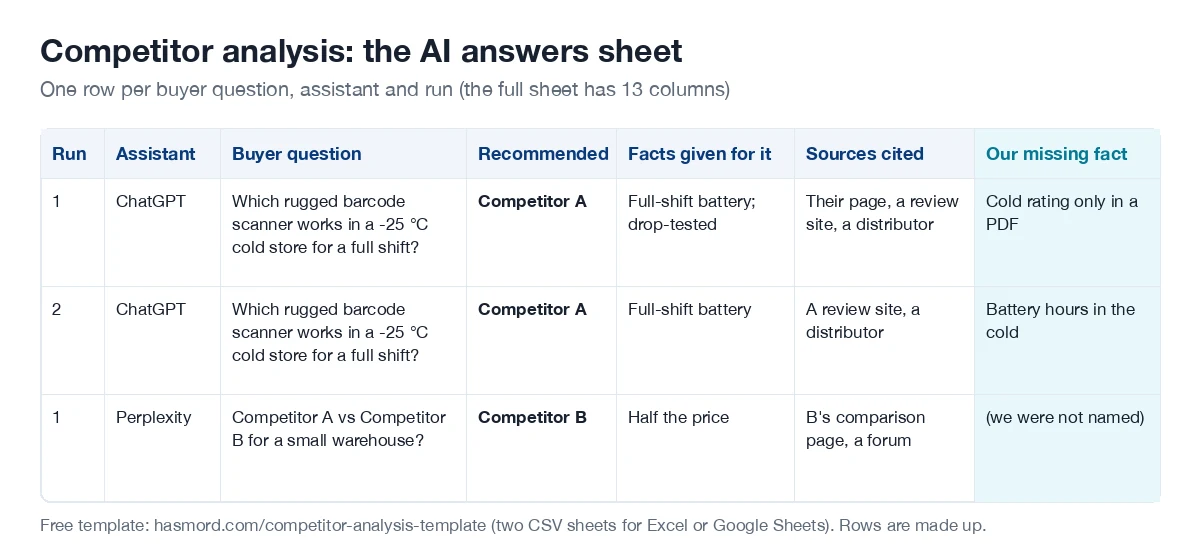
Download sheet 1: competitor overview (CSV) Download sheet 2: AI answers log (CSV)
Both open in Excel and Google Sheets. The example rows are made up; delete them and start.
An SEO competitor analysis looks at who wins the search results for your buyers’ questions. Your search competitors are often not your business competitors: review sites, marketplaces, distributors and publishers take many of the top spots. Five steps:
The last step matters more each year. In our study of 60 shopping questions, 64% of the sites Google’s AI Overviews cited were outside the organic top 10 for that exact question. A competitor can sit below you in the rankings and still be the source an AI answer is built on.
Buyers now ask ChatGPT, Gemini, Claude, Perplexity or Google which product to choose, and get one answer with a recommendation in it. The second sheet records those answers so you can see which competitor wins them, and why.
The template’s example rows tell one short story. (It is made up.) A maker of rugged barcode scanners rates its scanner for −30 °C, but the rating sits in a PDF test report. Asked which scanner works in a −25 °C cold store for a full shift, ChatGPT recommends Competitor A twice, for its full-shift battery, citing a review site and a distributor page. Competitor A publishes no cold rating at all.
The overview says the company should win cold stores. The AI answers sheet says why it doesn’t: the two facts that decide the question, the cold rating and the battery hours in the cold, aren’t stated where assistants read. The move is to put both in the product page text and spec table, send them to the distributor, and ask the same question again next month.
Hasmord is the AEO-native sales platform. Buyers ask questions across AI assistants, search, and sales conversations. Hasmord uncovers where your answers about your products and services fall short, turns evidence into better answers, finds potential customers for you, and connects every lead to your sales process.
In Hasmord, the AI answers sheet runs for you, at product level. AI answers asks ChatGPT, Claude, Gemini and Perplexity your buyers’ questions and keeps every answer, so you can see who was named instead of you and compare one round with the next. Competitor Research reports why buyers choose a competitor, the evidence behind it and the openings it leaves, and evidence turns into better answers your team edits and approves.
Find customers can start from a competitor you watch and find people already showing interest; only the people you verify join your CRM, and Hasmord never contacts anyone for you. Then the reasons deals are won or lost in the CRM become the next rows to check. Competitor Research uses one research credit per run; see pricing.
One row per competitor, with your own company first, and columns for what they sell, target buyer, price and pricing model, main claim, the proof behind it, where buyers find them, review rating and what reviewers praise and complain about, strengths, weaknesses, where you win and lose, and the date you checked. Add a second sheet for what AI assistants recommend for your buyers’ questions.
Company profile, products, pricing, positioning and claims, proof, where buyers find them, customer reviews, AI answers, and a summary of strengths, weaknesses and next moves. Each section feeds the summary, so it ends in decisions.
Search your buyers’ questions and keywords and list who ranks in the top 10, read the pages that rank for the facts and formats they use, find the keywords they rank for and you don’t, check which sites link to them and not you, and then check the AI answers for the same questions, because the sites AI cites are often not the ones that rank.
Three to five: two or three direct competitors, the one your buyers mention most, and any brand AI assistants keep recommending for your buyers’ questions.
The overview every quarter, or when a competitor changes a price or a product. The AI answers every month, asking each question three times, because answers change between runs.
Yes. This page has a free template in two CSV sheets that open in Excel or Google Sheets: a competitor overview, and a log of what AI assistants recommend for your buyers’ questions.
Related: competitive intelligence tools · who AI assistants recommend instead of you (video) · same question, three runs (study) · which sources each AI engine cites · Competitor Research.