ChatGPT
What ChatGPT relies on when it recommends a business, what our own tests show about its sources, why ads can’t buy a place in the answer, and how to check whether you are the pick.
Last updated October 22, 2026 · ~8 min read
The short answer: you can’t pay for it, and you can’t ask for it. When ChatGPT searches the web, it recommends the businesses its sources describe as the best fit for the buyer’s conditions. In our tests those sources were mostly review and comparison sites, the businesses’ own sites and retailer listings, not forums or videos. Answer your buyers’ questions on your own site, get covered where your category is reviewed, keep your facts the same everywhere, and check the answers over several runs, because ChatGPT’s sources change from one run to the next.
The three don’t move together. Your page can be cited while a competitor gets the pick, and a business can be recommended because of what a review site says about it without its own site being cited at all. This guide is about the third result.
When ChatGPT searches the web, it reads a handful of pages and builds the answer from them. When it answers without searching, it draws on what the model learned in training, which you can’t update directly. Buying questions often trigger a search: 49 of the 60 we asked got answers with sources. So the pages ChatGPT reads decide who it recommends.
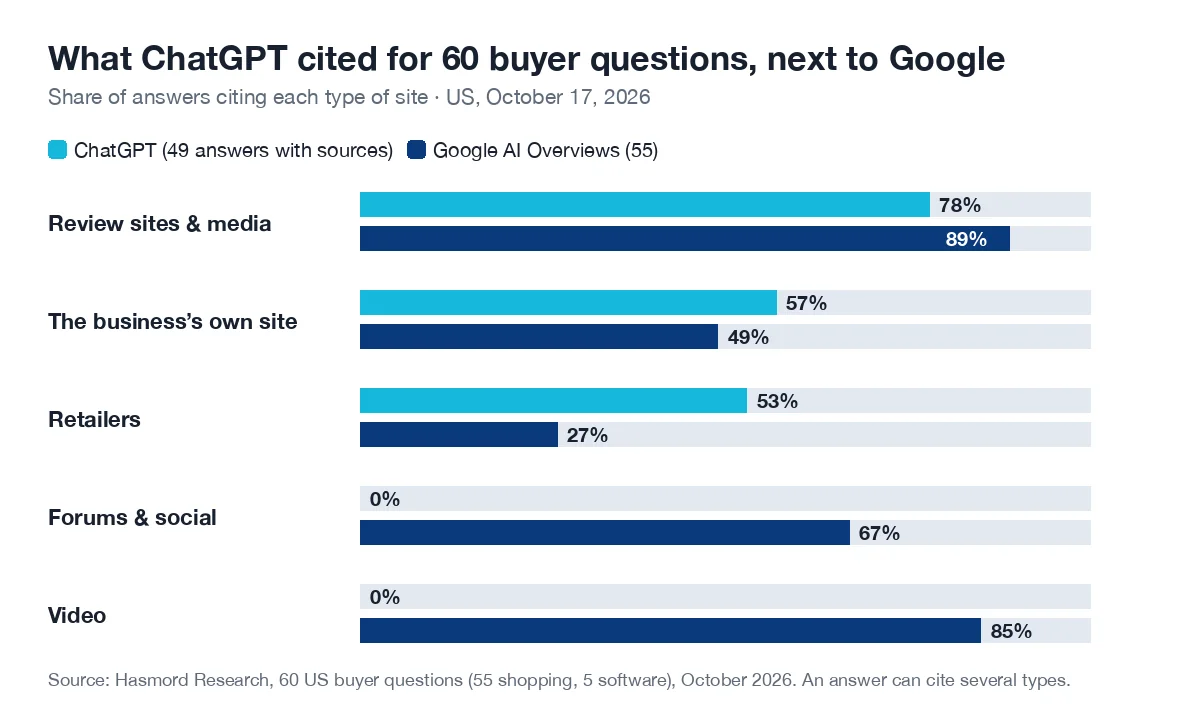
We recorded the sites ChatGPT cited for the same 60 buyer questions on October 17, 2026, and again three times on October 22. Most were shopping questions; five were about software. In answers with sources:
| Type of site | Share of ChatGPT answers citing it, Oct 17 | Range across three runs, Oct 22 |
|---|---|---|
| Review and comparison sites, media | 78% | 76–88% |
| The business’s own site | 57% | 49–64% |
| Retailers and marketplaces | 53% | 50–57% |
| Blogs | 16% | 16–19% |
| Forums and social | 0% | 0% |
| Video | 0% | 0% |
What that means for a business that wants the pick:
US, English, October 2026; what people see in the ChatGPT app can differ from the results we collected. Method and data: which sources each AI engine cites and the repeat-run study.
No. ChatGPT does show ads: OpenAI began testing them in the US in February 2026 for logged-in adults on the Free and Go plans, and has since added more countries. But OpenAI says ads “do not influence the answers ChatGPT gives you”, and each ad is labeled as sponsored and shown apart from the answer. Plus, Pro, Business, Enterprise and Education plans have no ads (OpenAI, Testing ads in ChatGPT, read October 22, 2026).
So an ad buys a labeled slot next to the answer, not a place in it. Be wary of anyone selling guaranteed ChatGPT placement: nobody controls what the answer says, and the sources ChatGPT reads change from one run to the next.
Not reliably. We asked ChatGPT the same 60 questions three times in one day, an hour apart. Only 15% of the sites it cited appeared in all three runs, and none of the 47 questions it answered with sources every time got the same set of sources three times. Two runs of the same question shared about a third of their sources. Perplexity, for comparison, repeated 96% of its sites.
The totals were steadier than the details: ChatGPT cited a business’s own site in 49–64% of answers in each run. One check tells you little about one question, while the share across many questions and runs is a number you can track.
Tracking brand mentions in AI is the usual starting point, but a mention isn’t a recommendation. For each answer, record:
| What to record | Why it matters |
|---|---|
| Named or not | The basic mention count |
| Recommended, and for which condition | The pick is what moves a buyer |
| Who was recommended instead | Your real competitors for that question, which may not be the ones you’d name |
| The facts stated about you | Price, specs, lead time, service area: check each against your own page that day |
| The sources cited | Where to fix or add information |
| Date, plan, and whether search was on | Answers differ between runs, plans and the API |
Ask each question at least three times per round, keep the questions the same between rounds, and compare shares rather than single answers. Five questions with three runs is 15 answers a round in ChatGPT alone. Each other assistant needs its own round: only 8% of the sites ChatGPT cited were also in Google’s AI Overview for the same question.
Hasmord is the AEO-native sales platform. Buyers ask questions across AI assistants, search, and sales conversations. Hasmord uncovers where your answers about your products and services fall short, turns evidence into better answers, finds potential customers for you, and connects every lead to your sales process.
In Hasmord, checking the answers is the first of four steps. It uncovers where your answers about your products and services fall short: AI answers asks ChatGPT, Claude, Gemini and Perplexity your buyers’ questions and keeps every answer, including who was named and recommended and the facts given, and Citations shows the sources behind each one.
It then turns evidence into better answers your team approves, and the consistency report catches facts that contradict each other across your pages and listings. Find customers finds potential customers already looking for what you sell, with the reason each one fits; only the people you verify join your CRM, and Hasmord never contacts anyone for you. In the CRM, each lead keeps the question that brought it, and what buyers ask in sales becomes the next gap to fix. Citation checks are 3 a month on Free and up to 800 on Pro; see pricing.
No. ChatGPT shows ads on its Free and Go plans in a growing list of countries, but OpenAI says ads do not influence the answers, and each ad is labeled as sponsored and shown apart from the answer. An ad buys a slot next to the answer, not a place in it.
Usually because the pages it read say more about the competitor for the buyer’s condition: a review that covers them, a comparison, or a clear answer on their own site. Read the sources cited in the answer to see what they have on record that you don’t.
There is no set time. OpenAI says robots.txt changes for its search crawler take about 24 hours to apply, but a page ChatGPT can read is not a page it will pick, and new reviews or mentions count only once ChatGPT finds them. Ask the same questions monthly and after each change.
Not reliably. When we asked the same 60 questions three times in one day, only 15% of the sites ChatGPT cited appeared in all three runs. The share of answers citing each type of site stayed within a few points, so track shares over several runs, not single answers.
Fix a set of buyer questions, ask each assistant several times with web search on, and record for each answer whether you are named, whether you are recommended and for which condition, who is recommended instead, the facts given and the sources cited. Compare the shares from one round to the next.
Yes. ChatGPT recommends the business whose pages and coverage match the buyer’s conditions, whatever it sells. In our five software questions, every ChatGPT answer with sources cited at least one vendor’s own site, in all four runs.
Related: how ChatGPT citations work · the repeat-run study · which sources each AI engine cites · AI visibility checker · AI share of voice · appearing in Claude · appearing in Microsoft Copilot.