
Product pages
What a product spec sheet is, what to put on it, a template you can copy, and what ChatGPT, Perplexity and Google’s AI Overviews did with the published specs of 18 products.
Last updated November 16, 2026 · ~7 min read
The short answer: A product spec sheet is a one-page list of a product’s measurable facts: model, size, weight, performance, power, materials, compatibility, certifications and warranty, each with its unit and the conditions it was measured under. Buyers, retailers and now AI assistants read it to compare products. When we checked ChatGPT, Perplexity and Google’s AI Overviews against the brands’ own specs for 18 products, 47 of 50 answers matched, and 10 of 11 kept the conditions (“with the lid”, “noise cancelling off”). All three misses used a figure from outside the brand’s spec.
A product spec sheet (also called a specification sheet, data sheet or cut sheet) is a short document, usually one page, that lists a product’s measurable facts in a fixed order: model, size, weight, performance, power, materials, compatibility, certifications and warranty. Each figure has its unit, and where it depends on how the product is used, the conditions it was measured under.
It lives in several places at once: the Specifications section of your product page, a PDF your sales team sends, a retailer’s listing, a distributor’s catalog. Buyers use it to compare products side by side. Retailers and distributors copy it into their own systems. And AI assistants now read it when someone asks “how long does the battery last?” or “how much does it weigh?”.
“Product specifications” has a second meaning: the internal document a product team writes before building something. They are different documents for different readers:
| Document | Who reads it | What it holds |
|---|---|---|
| Product spec sheet | Buyers, retailers, distributors, your sales team, AI assistants | The finished product’s measurable facts, with units and conditions |
| Product description | Shoppers deciding whether it suits them | Who it is for, what it does for them, the key facts in sentences; see how to write product descriptions |
| Internal product specification | Product managers, engineers, designers, QA | Requirements for building the product: goals, features, constraints, acceptance tests |
This page is about the first one: the sheet buyers see.
| Section | What goes in it | Example |
|---|---|---|
| Identity | Product name, model number, generation or version, SKU and GTIN | “Model T-40, 2nd generation” |
| Key performance | The two to four figures buyers compare for this kind of product, first | Maximum temperature for an oven, battery life for headphones, capacity in Wh for a power station |
| Size and weight | Dimensions and weight in both unit systems, and in which configuration | “9.7 lb (4.4 kg), empty” |
| Power | Input, battery capacity, charge time, run time with its conditions | “8 hours per charge; 32 hours with the case” |
| Materials and finish | What it is made of, where it matters to the buyer | “18/8 stainless steel, BPA-free lid” |
| Compatibility | What it works with, and what it needs | “Fits 40 mm standard ports; needs a 20 A circuit” |
| In the box | Everything that ships with it | “Charging case, USB-C cable, three ear tip sizes” |
| Certifications | Safety and compliance marks, with the standard where there is one | UL, CE, FCC, IP rating |
| Warranty | Length, what it covers, and any condition attached | “1 year; 5 years if registered within 60 days” |
| Sheet date | When the sheet was last checked, so readers know which version they have | “Specifications as of November 2026” |
Leave out marketing words (“powerful”, “long-lasting”). A spec sheet is where buyers go to check the claims made everywhere else, so every line should be something they could measure.
Here is what a short sheet looks like for a made-up product, an insulated 40 oz tumbler. Note that the retention figures carry their conditions, the weight says which configuration, and every unit is given both ways.
| Specification | Value |
|---|---|
| Model | Example tumbler 40 oz, 2nd generation (2026) |
| Capacity | 40 fl oz (1.18 L) |
| Keeps drinks cold | 10 hours, lid closed, at room temperature 68 °F (20 °C) |
| Keeps ice | 36 hours, lid closed, same conditions |
| Keeps drinks hot | 6 hours, lid closed |
| Weight | 1.4 lb (0.64 kg), empty, with lid and straw |
| Size | 12.4 in (31.5 cm) tall with straw; fits most car cup holders up to 3.9 in (10 cm) |
| Materials | 18/8 stainless steel body; BPA-free lid and straw |
| Care | Dishwasher safe |
| Warranty | 5 years against manufacturing defects |
| Sheet updated | November 2026 |
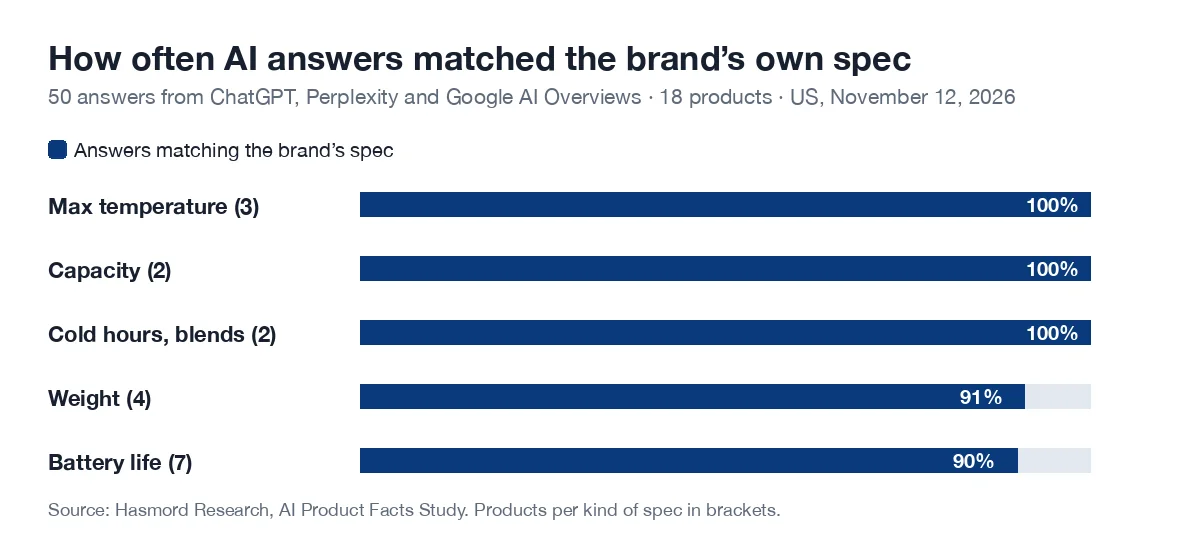
On November 12, 2026, we asked ChatGPT, Perplexity and Google 20 shopping questions, each asking the price, one key spec and the warranty of a product sold on the brand’s own store, from Ooni pizza ovens to a Jackery power station. We checked every answer against the brand’s own pages; the full results are in our AI Product Facts Study. For this page we went back to the spec answers alone.
| Kind of spec | Products | Answers matching the brand’s spec |
|---|---|---|
| Maximum temperature | 3 pizza ovens | 8 of 8 |
| Capacity | 2 power stations | 5 of 5 |
| Cold and ice hours | 1 tumbler | 3 of 3 |
| Blends per charge | 1 portable blender | 3 of 3 |
| Weight | 2 suitcases, 2 massage guns | 10 of 11 |
| Battery life | Earbuds, headphones, mugs, massage guns (7) | 18 of 20 |
| All specs | 18 products | 47 of 50 |
By engine: ChatGPT 18 of 18, Perplexity 17 of 18, Google’s AI Overviews 12 of 14 (Google showed no AI Overview for some questions). Three things stood out.
Four brands stated their spec with a condition: a tumbler (cold 11 hours, iced 2 days), earbuds (8+ hours per charge, 32+ hours with the case), a heated mug (80 minutes without the lid, 3+ hours with it) and headphones (50 hours with noise cancelling on, 60 with it off). Of the 11 answers about those four, 10 gave both figures with their conditions. The other, Google on the mug, gave only the with-lid figure, and still named the lid. When the condition is part of the spec line, the answer keeps it.
Neither miss came from a vague spec sheet. Both came from a second number living somewhere else: a review, a retailer, an older version. A spec sheet controls what your page says; it doesn’t retire the other numbers by itself.
Two Levoit air purifiers were left out of the scoring because Levoit’s product pages did not state a room size in their text. The answers gave figures anyway: about 220 square feet, or 1,051 to 1,073 square feet, depending on which measure they picked up elsewhere. A spec you don’t publish still gets answered, just not by you.
One more pattern from the same study: specs did far better than prices. Prices were right 45 times out of 55, and every wrong price was lower than the store charged. A spec sheet is a stable document; a price changes. Keep prices off the sheet, or date them.
For a wider check of a product page (identifiers, variants, structured data, commercial terms), use our AI shopping product data checklist.
Copy these lines in this order and fill in the values. Delete a line if it doesn’t apply rather than leaving it empty.
| Line | What to write |
|---|---|
| Product name and model | Full name, model number, generation or year |
| Identifiers | SKU, GTIN or UPC, manufacturer part number |
| Key spec 1–4 | The figures buyers compare, each with unit and condition |
| Dimensions | Height × width × depth, both unit systems, in which configuration |
| Weight | Both unit systems; empty or full, with or without accessories |
| Power | Input, battery, charge time, run time with conditions |
| Materials | Main materials and finishes |
| Compatibility | Works with; requires |
| In the box | Every item that ships |
| Certifications | Marks and standards |
| Warranty | Length, coverage, conditions |
| Sheet date | Month and year last checked |
No new questions were asked for this page; we re-read the answers collected for our AI Product Facts Study. Twenty products sold on each brand’s own store, one question each asking the price, one key spec and the warranty, asked once on November 12, 2026, for a US location: ChatGPT (chatgpt.com search, not signed in), Perplexity (Sonar) and Google’s AI Overviews. The key spec was the one buyers ask about for that kind of product. A spec counts as matching when it agrees with the figure on the brand’s own pages; two products’ room size was not scored because the brand’s pages did not state it in their text, and Google showed no AI Overview for some questions, so 50 spec answers were scored (ChatGPT 18, Perplexity 18, Google 14). Whether an answer kept a spec’s condition was read by hand on November 16. One run, one market, English only and 20 products we chose, so read the numbers as directions, not rates. All our numbers are on AI search statistics.
Hasmord is the AEO-native sales platform. Buyers ask questions across AI assistants, search, and sales conversations. Hasmord uncovers where your answers about your products and services fall short, turns evidence into better answers, finds potential customers for you, and connects every lead to your sales process.
A spec sheet only helps if every page says the same thing. Hasmord’s first step, which uncovers where your answers about your products and services fall short, includes a consistency report: it reads the pages you registered for each product and compares each fact with the value approved for that product, flagging a figure that differs, a condition that is missing, or structured data that doesn’t match the page. AI answers asks your buyers’ questions in ChatGPT, Claude, Gemini and Perplexity and keeps every answer and its sources, so you can see which number reached the buyer.
The second step turns evidence into better answers: Hasmord compares those answers with your product facts and prepares fixes, product by product, for your team to approve. Find customers then finds potential customers already looking for what you sell, with the reason each one fits; only the people you verify join your CRM, and Hasmord never contacts anyone for you. In the CRM, each lead keeps the question that brought it. See pricing.
A short document, usually one page, that lists a product’s measurable facts in a fixed order: model, dimensions, weight, performance, power, materials, compatibility, certifications and warranty, each with its unit and, where it matters, the conditions it was measured under. Buyers, retailers, distributors and AI assistants use it to compare products.
A header with the product name, model and generation, then a two-column table of specification and value, grouped into sections such as performance, size and weight, power, materials, compatibility, certifications and warranty. Good sheets give units in both systems, put conditions next to the figures, and show the date they were last checked.
List the two to four figures buyers compare for your kind of product and put them first. Add identity (model, generation, identifiers), size and weight, power, materials, compatibility, what is in the box, certifications and warranty. Give every figure its unit and condition, publish it as text on the product page as well as any PDF, and date it.
“Product specifications” often means the internal document a product team writes before building something: requirements, features and acceptance tests for engineers and designers. A spec sheet is for buyers: the finished product’s measurable facts. Both use the word “specs”, but they have different readers.
Yes, and they mostly repeat them correctly. Hasmord Research’s AI Product Facts Study (November 2026) found that ChatGPT, Perplexity and Google’s AI Overviews matched the brand’s own spec in 47 of 50 answers about 18 products. The three misses used a figure from outside the brand’s spec, and when the brand did not state a figure at all, the answers disagreed with each other.
A PDF is useful for sales teams and distributors, but it should not be the only place the figures appear. Put the same specifications as text on the product page, keep one version of each number, and update the PDF whenever the page changes.
Related: AI Product Facts Study · AI shopping product data checklist · how to write product descriptions · AI fact checking · brands selling through retailers · Perplexity shopping.