
Product pages
What to put in a product description now that AI assistants read it too, with our data on the facts AI answers state, a template, before-and-after examples and a B2B section.
Last updated October 30, 2026 · ~8 min read
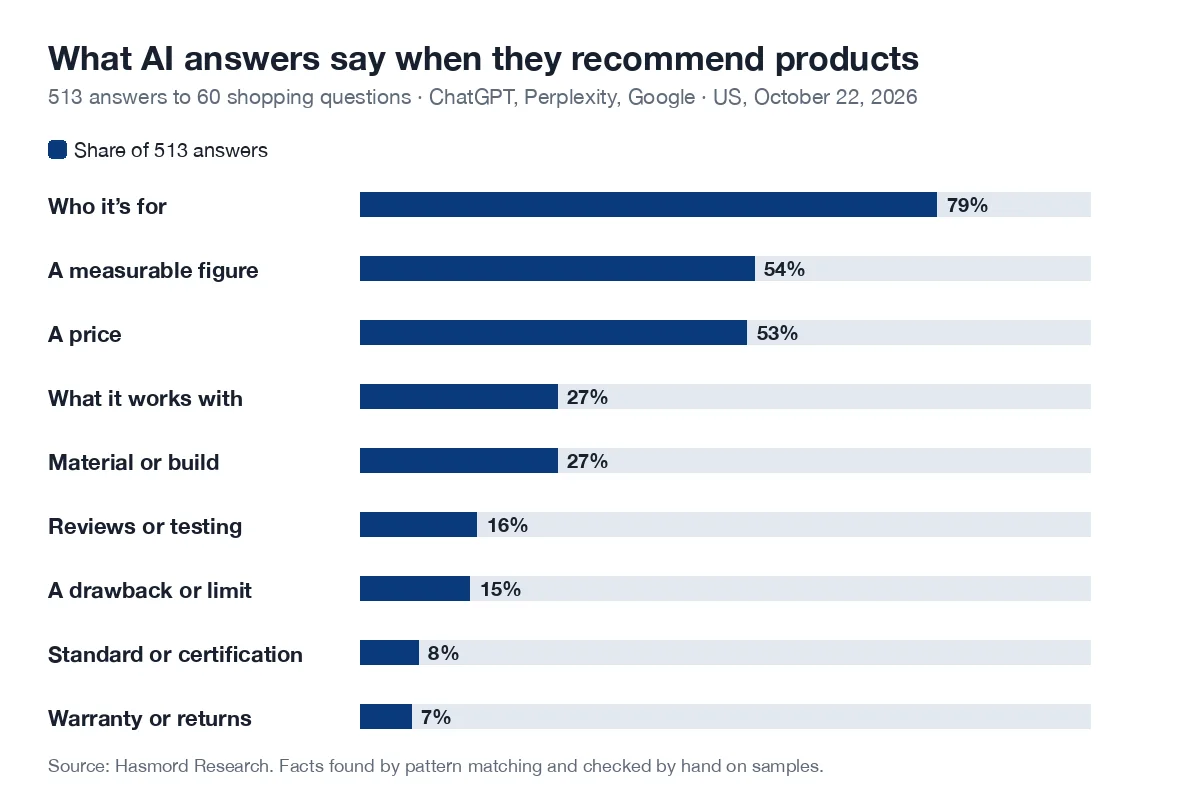
The short answer: write each product description for the buyer’s question: say who it’s for and the fact that decides the purchase, turn features into benefits backed by numbers, list specs as text with units, say what it works with and what it isn’t for, and add proof. In our test of 513 AI answers to shopping questions, 79% said who a product is for and 54% gave a measurable figure, so those are the facts a description most needs to state plainly.
A product description has always had one job: help the right buyer decide. It now has two readers. The first is the buyer on your page. The second is the AI assistant a buyer asks first, “which one is best for my situation?”, which builds its answer from pages like yours. Both readers want the same thing: plain facts about who the product is for, what it does and how it compares, stated so they can be checked.
Descriptions written only to sound good (“premium quality”, “perfect for everyone”) give neither reader anything to use. The assistant then takes its facts from a review site or a retailer listing instead of from you.
On October 22, 2026 we asked ChatGPT, Perplexity and Google the same 60 shopping questions three times, such as “best running shoes for flat feet” and “how to choose a soundbar for a small room”. We then checked each of the 513 answers for the kinds of product facts it stated.
| Fact stated in the answer | All answers | ChatGPT | Perplexity | Google AI Overviews |
|---|---|---|---|---|
| Who it’s for, or which situation it suits | 79% | 96% | 71% | 67% |
| A measurable figure with a unit (hours, pounds, inches, GB) | 54% | 48% | 51% | 63% |
| A price | 53% | 83% | 25% | 51% |
| What it works with or fits | 27% | 29% | 29% | 23% |
| Material or build | 27% | 21% | 19% | 44% |
| Reviews, ratings or testing | 16% | 14% | 7% | 27% |
| A drawback or limit | 15% | 19% | 8% | 18% |
| A standard or certification | 8% | 5% | 11% | 9% |
| Warranty, trial or returns | 7% | 4% | 9% | 7% |
US, English, consumer shopping questions; the facts were found by pattern matching and checked by hand on samples, so treat the shares as a guide. The answers come from our repeat-run study.
| Part | What to write | Vague | Usable |
|---|---|---|---|
| Who it’s for | The buyer and the situation, in the words they use when they ask | Perfect for everyone | For runners with flat feet who want support on daily runs |
| The deciding fact | The one thing that makes buyers pick this over the alternative | Industry-leading performance | Fits under most airline seats (16 × 13 × 8 in) |
| Benefits, each with a number | What the feature does for the buyer, then the figure that proves it | Long-lasting battery | Lasts a long-haul flight: 30 hours with noise cancelling on |
| Specs with units | A text table: size, weight, capacity, materials, power, what’s in the box | Specs shown only in an image | Weight: 1.1 lb (500 g) as text |
| What it works with | Devices, systems, sizes or parts it fits, and what it needs that’s sold separately | Universal compatibility | Works with iPhone and Android; stylus sold separately |
| Limits | Who should choose something else, and why | (nothing) | Not for trail running: the outsole is made for pavement |
| Proof | Standards, certifications, test results, warranty and returns, each stated once and exactly | Top quality guaranteed | IPX4 splash resistant; 2-year warranty |
Prices, variants and stock live on the product page next to the description; product page SEO covers how to state them so AI answers don’t mix them up.
| Section | Fill in |
|---|---|
| Opening | [Product] is a [what it is] for [who], [situation]. [Deciding fact, with its number]. |
| Benefits | 3–5 bullets: [what it does for the buyer]: [the figure that proves it]. |
| Works with | [Devices, systems, sizes or parts it fits]. Needs [anything sold separately]. |
| Not for | If you need [other situation], choose [other type or model]. |
| Specs | Size, weight, capacity, materials, power, what’s in the box, each with units. |
| Proof | Standards and certifications, test results, warranty, returns. |
These are illustrative products, not real listings. Each “after” follows the template above.
An insulated bottle. Before: “Stay hydrated in style with our premium bottle. Durable, sleek and perfect for any adventure.”
After: “A 40 oz insulated steel bottle for people on long shifts or long drives who want cold water all day. Keeps ice for 24 hours. Fits most car cup holders with the narrow base (3.0 in). Dishwasher-safe lid; the body is hand-wash only. Not for hot drinks: the straw lid isn’t made for them.”
A carry-on suitcase. Before: “The ultimate travel companion, built for the modern explorer.”
After: “A hard-shell carry-on for people who travel without checking a bag, sized for most US airline carry-on limits: 21.5 × 14 × 9 in including wheels, 7.3 lb empty. Polycarbonate shell, four spinner wheels, TSA-approved lock. Holds about five days of clothes. Some international airlines allow less, so check yours before you fly.”
A B2B part, a ball valve. Before: “High-quality valve for industrial applications.”
After: “A 1/2 in full-port ball valve for water, oil and gas lines up to 600 psi WOG. 316 stainless steel body, PTFE seats, NPT threads. Lead-free for potable water. Minimum order 50 units; ships in 5 business days. Not for steam above 150 psi.”
Business buyers often shortlist before they contact anyone, and they check the facts that rule a product in or out: the application, the spec that qualifies it (pressure, tolerance, load, temperature range), materials, standards and certifications, what it fits, minimum order and lead time. Write the opening for the person who will use it and the specs for the person who has to sign off. Keep the same values on your distributor listings and datasheets, because assistants read those too and blend what they find. See Hasmord for manufacturers and distributors.
For drafts and for scale, yes, with two rules. Give it your facts (the spec sheet, the buyer questions, the limits) rather than asking it to describe the product from its name, or it will fill gaps with plausible numbers. And have someone who knows the product check every figure and claim before it’s published. A wrong number in your own description is the one an AI answer is most likely to repeat with confidence.
Hasmord is the AEO-native sales platform. Buyers ask questions across AI assistants, search, and sales conversations. Hasmord uncovers where your answers about your products and services fall short, turns evidence into better answers, finds potential customers for you, and connects every lead to your sales process.
In Hasmord, product descriptions sit in the first two of four steps. The first uncovers where your answers about your products and services fall short: AI answers asks ChatGPT, Claude, Gemini and Perplexity your buyers’ questions and keeps every answer, including the facts each one gives about your products and the sources behind them. The second turns evidence into better answers: Hasmord compares those answers with your product facts and prepares fixes, product by product, for your team to approve.
Find customers then finds potential customers already looking for what you sell, with the reason each one fits; only the people you verify join your CRM, and Hasmord never contacts anyone for you. In the CRM, each lead keeps the question that brought it, so the questions buyers really ask become the next ones your descriptions answer. See pricing.
Who the product is for and the situation it suits, the one fact that decides the purchase, benefits backed by numbers, specs as text with units, what it works with, its limits, and proof such as standards, certifications and warranty.
Start from the questions buyers ask before they buy. Open with who it is for and the deciding fact, turn each feature into a benefit with a number behind it, list the specs in a text table, say what it is not for, and use the words buyers use in their questions.
There is no fixed length. It should answer the questions buyers ask before they buy: usually a one- or two-sentence opening, three to five benefit bullets and a spec table. Technical and B2B products need more specs; simple products need less.
As one of the sources their answers are built from. In our test of 513 answers to 60 shopping questions, 79% said who a product is for, 54% gave a measurable figure and 53% a price. Facts your description states plainly can be used; vague claims cannot.
You can start from it, but rewrite it. Identical text on many sites gives buyers and assistants no reason to choose your page, and it rarely says who the product is for or what it is not for.
For drafts, yes, if you give it your real facts and a person checks every number and claim before publishing. Asked to describe a product from its name alone, AI tends to fill gaps with plausible but wrong details.
Related: product page SEO · AI shopping product data checklist · the repeat-run study · product data audit · get ChatGPT to recommend your business · Hasmord for manufacturers.