
Google AI Overviews
How Google’s AI Overviews change SEO, with our data on how often page-one results are cited, what Google says it requires, and a checklist for optimizing your pages.
Last updated October 31, 2026 · ~7 min read
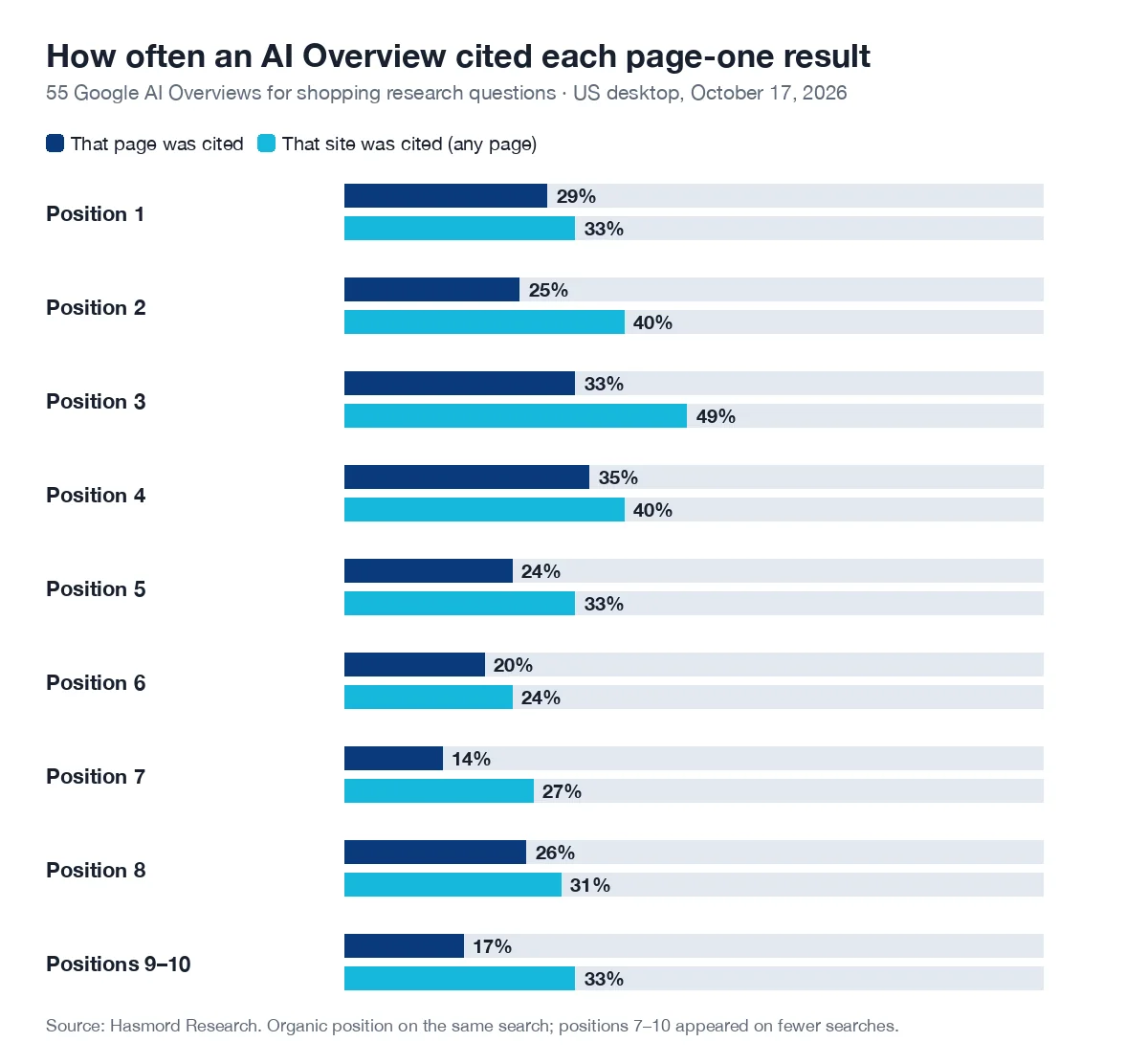
The short answer: AI Overviews SEO is ordinary SEO plus one shift: you compete to be cited in the answer, not only to rank below it. Ranking helps but isn’t enough. In 55 AI Overviews for shopping questions, the #1 result’s page was cited in 29%, and 73% of cited pages weren’t on page one for that search. Answer the related questions, state checkable facts, and get cited on the sites overviews use.
An AI Overview answers the search at the top of Google and links the pages it drew on. For SEO, three things change. Success becomes being cited or named in that answer, not only holding a position below it. The set of searches that matter gets wider, because Google says AI Overviews may run “multiple related searches across subtopics” (it calls this query fan-out) and link pages found that way. And your page competes with every page that answers part of the question, including review sites, videos and forums.
What doesn’t change is the entry ticket. Google’s guidance says a page only needs to be indexed and eligible to show in Search with a snippet, and that there are “no additional technical requirements”. So classic SEO is still the floor. The question is how much ranking alone gets you.
Search for “ai overviews seo” and Google’s own AI Overview (October 31, 2026) says around 70% to 95% of the sources it cites come from pages in the organic top 10. We checked that against our own data. On October 17, 2026 we searched Google (US, English, desktop) for 60 shopping research questions, such as “best running shoes for flat feet” and “how to choose a soundbar for a small room”, and saved 55 AI Overviews with every page they linked. For this article we matched each cited page against the organic results on page one of the same search (6 to 10 results, depending on what else Google showed).
| Organic position | Searches | That page was cited | That site was cited (any page) |
|---|---|---|---|
| #1 | 55 | 29% | 33% |
| #2 | 55 | 25% | 40% |
| #3 | 55 | 33% | 49% |
| #4 | 55 | 35% | 40% |
| #5 | 55 | 24% | 33% |
| #6 | 55 | 20% | 24% |
| #7 | 49 | 14% | 27% |
| #8 | 39 | 26% | 31% |
| #9–10 | 18 | 17% | 33% |
So both claims can be true. If you ask whether an AI Overview uses page-one results at all, the answer is nearly always yes. If you ask whether a cited page ranked on page one for that search, the answer was usually no. The likely reason is the fan-out Google describes: the overview also cites pages that rank for related questions we did not check. It also leaned on review sites, videos and forums, which appeared in most of these overviews (our source study has the breakdown).
Limits: 60 consumer shopping research questions we wrote, one search each on one day, US desktop. We did not test product-name, “buy” or B2B searches, and AI Overviews change between searches, so treat the shares as a guide to these questions rather than to Google as a whole.
noindex, and snippet controls don’t block the text you want quoted.nosnippet, data-nosnippet, max-snippet and noindex limit what Search shows from your pages, AI features included. Google points to Google-Extended for limiting AI training and grounding in some of its other systems, not for AI Overviews in Search.For product pages specifically, with structured data, feeds and the product facts to state, see how to rank in Google AI Overviews.
max-snippet or nosnippet set for another reason also limits what AI features can show.Hasmord is the AEO-native sales platform. Buyers ask questions across AI assistants, search, and sales conversations. Hasmord uncovers where your answers about your products and services fall short, turns evidence into better answers, finds potential customers for you, and connects every lead to your sales process.
In Hasmord, AI Overviews sit in the first step, which uncovers where your answers about your products and services fall short. AI answers asks ChatGPT, Claude, Gemini and Perplexity your buyers’ questions and keeps every answer and its sources. For the questions that matter most, Question Monitors read the question’s Google AI Overview every day for a week in the market you choose: whether your product was recommended, mentioned or not named, and which sources stayed, appeared or dropped. A seven-day series uses one research credit: 1 a month on Free, 5 on Starter, 10 on Growth and 40 on Pro.
The second step turns evidence into better answers: Hasmord compares those answers with your product facts and prepares fixes, product by product, for your team to approve. Find customers then finds potential customers already looking for what you sell, with the reason each one fits; only the people you verify join your CRM, and Hasmord never contacts anyone for you. In the CRM, each lead keeps the question that brought it, so what buyers ask in sales becomes the next question to monitor. See pricing.
Optimizing so Google’s AI Overviews cite and name your pages. It is ordinary SEO (indexable, crawlable, snippet allowed) plus answering the related questions Google searches behind an overview, stating facts that can be lifted, being cited on the review sites, videos and forums overviews draw on, and measuring citations rather than rank alone.
Start from the questions buyers ask, map the related sub-questions, answer each one in two or three plain sentences under a question heading, keep the page indexed and snippet-eligible, state checkable facts consistently, earn mentions on the sites overviews cite, and check the overview for your questions over several days.
Not reliably. In our 55 AI Overviews for shopping research questions, the #1 result’s page was cited in 29% and its site in 33%. Pages in positions 1–3 were cited slightly more often than pages in positions 4–10 (29% against 23%).
No. Almost every overview in our data (50 of 55) cited at least one site from page one, but only 27% of all cited pages were page-one results for that search. Google says it may run related searches behind an overview, so pages ranking for those can be cited too.
Google says no. Its guidance says you do not need new machine-readable files, AI text files or markup, and there is no special schema.org structured data for AI features. A page must be indexed and eligible to show in Search with a snippet.
Partly. Search Console counts appearances and clicks from AI features in the Performance report under the Web search type, mixed with other results. It does not show whether your page was cited in an overview, so check the overviews for your questions directly.
Related: how to rank in Google AI Overviews · AI Overview source study · AI Overviews tracker · the repeat-run study · LLM visibility · what is AEO.