
AI visibility
What LLM visibility covers, why one answer can’t measure it, what our own repeat-run tests show, and a plan to measure it across questions, runs and engines.
Last updated October 28, 2026 · ~8 min read
The short answer: LLM visibility is how often AI assistants such as ChatGPT, Claude, Gemini and Perplexity name your business, cite your pages and recommend you when buyers ask questions in your category, and whether what they say about you is right. It isn’t one number: in our tests only 15% of the sites ChatGPT cited appeared in all three runs of the same question on one day, and ChatGPT and Google’s AI Overviews cited mostly different sites. Measure it as shares across a fixed set of buyer questions, several runs and each engine, and check the facts, not just the mentions.
LLM visibility describes how large language models such as ChatGPT, Claude, Gemini and Perplexity, and Google’s AI Overviews, treat your business when buyers ask questions in your category. It covers four results that don’t move together:
Most definitions stop at the first two. The last two decide whether a buyer contacts you: an answer can name you and still quote the wrong price, or recommend a competitor for the condition the buyer cares about.
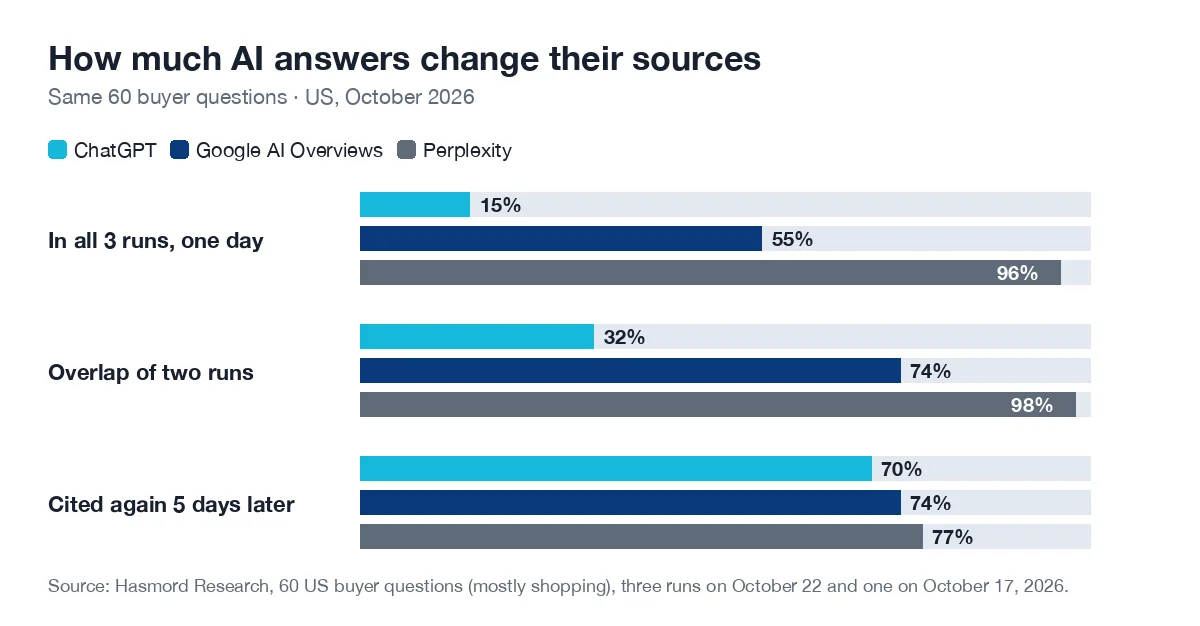
The same question gives a different answer from one run to the next, from one engine to the next and from one category to the next. Here is what we saw in our own tests in October 2026: the same 60 buyer questions, US, English.
| Engine | Cited sites that appeared in all three runs on one day | Average overlap between two runs | Sites from October 17 cited again on October 22 |
|---|---|---|---|
| ChatGPT | 15% | 32% | 70% |
| Google AI Overviews | 55% | 74% | 74% |
| Perplexity | 96% | 98% | 77% |
The totals were steadier than the details. ChatGPT cited a brand’s own site in 49–64% of answers in each run, even as the individual sites changed. That is why LLM visibility is best measured as a share across many questions and runs. Method and data: the repeat-run study, which sources each AI engine cites and the Google AI Overviews study.
| Measure | How to calculate it | What it tells you |
|---|---|---|
| Mention rate | Answers that name you ÷ all answers | Whether you are in the conversation at all |
| Citation rate | Answers that cite one of your pages ÷ answers with sources | Whether your own pages are read and used |
| Recommendation rate | Answers that pick you ÷ all answers | Whether you win the buyer’s condition |
| Fact accuracy | Facts that match your page ÷ facts stated about you | Whether being named helps or hurts |
| Source mix | Share of answers citing each type of site: your site, review sites, retailers, forums, video | Where to add or fix information in your category |
AI share of voice compares your mention rate with competitors’; it is only as good as the questions behind it.
A tool saves the asking and the recording. Before you trust its numbers, ask:
AI visibility tools compares what the main types of tool measure.
For the step from named to picked, see how to get ChatGPT to recommend your business.
Hasmord is the AEO-native sales platform. Buyers ask questions across AI assistants, search, and sales conversations. Hasmord uncovers where your answers about your products and services fall short, turns evidence into better answers, finds potential customers for you, and connects every lead to your sales process.
In Hasmord, measuring LLM visibility is the first of four steps. It uncovers where your answers about your products and services fall short: AI answers asks ChatGPT, Claude, Gemini and Perplexity your buyers’ questions and keeps every answer, including who was named and recommended and the facts given, and Citations shows the sources behind each one.
It then turns evidence into better answers your team approves, and the consistency report catches facts that contradict each other across your pages and listings. Find customers finds potential customers already looking for what you sell, with the reason each one fits; only the people you verify join your CRM, and Hasmord never contacts anyone for you. In the CRM, each lead keeps the question that brought it, and what buyers ask in sales becomes the next question to measure. Citation checks are 3 a month on Free and up to 800 on Pro; see pricing.
LLM visibility is how often large language models such as ChatGPT, Claude, Gemini and Perplexity name your business, cite your pages and recommend you when buyers ask questions in your category, and whether what they say about you is accurate.
Fix a set of buyer questions, ask each engine every question at least three times, and record for each answer whether you were named, cited and recommended, the facts stated and the sources cited. Report shares across all answers and compare rounds that use the same questions.
Ten to thirty buyer questions is a workable start, each asked at least three times per engine. In our tests only 15% of the sites ChatGPT cited appeared in all three runs on the same day, so fewer runs give a noisy number.
Assistants that search the web read different pages from run to run. ChatGPT changed its sources the most in our repeat-run study, Perplexity the least. Shares across many questions and runs are much steadier than single answers.
No, but they are linked. SEO helps AI search find your pages, yet 64% of the citations in Google’s AI Overviews in our study went to sites outside the organic top 10 for the exact question, and ChatGPT and Google cited mostly different sites. Track both.
Software that asks AI assistants a set of questions on a schedule and records whether your brand is named, cited or recommended. Check who writes the questions, how many runs each question gets, which engines are asked and how, and whether the tool keeps full answers and checks facts.
Related: the repeat-run study · which sources each AI engine cites · the Google AI Overviews study · AI visibility checker · AI visibility tools · AI share of voice · get ChatGPT to recommend your business.