AI visibility
What AI SEO agencies do, what to ask before you hire one, and how to tell whether “ChatGPT now recommends you” means anything.
Last updated November 19, 2026 · ~8 min read
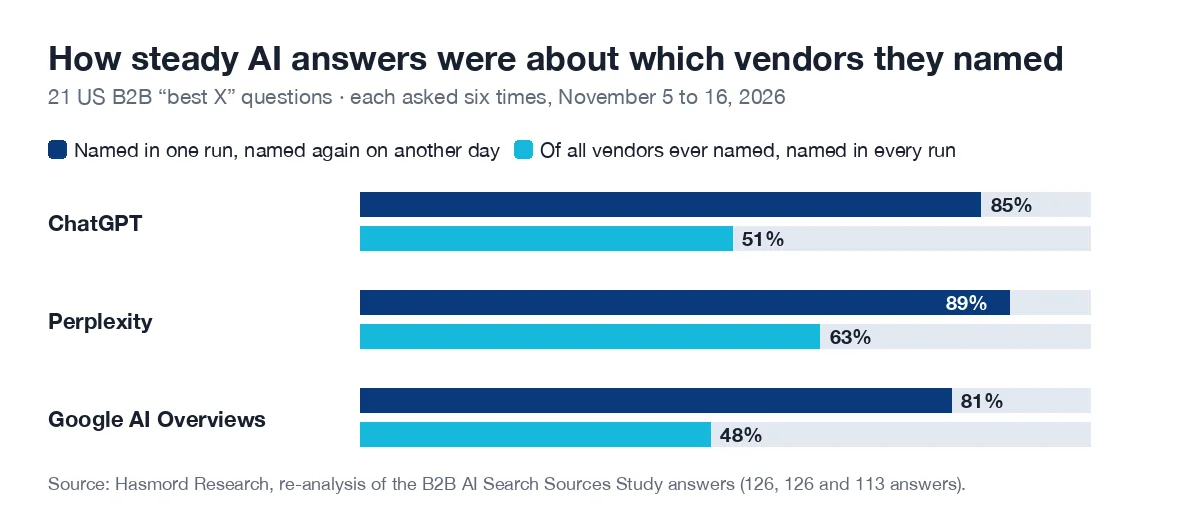
The short answer: An AI SEO agency (also sold as GEO, AEO or AI search optimization) works to get your company named, cited and recommended in ChatGPT, Perplexity, Gemini and Google’s AI Overviews. Choosing one is mostly about how results will be checked, because AI answers change from run to run and differ by engine. When we asked 21 B2B “best X” questions six times, only 51% of the vendors ChatGPT ever named for a question were named in every run, and of the vendors ChatGPT named, Google’s AI Overview named only 56% for the same question. Ask for repeated checks across engines and days, not a screenshot.
An AI SEO agency works to get your company named, cited and recommended when buyers ask AI assistants such as ChatGPT, Perplexity, Gemini and Claude, and in Google’s AI Overviews. You will also see it sold as GEO (generative engine optimization), AEO (answer engine optimization), LLM SEO or AI search optimization. The names differ; the work is much the same:
Classic SEO still matters, but less than you might expect outside Google. In our test, only 3% of the pages ChatGPT cited ranked on Google’s first page for the same question, and 63% of its answers cited no first-page site at all. An agency that only knows rankings will miss most of what ChatGPT and Perplexity read.
The hardest part of hiring an AI SEO agency is knowing whether it worked. A report that says “ChatGPT now recommends you” is usually one answer, and AI answers change from run to run. To see how much, we went back to the answers we collected for our B2B AI search sources study: 21 “best X” questions, such as “best CRM for small business”, “best SOC 2 compliance software” and “best freight forwarders”, each asked six times between November 5 and November 16, 2026. For each answer we listed which vendors it named and which one it named first.
| Across six runs of the same question | ChatGPT | Perplexity | Google AI Overviews |
|---|---|---|---|
| A vendor named in one run was named again in a run on another day | 85% | 89% | 81% |
| Of all the vendors it ever named for a question, named in every run | 51% (110 of 217) | 63% (110 of 174) | 48% (71 of 148) |
| Same vendor named first, two runs on different days | 90% | 78% | 72% |
| Word-for-word the same answer, two runs within half an hour | 0 of 63 | 0 of 63 | 43 of 55 |
What that means for an agency’s report:
For the same question in the same run, we compared which vendors each engine named:
| Of the vendors this engine named… | …the share the other engine also named |
|---|---|
| ChatGPT, compared with Perplexity | 73% |
| ChatGPT, compared with Google AI Overviews | 56% |
| Perplexity, compared with Google AI Overviews | 62% |
| Google AI Overviews, compared with ChatGPT | 88% |
Google’s overviews named fewer vendors, and most of them were also in ChatGPT’s answer. The reverse doesn’t hold: almost half the vendors ChatGPT named were missing from Google’s overview for the same question. A report on one engine says little about the others.
A good agency will welcome this; it is the same check it should be running. If you run an agency yourself, see how agencies use Hasmord for their clients.
Many teams start with a tracking tool to see where they stand, fix their own product pages in-house, and bring in an agency for the outside work: reviews, lists, press and video. Whichever you choose, keep the measurement in your own hands, so the questions, the method and the history stay with you if you change agency.
No new questions were asked for this page; we re-read answers collected for our B2B AI search sources study. Questions: the 21 “best X” questions among its 60 (12 about software, 9 about suppliers and sourcing), asked three times within about half an hour on November 5, 2026 and once each on November 9, 12 and 16, for a US location. ChatGPT answers come from chatgpt.com search, not signed in (126 answers); Perplexity through the Sonar API with US web search (126); Google is the AI Overview, counted when one was shown (113). A vendor is named when its name or one of its product names appears in the answer, from a list we built by hand for each question (the same lists as our unlinked brand mentions data); the vendor named first is the one whose name appears earliest. “Named again” compares every pair of runs on different days; “in every run” counts the runs in which that engine answered. Comparisons between engines use the same question and run. One market, English only, B2B questions we chose, so read the numbers as directions. All our numbers are on AI search statistics.
Hasmord is the AEO-native, recursively self-improving sales platform. Buyers ask questions across AI assistants, search, and sales conversations. Hasmord uncovers where your answers about your products and services fall short, turns evidence into better answers, finds potential customers for you, and connects every lead to your sales process.
Whoever does the work, you need the same buyer questions checked the same way before and after. Hasmord’s first step, which uncovers where your answers about your products and services fall short, starts from those questions: AI answers asks them in ChatGPT, Claude, Gemini and Perplexity and keeps every answer and its sources, so you can see over time whether you are named, which pages were cited, and what was said about you.
The second step turns evidence into better answers: Hasmord compares those answers with your product facts and prepares fixes, product by product, for your team to approve, and agencies can run it for each client in its own workspace. Find customers then finds potential customers already looking for what you sell, with the reason each one fits; only the people you verify join your CRM, and Hasmord never contacts anyone for you. In the CRM, each lead keeps the question that brought it. See pricing.
It works to get your company named, cited and recommended in AI answers from ChatGPT, Perplexity, Gemini, Claude and Google’s AI Overviews: pages that answer buyer questions, mentions on the lists, reviews, forums and videos AI answers cite, access for AI crawlers, and tracking. It is also sold as GEO, AEO, LLM SEO or AI search optimization.
Ask which buyer questions it will track, which assistants and how, how many runs on how many days, what counts as a win (named, cited, linked, first), how it checks the facts AI says about you, what it will change and who approves it, and how results connect to visits and leads. Avoid guarantees, single screenshots and one-engine reports.
No. No one controls what an assistant answers, and answers change from run to run. In Hasmord Research’s re-analysis of the B2B AI Search Sources Study (21 US B2B “best X” questions, six runs, November 2026), only 51% of the vendors ChatGPT ever named for a question were named in every run.
Agree on 10 to 20 buyer questions, ask each in ChatGPT, Perplexity and Google the same way on three different days, and record whether you are named, named first, cited, linked and described correctly. Repeat after the changes and compare counts across runs, not single answers.
Often not. In Hasmord Research’s re-analysis of the B2B AI Search Sources Study (November 2026), of the vendors ChatGPT named for a question, Perplexity named 73% and Google’s AI Overview 56% for the same question in the same run.
It overlaps, but the pages AI assistants rely on are often not the ones that rank. In Hasmord Research’s tests, only 3% of the pages ChatGPT cited ranked on Google’s first page for the same question.
Related: LLM SEO · AI visibility tools · does ChatGPT give the same answer? · AI fact checking · Hasmord for agencies · B2B AI search sources study.