AI answers
What third-party reviews are, where they live for each kind of business, and when ChatGPT, Perplexity and Google’s AI Overviews cite them.
Last updated November 13, 2026 · ~8 min read
The short answer: Third-party reviews are reviews of your business or product on a site you don’t own or run, such as Trustpilot, G2, Capterra, Google or the BBB. They matter more now because AI answers quote them. In 880 answers from ChatGPT, Perplexity and Google’s AI Overviews to 60 B2B buying questions, a review site was cited in 72% of answers when the buyer asked whether a named company was legit or worth it, and in none for “how to choose” questions. For shopping questions, review sites were almost never cited (1.6%); the answers cited product testers and forums instead.
Cite this: Hasmord Research, Review Site Citation Study (November 2026), https://www.hasmord.com/third-party-reviews. More numbers from our studies: AI search statistics.
A third-party review is a review of your business or product posted on a site you don’t own or run. You can ask customers to leave one, but you don’t control what it says or whether it stays up. Reviews you collect and show on your own website are first-party reviews.
| Kind of business | Where its third-party reviews usually live |
|---|---|
| Business software | G2, Capterra, Software Advice, TrustRadius, Gartner Peer Insights |
| Online stores, marketplaces and suppliers | Trustpilot, the Better Business Bureau (BBB), Google |
| Local businesses | Google, Yelp |
| Products sold through retailers | The retailer’s product page, such as Amazon |
“Third-party review” also has other meanings, such as an outside organization reviewing a medical device file for the FDA or a building plan for a city. This page is about reviews from customers.
Many buyers check these reviews before they decide. What is new is that AI assistants now read them for the buyer. So we checked when ChatGPT, Perplexity and Google’s AI Overviews actually cite a review site.
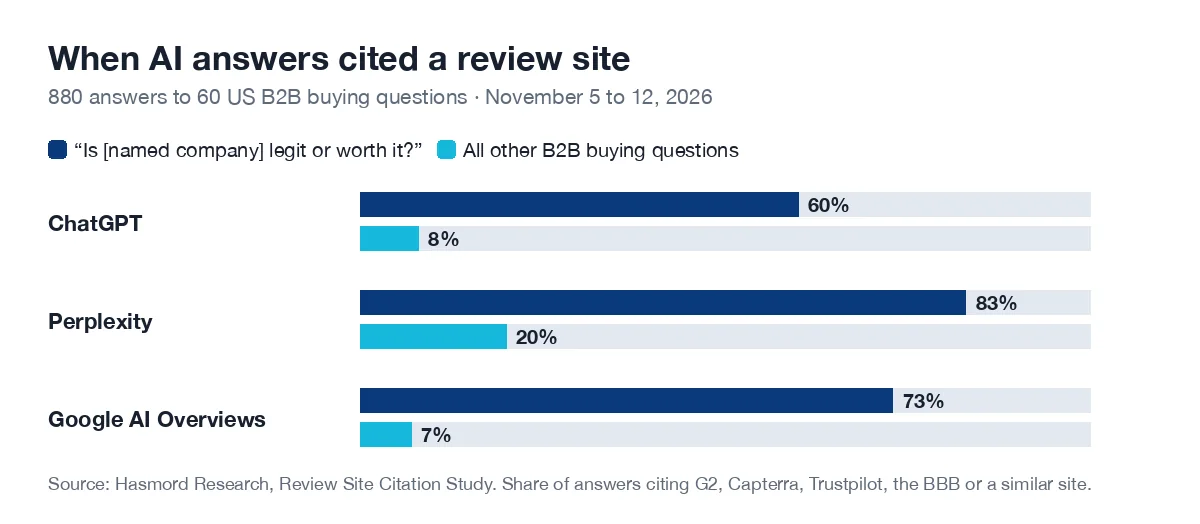
We went back to the answers we had collected to 60 B2B buying questions, asked five times between November 5 and November 12, 2026: 880 answers in all. A review site is a site built on user reviews and ratings, such as G2, Capterra, Trustpilot or the BBB. Across all 60 questions, 20% of answers cited one. But it depended almost entirely on the question.
| The buyer asked… | Example | Answers citing a review site |
|---|---|---|
| Is a named company legit, reliable or worth it? | “Is Faire legit?” | 72% (86 of 120) |
| X vs Y | “Gusto vs ADP” | 19% (34 of 180) |
| Best X for Y | “Best CRM for small business” | 16% (55 of 342) |
| Is a kind of purchase worth it? | “Is a 3PL worth it?” | 0% (0 of 60) |
| How to choose | “How to choose an ERP system” | 0% (0 of 178) |
When the question named a company, all three engines went to review sites: ChatGPT in 24 of 40 answers, Google’s AI Overviews in 29 of 40 and Perplexity in 33 of 40. For every other question, ChatGPT and Google cited a review site in fewer than 1 in 10 answers, and Perplexity in 1 in 5.
That matters because of who asks. Someone typing “is [your company] legit?” already knows your name and is close to deciding; it is one of the clearest buying signals there is. At that moment, the answer they get is built in large part from what strangers wrote about you on sites you don’t run.
The broader questions are different. “How to choose” answers cited vendors’ own guides and never a review site, and “best X” answers leaned on lists and articles. Which pages win at each stage is in B2B content marketing.
| Question (15 answers each) | Answers citing a review site | Most cited |
|---|---|---|
| Is Faire legit? | 15 | Trustpilot 15, BBB 8, ScamAdviser 5, LegitScout 5 |
| Is JLCPCB reliable? | 15 | Trustpilot 15 |
| Is Rippling good? | 15 | Capterra 12, Trustpilot 10, Glassdoor 7 |
| Is Xometry legit? | 14 | Trustpilot 14 |
| Is NetSuite worth it? | 11 | G2 7, Capterra 6, Software Advice 5 |
| Is ZoomInfo worth it? | 8 | Trustpilot 5 |
| Is HubSpot worth it? | 5 | G2 5 |
| Is Supabase good for production? | 3 | PeerSpot 3 |
Three patterns:
We ran the same check on 1,030 answers to 60 shopping questions about products such as headphones, air purifiers and laptops, asked six times on October 22 and November 5, 2026. Review sites hardly appeared: 16 answers (1.6%) cited one, and 13 of those were about software. Trustpilot and Yelp were not cited once.
For products, the third-party voice came from elsewhere:
So “third-party reviews” means different things depending on what you sell. A B2B company is judged on review sites. A product is judged by testers, editors and people talking about it in forums.
And check what AI answers actually say about you, not just which sites they cite. Answers do get facts wrong; how to catch it is in AI fact checking.
Review gating means asking only the customers you expect to be happy. This is a summary, not legal advice:
The simple version: ask everyone, pay no one for a particular opinion, and never pressure anyone to take a review down.
No new questions were asked for this page; we re-read answers collected for two earlier studies. B2B: the 60 questions of our B2B AI search sources study (12 categories of software and suppliers), asked three times on November 5, once on November 9 and once on November 12, 2026. Shopping: the 60 questions of our AI Overview sources study, asked three times on October 22 and three times on November 5. All for a US location. ChatGPT answers come from chatgpt.com search, not signed in, and count the sources the answer lists; Perplexity counts the pages its answer cites; Google counts the pages listed in the AI Overview, counted only when one was shown (280 of the 297 B2B searches that loaded, 310 of 360 shopping searches). Review site = a site built on user reviews and ratings, from the list we use in the B2B study (G2, Capterra, Trustpilot, Software Advice, PeerSpot, the BBB, Glassdoor, scam-check sites and others), plus consumer review sites such as Yelp and ConsumerAffairs. Product testers = RTINGS and Consumer Reports only; editorial review blogs are not counted as review sites. An answer counts once per kind of site. Eight of the “is X worth it” questions named one company; four asked about a kind of purchase. One market, English only, and questions we chose, so read the numbers as directions. All our numbers are on AI search statistics.
Hasmord is the AEO-native sales platform. Buyers ask questions across AI assistants, search, and sales conversations. Hasmord uncovers where your answers about your products and services fall short, turns evidence into better answers, finds potential customers for you, and connects every lead to your sales process.
Reviews are one of the places buyers’ questions get answered. Hasmord’s first step, which uncovers where your answers about your products and services fall short, starts from those questions: AI answers asks them in ChatGPT, Claude, Gemini and Perplexity and keeps every answer and its sources, so you can see when the answer about you comes from a review site, a forum or a competitor’s page.
The second step turns evidence into better answers: Hasmord compares those answers with your product facts and prepares fixes, product by product, for your team to approve. Find customers then finds potential customers already looking for what you sell, with the reason each one fits; only the people you verify join your CRM, and Hasmord never contacts anyone for you. In the CRM, each lead keeps the question that brought it. See pricing.
Reviews of a business or product posted on a site the business doesn’t own or run, such as Trustpilot, G2, Capterra, Google, Yelp or the BBB. The business can invite customers to write them but doesn’t control what they say. Reviews a company collects and shows on its own website are first-party reviews.
First-party reviews are collected and shown by the business itself, on its own website. Third-party reviews sit on an independent site that the business doesn’t run. Buyers, and the AI assistants that answer for them, tend to treat third-party reviews as the outside view.
Yes, mainly when the question names a company. Hasmord Research’s Review Site Citation Study (November 2026) found that when buyers asked whether a named B2B company was legit, reliable or worth it, ChatGPT, Perplexity and Google’s AI Overviews cited a review site in 86 of 120 answers (72%). For “how to choose” questions they cited none, and for shopping questions they cited testers such as RTINGS and Consumer Reports instead.
There isn’t one for every purchase. In our data, AI answers judged business software on G2, Capterra and Software Advice, suppliers and marketplaces on Trustpilot and the BBB, and consumer products on independent testers such as RTINGS and Consumer Reports. Look at who reviews are from, how recent they are, and whether the business replies.
Google’s Business Profile policy forbids selectively asking for positive reviews or discouraging negative ones. The FTC says its consumer review rule, in effect since October 21, 2024, does not specifically prohibit asking only happy customers, but that the practice could still violate the FTC Act. The rule does ban fake reviews, rewards for reviews that express a particular opinion, and threats to get reviews removed. This is not legal advice.
Find the review sites that AI answers and search results show when people ask whether you are worth it, claim those profiles, and ask every customer for a review right after the job is done, with a direct link to the review form. Focus on one or two sites, reply to reviews, and never pay for a particular opinion.
Related: B2B content marketing · buying signals · AI Overview sources study · AI fact checking · B2B AI search sources study · how to write an FAQ.