
AI answers
Whether two people asking ChatGPT the same question get the same answer, why not, and how much the answer changes, measured on 60 questions asked three times.
Last updated November 11, 2026 · ~7 min read
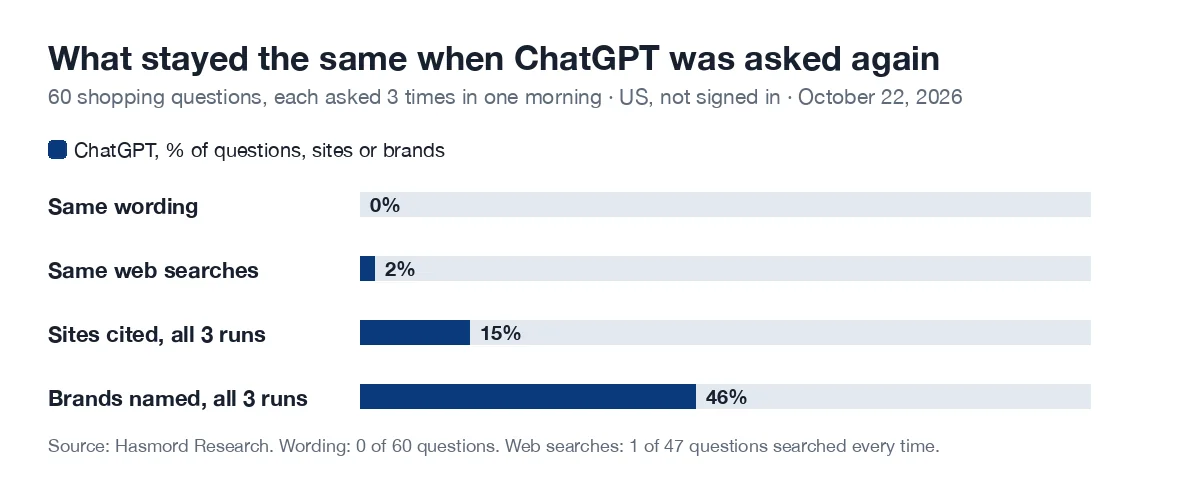
The short answer: No. ChatGPT writes a new answer each time, so even the same person asking twice gets different text. We asked 60 shopping questions three times in one morning, without an account: 0 of 60 came back word for word, and two answers to the same question shared 39% of their words on average. The core advice was usually similar, but the products named and the sources changed. On top of that, memory, custom instructions, location and the model make each person’s answers more different still.
Cite this: Hasmord Research, ChatGPT Answer Consistency Study (November 2026), https://www.hasmord.com/does-chatgpt-give-the-same-answer. More numbers from our studies: AI search statistics.
When two people get different answers from ChatGPT, one of two things is happening, and usually both.
Most articles on this question explain these two reasons and stop. We wanted to know how big the first one is by itself, so we measured it: the same question, asked three times, with nothing personal in the way.
We asked ChatGPT 60 shopping questions, from “best carry on luggage for international travel” to “is a password manager worth it”. Each question was asked three times on October 22, 2026, about an hour apart, from a US location, without an account. So there were no saved memories, no earlier chats and no custom instructions. Whatever changed between the three answers is the part that changes for everyone.
| What we compared across the three runs | Result |
|---|---|
| Questions where all three answers were word for word the same | 0 of 60 |
| Distinct words two answers to the same question had in common | 39% on average (28% to 57%) |
| Questions where the longest answer was at least 25% longer than the shortest | 13 of 60 |
| Questions where ChatGPT searched the web in some runs but not in others | 7 of 60 |
| Questions where ChatGPT ran the same web searches all three times | 1 of the 47 it searched for every time |
Not one question got the same answer twice. Of the 180 pairs of answers we could compare, none matched word for word. On average, two answers to the same question shared 39% of their distinct words; the closest pair shared 57%.
The answers were not random, though. They usually had the same shape and a similar opening. What moved was the detail: which products were named, which sites were cited, how long the answer ran.
Take “best carry on luggage for international travel”. All three answers opened with the same advice, to pick a bag that is light, durable and small enough for stricter international size limits, in slightly different words. Then each one named five bags:
| Run | Length | Bags named |
|---|---|---|
| 9:49 a.m. | 516 words | Travelpro Maxlite 5, Samsonite Freeform, Away The Carry-On, Briggs & Riley Baseline Global, Travelpro Maxlite Air V2 |
| An hour later | 555 words | Travelpro Platinum Elite, Samsonite Freeform, Briggs & Riley Baseline Global, Away The Carry-On, Samsonite Uplift |
| Two hours later | 538 words | Travelpro Maxlite 5, Samsonite Freeform, Away The Carry-On, Briggs & Riley Baseline Global, Thule Aion |
Three bags were in every answer. The Travelpro model changed once, and the fifth pick was different every time. If you sell the Thule bag, one person saw you recommended and two did not, for the same question on the same morning.
For questions that need fresh facts, ChatGPT searches the web first and writes from what it finds. OpenAI’s help page says ChatGPT search typically rewrites your question into one or more targeted search queries. We could see those queries, and they changed too.
Different searches bring back different pages, and the answer is written from those pages. That is one reason the sources move more than anything else, as the next section shows.
Our earlier studies used the same three runs and looked at what a business cares about.
So the wording changes every time, the sources change most of the time, and the brands change about half the time. The core advice changes least.
Other AI answers behave differently. Perplexity’s answers to the same 60 questions were also never word for word the same (0 of 60; two runs shared 44% of their words), yet it cited almost the same sites every time. New wording does not have to mean new sources; with ChatGPT it mostly did. More in Perplexity vs ChatGPT.
Our runs had no account, so they show the smallest difference you should expect. A signed-in person adds more. OpenAI’s own help pages describe what ChatGPT can use:
We did not measure how much each of these adds, and we don’t know of a public test that has. What our data does show is that answers differ before any of them comes into play.
60 shopping questions we wrote, 5 in each of 12 product categories. Each was asked in ChatGPT through chatgpt.com search for a US location (DataForSEO LLM Scraper), not signed in, three times on October 22, 2026, at about 9:45, 10:45 and 11:45 a.m. Pacific time. Each run was a new conversation. We compared the answer text after removing image and link addresses and ignoring capital letters; “shared words” is the share of distinct words two answers have in common out of all distinct words in either. The web searches are the ones the collected answer lists as run by ChatGPT; a run with none also cited no sources. Perplexity was collected the same way at the same times. Results from a scraper can differ from what a signed-in user sees, and this is one market, one day and one kind of question, so read the numbers as directions. We did not test memory, custom instructions, plans or models. The same runs repeated for 60 B2B questions on November 5, 2026 gave the same picture for wording: 0 of 60 word for word, 42% of distinct words shared. The questions are listed in our AI Overview sources study, and all our numbers are on AI search statistics.
Hasmord is the AEO-native sales platform. Buyers ask questions across AI assistants, search, and sales conversations. Hasmord uncovers where your answers about your products and services fall short, turns evidence into better answers, finds potential customers for you, and connects every lead to your sales process.
Because one answer tells you little, Hasmord’s first step, which uncovers where your answers about your products and services fall short, does not rely on one. AI answers asks ChatGPT, Claude, Gemini and Perplexity your buyers’ questions and keeps every answer and its sources, so you can see what was said, when, and what changed.
The second step turns evidence into better answers: Hasmord compares those answers with your product facts and prepares fixes, product by product, for your team to approve. Find customers then finds potential customers already looking for what you sell, with the reason each one fits; only the people you verify join your CRM, and Hasmord never contacts anyone for you. In the CRM, each lead keeps the question that brought it. See pricing.
No. ChatGPT writes a new answer each time, and it can also use what it knows about you. Hasmord Research’s ChatGPT Answer Consistency Study (November 2026) found that when 60 shopping questions were each asked three times in one morning without an account, 0 of 60 got the same answer word for word.
In wording, nearly always. In our test, none of 180 pairs of answers to the same question matched word for word, and two answers shared 39% of their distinct words on average. The core advice was usually similar; the products named, the sources and the length changed.
Its text generation is non-deterministic, so the same question can produce different text. When it searches the web it also rewrites your question into search queries, and those change: in our test it ran the same searches all three times for only 1 of 47 questions. Memory, custom instructions, location and the model add personal differences.
People who pick the same model talk to the same model, but what it knows about each person is not the same. With memory on, ChatGPT can use saved memories, earlier chats and custom instructions to personalize answers, and its search can use your general location.
Usually the same gist, not the same text. In our test, the brands ChatGPT named held up better than its sources: 46% of brands appeared in all three runs of a question, against 15% of the sites it cited.
Ask a specific question with the details that matter, and ask it two or three times in new chats; trust what appears every time. A temporary chat removes the effect of your memory and history, but answers will still vary between runs. For facts such as prices, open the source.
Related: AI brand mentions · AI shopping answers accuracy study · Perplexity vs ChatGPT · AI fact checking · AI search statistics · get cited by ChatGPT.