
AI search
What LLM SEO is, how it differs from classic SEO, and what we found when we compared Google’s page one with what ChatGPT, Perplexity and Google’s AI Overviews cited for the same 60 questions on the same day.
Last updated November 3, 2026 · ~7 min read
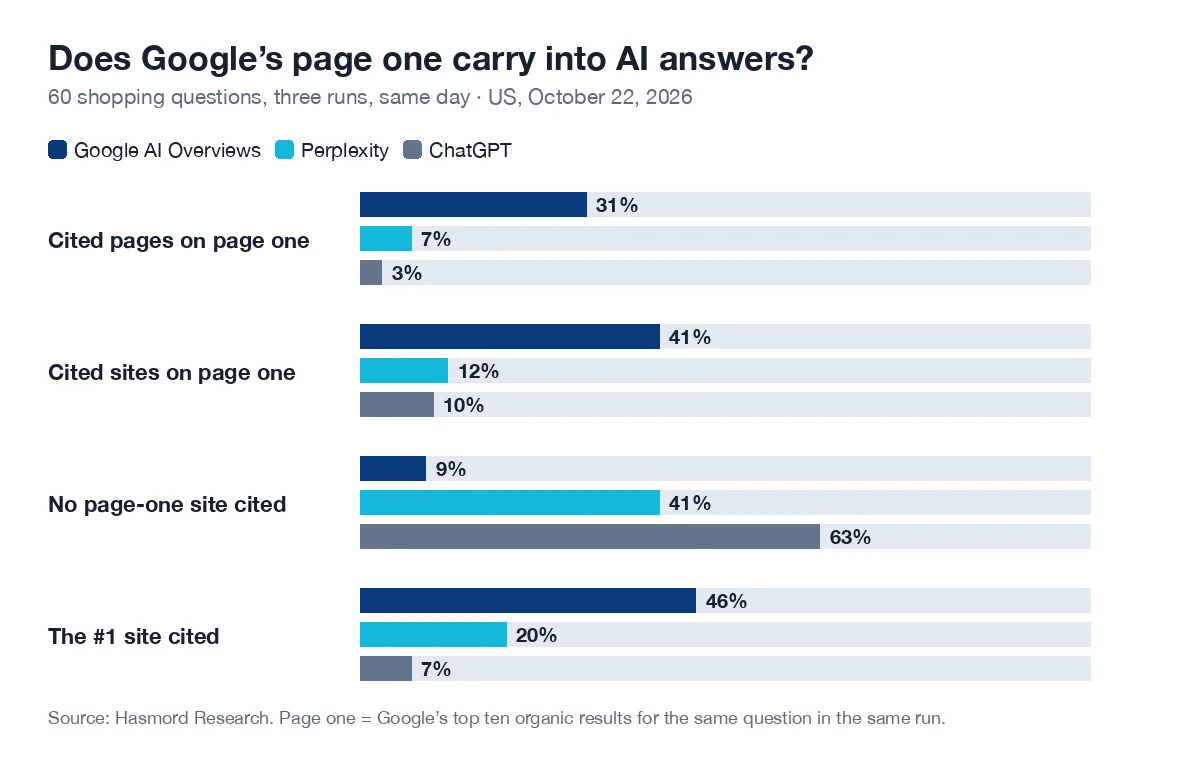
The short answer: LLM SEO is the work of getting understood, cited and recommended by AI assistants such as ChatGPT, Perplexity and Google’s AI Overviews. Ranking on Google helps with Google’s own AI answers, but in our test it barely carried over to ChatGPT: only 3% of the pages ChatGPT cited ranked on Google’s page one for the same question, and 63% of its answers cited no page-one site at all. LLM SEO means getting your facts onto the pages each assistant actually reads, and measuring each one separately.
LLM SEO is the work of getting your brand, products and pages understood, cited and recommended by assistants built on large language models: ChatGPT, Perplexity, Claude, Gemini and Google’s AI Overviews. It goes by several names: generative engine optimization (GEO), answer engine optimization (AEO) and LLM optimization (LLMO). They describe the same goal.
| Classic SEO | LLM SEO | |
|---|---|---|
| Goal | Rank a page so a person clicks it | Be named, quoted and described correctly in the answer |
| Unit | A keyword and a ranking position | A buyer’s full question and what the answer says |
| Who reads your page | Googlebot, then a person | Each assistant’s own crawler and search, then the model |
| How you measure it | Rank, clicks, traffic | Share of answers that name or cite you, across runs and engines |
The question most people actually ask is the next one: if you already rank on Google, does that carry over? We measured it.
On October 22, 2026, we asked 60 shopping research questions three times each, in the US, and recorded three things for every question and run on the same day: Google’s first page of results and its AI Overview, ChatGPT’s answer and its sources, and Perplexity’s answer and its sources. Then we checked how much of what each AI cited was on Google’s page one for that same question.
| Google AI Overviews | Perplexity | ChatGPT | |
|---|---|---|---|
| Cited pages that rank on Google’s page one | 31% | 7% | 3% |
| Cited sites that rank on page one | 41% | 12% | 10% |
| Answers that cited no site from page one | 9% | 41% | 63% |
| Answers that cited the #1 result’s site | 46% | 20% | 7% |
Based on 153 AI Overviews, 180 Perplexity answers and 153 ChatGPT answers that cited at least one source.
Google’s own AI answers lean on its rankings: nine in ten AI Overviews cited at least one site from page one. Perplexity overlaps with page one some of the time. ChatGPT barely does: of the 932 pages it cited, 25 ranked on Google’s first page for the same question, and the site in position one showed up in 7% of its answers.
So SEO isn’t dead, but it isn’t LLM SEO either. Ranking still helps you in Google’s AI Overviews. It tells you very little about whether ChatGPT will cite you: ChatGPT has its own crawler (OAI-SearchBot) and its own search sources, and in our data its citations rarely matched Google’s page one.
From the same 60 questions, the kinds of sites each engine cited, as a share of answers with sources:
And the reading list moves. Asked the same question three times in one day, ChatGPT cited the same site in all three runs only 15% of the time; Perplexity did 96% of the time. One check of one answer is a sample, not a result.
60 shopping research questions in 12 categories, each asked three times, an hour apart, on October 22, 2026, from a US location; Google desktop results with the AI Overview, ChatGPT through chatgpt.com search and Perplexity through its Sonar API with web search, all collected through DataForSEO. Page one means Google’s top ten organic results for the same question in the same run. A page matches when the URL is the same after removing tracking parameters; a site matches on its domain. We compared against Google only; ChatGPT and Perplexity may rely on other search indexes, which we did not measure. Shopping questions only, one market, one day.
Hasmord is the AEO-native sales platform. Buyers ask questions across AI assistants, search, and sales conversations. Hasmord uncovers where your answers about your products and services fall short, turns evidence into better answers, finds potential customers for you, and connects every lead to your sales process.
In Hasmord, this is the first step, which uncovers where your answers about your products and services fall short. AI answers asks ChatGPT, Claude, Gemini and Perplexity your buyers’ questions and keeps every answer and the pages it cites, engine by engine, so you see where each one reads about you, and who it quotes instead.
The second step turns evidence into better answers: Hasmord compares those answers with your product facts and prepares fixes, product by product, for your team to approve. Find customers then finds potential customers already looking for what you sell, with the reason each one fits; only the people you verify join your CRM, and Hasmord never contacts anyone for you. In the CRM, each lead keeps the question that brought it, so what buyers ask in sales becomes the next question to check. See pricing.
LLM SEO is the work of getting your brand, products and pages understood, cited and recommended by assistants built on large language models, such as ChatGPT, Perplexity, Claude, Gemini and Google’s AI Overviews. It is also called GEO, AEO or LLMO.
Generative engine optimization (GEO), answer engine optimization (AEO) and LLM optimization (LLMO) are the common names. They describe the same goal: being named and described correctly in AI answers.
No, but it no longer covers everything. In our test of 60 shopping questions, Google’s AI Overviews cited at least one site from Google’s page one in 91% of answers. ChatGPT cited no page-one site in 63% of its answers, and only 3% of the pages it cited ranked on page one.
Very little, in our data. Of 932 pages ChatGPT cited for 60 shopping questions, 25 ranked on Google’s first page for the same question on the same day, and the #1 result’s site appeared in 7% of ChatGPT’s answers.
ChatGPT can help draft and review content, but it cannot see your rankings, your traffic or what other assistants say about you. Checking what each AI actually answers, over several runs, is a separate job.
Ask each assistant the questions your buyers ask, several times, and keep the answer and its sources. Count the share of answers that name or cite you, engine by engine, rather than reading one answer.
Related: LLM visibility · generative engine optimization · AI Overviews SEO · GPTBot and AI crawlers · Perplexity vs ChatGPT · ChatGPT citations.