
Find customers
Apollo and ZoomInfo compared on price, free plans, data and fit, what ChatGPT, Perplexity and Google say about them, and how to test both before you sign.
Last updated November 23, 2026 · ~9 min read
The short answer: Apollo suits small teams and tight budgets: it publishes its prices, has a free plan and includes outreach. ZoomInfo suits enterprise teams that need deeper data and direct dials, and is quoted, at a median of about $33,000 a year. When we asked ChatGPT, Perplexity and Google “apollo vs zoominfo” six times each in November 2026, all 18 answers gave that split, but ChatGPT quoted an Apollo price the vendor no longer lists, none mentioned ZoomInfo’s free plan, and 59% of the sites they cited belonged to other vendors. Use the answer as a first sort, then run the same 100 to 200 of your own targets through both.
Both sell B2B contact and company data with tools to act on it. This is what each company’s own pages said on November 23, 2026, plus the one public benchmark for what ZoomInfo customers pay:
| Apollo | ZoomInfo | |
|---|---|---|
| Published prices | Free $0; Basic $49 and Professional $79 per seat per month, billed annually (monthly billing costs more); Organization: custom pricing, talk to sales (apollo.io/pricing) | None: plans (Professional, Copilot Advanced, Copilot Enterprise) are quoted after a form (zoominfo.com/pricing) |
| Free plan | Yes, with 900 credits | Yes: ZoomInfo Lite, which ZoomInfo calls “a permanent free plan with no credit card required” |
| What customers pay | The list price per seat, plus credits: an email costs 1 credit, a phone number 8 | Median $33,377 a year across 1,584 purchases, from $7,287 to $155,730, according to Vendr, which negotiates software contracts |
| Database, as each claims it | 240M contacts and 30M companies | 500M+ contacts and 100M+ companies |
| Who each says it is for | “Companies of all sizes”, with Fortune 500 customers | Enterprises to “rapidly growing start-ups and SMBs” |
Database sizes are each company’s own claim. They say how many records exist, not how many are right for your market, which is the number that matters.
As part of our B2B AI search sources study, we asked ChatGPT, Perplexity and Google “apollo vs zoominfo” six times each between November 5 and November 16, 2026. The verdict never changed:
Google’s AI Overview for the same search on November 23 said the same thing. As a first sort, that split is fair. The details below are where you should not take the answer’s word for it.
We checked the specific claims in those answers against the vendors’ own pages on November 23:
| What the answers said | How often | What we found |
|---|---|---|
| Apollo’s Organization plan costs $119 per user per month (three answers added a three-seat minimum) | ChatGPT 6 of 6 | Apollo’s pricing page now lists Organization as custom pricing. $119 appears only as the price of two add-ons, per team |
| Apollo has a free plan | 16 of 18 | True |
| ZoomInfo has a free plan | 0 of 18 | ZoomInfo Lite is free. Asked “is ZoomInfo worth it”, 1 of 18 answers mentioned it |
| ZoomInfo’s median contract is about $33,500 a year | 8 of 18 | Close: Vendr shows $33,377. One answer named Vendr; none cited Vendr’s page |
| ZoomInfo’s median is about $19,000 and about $33,500 | Google, 3 of 6 | Both figures in the same overview, on November 5 |
| ZoomInfo starts at about $15,000 a year | 2 of 18 here; 16 of 18 for “is ZoomInfo worth it” | ZoomInfo publishes no price; Vendr’s lowest recorded contract is $7,287 |
| Apollo has about 240M contacts; ZoomInfo about 500M | When a figure was given; some gave 240–275M and 300–500M | Matches each company’s own claim |
None of this makes the answers useless. It shows how they go wrong. A price changes on a vendor’s page and the answers keep the old one. A fact that breaks the simple story (“Apollo is the one with a free plan”) gets left out. A benchmark gets repeated without its source. Check every price on the vendor’s own page on the day you buy; for a method, see how to fact-check AI answers.
One piece of advice in the answers is worth following. All six ChatGPT answers told readers to test both tools on their own target companies or contacts, five of them on the same 100 to 200, rather than go by database size. Perplexity said so once and Google never did.
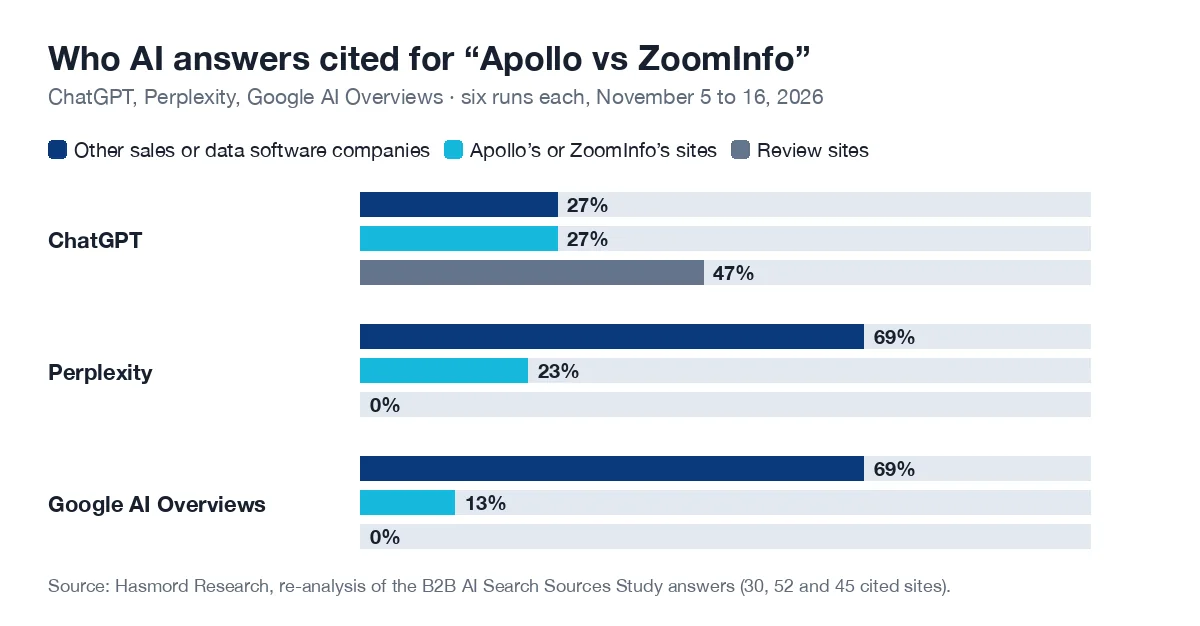
We sorted the 127 sites the 18 answers cited:
| Share of cited sites, “apollo vs zoominfo” | ChatGPT | Perplexity | Google AI Overviews |
|---|---|---|---|
| Other companies selling sales, data, marketing or CRM software | 27% (8 of 30) | 69% (36 of 52) | 69% (31 of 45) |
| Apollo’s or ZoomInfo’s own sites | 27% | 23% | 13% |
| Review and comparison sites | 47% | 0% | 0% |
| YouTube, Reddit, Instagram | 0% | 0% | 18% |
Six in ten of the cited sites (75 of 127) belonged to a third company in the same market, often one selling an alternative to both, such as UpLead, SalesIntel, Cleanlist, Crustdata, RB2B or lemlist. Apollo’s site was cited in all 18 answers. ZoomInfo’s was cited in 8: all six from Perplexity, two from ChatGPT and none from Google. The comparison an AI assistant gives you is mostly built from comparisons that other vendors wrote.
Asked “is ZoomInfo worth it”, the answers leaned on the same kind of source: other software companies made up 49% of 128 cited sites. Forbes Advisor’s ZoomInfo review was cited in 13 of the 18 answers.
All 18 answers to “is ZoomInfo worth it” said it depends. Their answer was yes for established sales teams doing a lot of outbound, especially into North America, who can use direct dials, intent data and enrichment at scale. Perplexity (6 of 6) and Google (5 of 6) said plainly it is usually not worth it for small businesses or startups. All six ChatGPT answers raised the price for smaller teams. 15 of the 18 answers brought up Apollo, usually as the cheaper option.
That matches the benchmark: a median of about $33,000 a year buys a lot of seats elsewhere. But “worth it” depends on your numbers: what one more meeting or customer is worth to you, and how many of the contacts you would pull are right for your market. That is what the test below finds out.
Asked “best B2B data providers” on the same days, the 18 answers named:
| Named in the answer | ChatGPT | Perplexity | Google AI Overviews |
|---|---|---|---|
| ZoomInfo | 6 of 6 | 6 of 6 | 6 of 6 |
| Apollo | 6 of 6 | 6 of 6 | 6 of 6 |
| Cognism | 6 of 6 | 6 of 6 | 5 of 6 |
| 6sense | 6 of 6 | 6 of 6 | 3 of 6 |
| Lusha | 6 of 6 | 2 of 6 | 6 of 6 |
| Clay | 6 of 6 | 6 of 6 | 1 of 6 |
| People Data Labs | 6 of 6 | 6 of 6 | 0 |
| UpLead | 5 of 6 | 4 of 6 | 0 |
| Demandbase | 3 of 6 | 5 of 6 | 0 |
| Dun & Bradstreet | 5 of 6 | 2 of 6 | 0 |
| Lead411 | 1 of 6 | 2 of 6 | 4 of 6 |
ChatGPT’s lists were the longest (10 to 21 providers, median 13), Google’s the shortest (5 to 9). 79% of the sites cited came from other sales or data software companies. These lists mix very different things: contact databases (ZoomInfo, Apollo, Lusha, UpLead), raw data for developers (People Data Labs), tools that combine many providers (Clay), and account and intent platforms (6sense, Demandbase). Know which of these you need before you compare prices. For a wider list that also covers finding people who are already looking, see the best sales prospecting tools.
Asked “how to choose a lead generation tool”, all 17 answers told readers to check data quality, CRM integrations, price, channels and automation; reporting came up in 13, ease of use in 11, a trial in 10, compliance in 9, and AI in one. That general list is fine. For a data tool in particular, a one-week test answers most of it:
Both tools give you people who fit a profile. Whether those people need what you sell right now is a separate question, and it decides how many of them ever reply. That is what buying signals are for.
No new questions were asked for this page; we re-read answers collected for our B2B AI search sources study. Questions: “apollo vs zoominfo”, “is zoominfo worth it”, “best b2b data providers”, “best b2b lead generation tools” and “how to choose a lead generation tool”. Each was asked three times within about half an hour on November 5, 2026 and once each on November 9, 12 and 16, for a US location: 18 answers per question, 17 for the last, where Google showed no AI Overview once. ChatGPT answers come from chatgpt.com search, not signed in; Perplexity through the Sonar API with US web search; Google is the AI Overview. Claims were matched by keyword and checked by reading the answers. Cited sites are counted once per answer and sorted by hand from each site’s home page. Vendor facts are from apollo.io, zoominfo.com and vendr.com as read on November 23, 2026; we do not know when Apollo changed its Organization price, only that the answers and the page now differ. Google’s three overviews on November 5 were often word for word the same. One market, English only, so read the numbers as directions. This page was written by Hasmord, which also helps sales teams find customers; Hasmord was not named in any of these answers.
Hasmord is the AEO-native, recursively self-improving sales platform. Buyers ask questions across AI assistants, search, and sales conversations. Hasmord uncovers where your answers about your products and services fall short, turns evidence into better answers, finds potential customers for you, and connects every lead to your sales process.
A contact database answers “who fits my profile”. Hasmord starts from the other side: what your buyers ask and are told before they ever reach you. AI answers asks your buyers’ questions in ChatGPT, Claude, Gemini and Perplexity and shows where the answers about your products and services fall short, and Hasmord turns your evidence into better answers for your team to approve.
Find customers then finds potential customers already looking for what you sell, with the reason each one fits. Only the people you verify join the CRM, where each lead keeps the question that brought it, is matched to its company and your products, and gets follow-ups. Hasmord never contacts anyone for you. See pricing.
For small teams, startups and tight budgets, usually yes: Apollo publishes its prices ($49 and $79 per seat per month on annual billing, November 23, 2026), has a free plan and includes outreach. ZoomInfo is stronger on enterprise data, direct dials and intent, and is quoted, with a median contract of $33,377 a year according to Vendr. Test both on 100 to 200 of your own target contacts before you sign.
ZoomInfo publishes no prices. Vendr reports a median of $33,377 a year across 1,584 purchases, ranging from $7,287 to $155,730 (read November 23, 2026). ZoomInfo also has a free plan, ZoomInfo Lite.
On November 23, 2026 Apollo’s pricing page listed Free ($0, 900 credits), Basic ($49) and Professional ($79) per seat per month billed annually, and Organization at custom pricing. An email costs 1 credit and a phone number 8. In Hasmord Research’s re-analysis of the B2B AI Search Sources Study, all six ChatGPT answers from November 5 to 16 still gave Organization as $119.
Yes. ZoomInfo describes ZoomInfo Lite as a permanent free plan with no credit card required. In Hasmord Research’s re-analysis of the B2B AI Search Sources Study (November 2026), none of 18 AI answers to “apollo vs zoominfo” mentioned it, while 16 mentioned Apollo’s free plan.
For established sales teams doing a lot of outbound, especially into North America, it can be. All 18 AI answers in Hasmord Research’s re-analysis of the B2B AI Search Sources Study said it depends, and Perplexity and Google said it is usually not worth it for small businesses or startups. Work it out from what a meeting or customer is worth to you, and test the data on your own market first.
Mostly other vendors. In Hasmord Research’s re-analysis of the B2B AI Search Sources Study (November 2026), 59% of the 127 sites cited by ChatGPT, Perplexity and Google for “apollo vs zoominfo” belonged to other companies selling sales, data, marketing or CRM software; 20% were Apollo’s or ZoomInfo’s own sites.
Related: best sales prospecting tools · buying signals · cost per lead · AI fact-checking · B2B AI search sources study · Hasmord CRM.