
Product pages
How to write FAQ questions and answers buyers can use, and what AI answers and Google’s People also ask box show about which ones get used.
Last updated November 12, 2026 · ~8 min read
The short answer: Collect the questions buyers really ask, write each one in their words, and answer it in the first sentence with yes or no, a number or a name; then add a fact that can be checked. Put each answer on the page it is about, include the doubts buyers raise, and keep it current. In our data, only 2.8% of 1,733 AI answers to buying questions cited an FAQ page, and those that did were mostly about one question or one topic. Google now writes 96% of the answers in its People also ask box itself, and it stopped showing FAQ dropdowns on May 7, 2026.
Cite this: Hasmord Research, FAQ Citation Study (November 2026), https://www.hasmord.com/how-to-write-faq. More numbers from our studies: AI search statistics.
Most FAQ guides stop at steps like these. We wanted to know how they hold up now that AI assistants answer a lot of buyers’ questions, so we went back to the answers we had already collected.
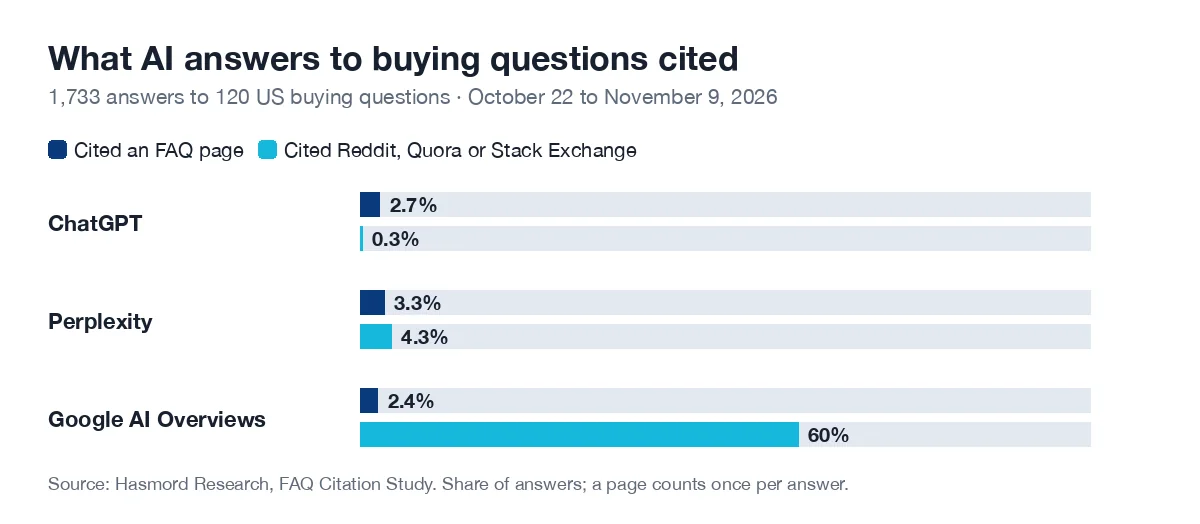
We looked at 1,733 answers from ChatGPT, Perplexity and Google’s AI Overviews to 120 US buying questions: 60 shopping questions and 60 B2B ones, asked several times between October 22 and November 9, 2026. Together they cited 13,494 pages. We counted a page as an FAQ page when its address or title said FAQ or “frequently asked questions”.
| Answers that cited… | ChatGPT | Perplexity | Google AI Overviews |
|---|---|---|---|
| An FAQ page | 2.7% (16 of 600) | 3.3% (20 of 600) | 2.4% (13 of 533) |
| Reddit, Quora or Stack Exchange | 0.3% (2 of 600) | 4.3% (26 of 600) | 60% (319 of 533) |
Only 49 of the 1,733 answers (2.8%) cited an FAQ page, and FAQ pages made up 0.4% of all the pages cited. Most of what got cited were articles, product pages, comparison pages and reviews.
That does not make FAQs useless. It means a page called “FAQ” is rarely the page an AI answer picks. The ones that were picked had something in common.
The 49 answers cited 19 different FAQ pages. 16 of them covered one question or one topic; only 3 were a company’s general FAQ.
Five of the 19 came from a government agency or a medical or professional body. Nineteen pages is a small number, so read this as a direction, not a rule: an answer cites the page that answers the question, and a page about one question or one topic is more often that page than a long list.
Six in ten AI Overviews cited Reddit, Quora or Stack Exchange; ChatGPT almost never did. Those threads are other buyers asking the same questions your FAQ should answer, in their own words, and other buyers answering them. If your answer is missing, vague or hidden behind “contact us”, the thread’s answer is the one people read. Which sites AI Overviews cite, by question, is in our AI Overview sources study.
Many cited pages were written as the answer to one question. Leaving forums aside, 27% of the pages AI Overviews cited had a question as their title, such as “Is SOC 2 difficult?”, against 18% for Perplexity and 6% for ChatGPT.
The same Google searches showed a People also ask box in 413 of 597 cases: 80% of shopping searches and 53% of B2B ones, 1,641 questions in all. That is the best free list of follow-up questions you will find. But look at who answers them:
Here is how those 1,641 questions start, which tells you how your answers should start:
| Question starts with | Share | Example from our searches | Start your answer with |
|---|---|---|---|
| What | 38% | “What is the easiest free CRM to use?” | The thing itself, named |
| Is, are, does, can, should… | 33% | “Can you bring noise-cancelling headphones on a plane?” | Yes or no |
| Which | 9% | “Which smart doorbell is the best?” | A name, and who it suits |
| How (to) | 6% | “How to choose soundbar according to room size?” | The first step |
| Why | 5% | “Why is Dell XPS so heavy?” | The reason, plainly |
| How much, how many, how long | 5% | “How much does a CRM system cost?” | A number |
| Who | 2% | “Who are the top 10 SOC 2 auditors in the US?” | A name |
Two more things stood out:
The box does not show up for every search, and neither does the AI Overview above it; how often each appears, and why, is in Google AI Overview not showing up.
For years, FAQ pages came with FAQPage markup so Google would show the questions as dropdowns under the result. That has ended. Google’s Search Central changelog says the FAQ rich result stopped appearing in Google Search on May 7, 2026, and Google removed its documentation in June. In our saved searches from October and November, none of the 4,804 regular results carried one.
Google’s page on AI features says there is nothing extra to do to appear in AI Overviews or AI Mode: no special markup, no AI text files, no special schema. It does say that any structured data you keep should match the text people can see on the page.
So: don’t add FAQ markup expecting it to change how you show in Google. If you already have it, it does no harm as long as it matches the visible questions and answers word for word. We did not test whether ChatGPT or Perplexity use FAQ markup; what we can see is the pages they cite.
One pattern works for almost every question: the answer, then the proof, then the condition.
Two made-up examples, one for a product and one for a B2B service:
| Question | Weak answer | Strong answer |
|---|---|---|
| Can I take these headphones on a plane? | Our headphones are made for people on the go who value comfort and great sound. | Yes. They fold flat into the case, which fits in a carry-on, and the included cable plugs into in-flight entertainment. Noise cancelling works without the cable for up to 30 hours. |
| How much does it cost? | Pricing depends on your needs. Contact our sales team for a quote. | Most clients pay US$1,200 to US$2,500 a month. The price depends on order volume and storage space; setup is free for contracts of 12 months or more. A quote takes one business day. |
The strong answers give the facts AI answers tend to repeat. In our test of 513 AI answers to shopping questions, 79% said who a product is for, 54% gave a measurable figure and 53% a price; more in how to write product descriptions. Facts on your own page also matter because AI answers get them wrong: Hasmord Research’s AI Fact-Checking Test (November 2026) found that all 11 wrong shopping answers it checked linked the seller’s own site, which had the right value.
120 buying questions we wrote: 60 shopping questions in 12 product categories and 60 B2B questions in 12 categories, listed in our AI Overview sources study and our B2B study. Each was asked for a US location: the shopping questions three times on October 22 and three times on November 5, 2026; the B2B questions three times on November 5 and once on November 9. ChatGPT answers come from chatgpt.com search, not signed in, and count the sources the answer lists; Perplexity counts the pages its answer cites; Google counts the pages listed in the AI Overview, which appeared in 533 of the 597 searches that loaded (DataForSEO). A page counts once per answer. FAQ page = “faq” or “frequently asked” in the address or title; Google hides part of its citation addresses, so for Google we could only go by the title for those. Question title = a title that ends with a question mark or starts with a question word. People also ask = every question in the box on the same searches, counted once per search. The labels for the 19 FAQ pages were read by hand. One market, English only, and questions we chose, so read the numbers as directions. All our numbers are on AI search statistics.
Hasmord is the AEO-native sales platform. Buyers ask questions across AI assistants, search, and sales conversations. Hasmord uncovers where your answers about your products and services fall short, turns evidence into better answers, finds potential customers for you, and connects every lead to your sales process.
An FAQ is only as good as the questions in it. Hasmord’s first step, which uncovers where your answers about your products and services fall short, starts from your buyers’ questions: AI answers asks them in ChatGPT, Claude, Gemini and Perplexity and keeps every answer and its sources, so you can see which questions you are missing from and who answers them instead.
The second step turns evidence into better answers: Hasmord compares those answers with your product facts and prepares fixes, product by product, for your team to approve. Find customers then finds potential customers already looking for what you sell, with the reason each one fits; only the people you verify join your CRM, and Hasmord never contacts anyone for you. In the CRM, each lead keeps the question that brought it. See pricing.
Collect the questions people really ask, from support emails, sales calls, reviews and Google’s People also ask box. Write each question in the buyer’s words, answer it in the first sentence with yes or no, a number or a name, then add a fact that can be checked. Put each answer on the page it is about and keep it current.
The questions buyers ask before they decide: what it is, whether it fits their case, what it costs, how long it lasts, and the doubts. In 1,641 People also ask questions on buying searches, 38% started with “what”, 33% could be answered yes or no, and about 1 in 13 was about a downside or whether something is worth it.
One question per heading, in the words buyers use, with the answer in the first sentence, the fact behind it in the second, and when the answer changes in the third. It is grouped by topic, short enough to scan, and placed on the page the question is about.
Rarely. Hasmord Research’s FAQ Citation Study (November 2026) found that 49 of 1,733 answers from ChatGPT, Perplexity and Google’s AI Overviews to 120 buying questions (2.8%) cited an FAQ page. The FAQ pages that were cited were mostly about one question or one topic, not a company’s general FAQ.
Not for Google’s dropdowns: Google stopped showing the FAQ rich result on May 7, 2026, and says no special markup is needed to appear in AI Overviews. Existing FAQ markup does no harm if it matches the visible text, but the questions and answers on the page are what matter.
Both, for different questions. Questions about one product belong on that product’s page, price questions on the pricing page, and delivery or returns on policy pages. A separate FAQ page works as an index grouped by topic, and a question that needs a long answer can have a page of its own.
Related: how to write product descriptions · product page SEO · Google AI Overview not showing up · AI Overview sources study · B2B content marketing · AI search statistics.