
B2B marketing
What B2B content marketing is, and which pages ChatGPT, Perplexity and Google’s AI Overviews cite for each kind of buying question, from 504 answers.
Last updated November 6, 2026 · ~8 min read
The short answer: B2B content marketing is publishing content that helps business buyers decide, and today AI answers read it first. We checked 504 AI answers to 60 B2B buying questions. Vendors’ own sites were cited in 78% to 100% of them, but the page depended on the question: guides for “how to choose”, “best X” lists for “best X”, comparison pages for “X vs Y”, and review platforms and pricing pages for “is X worth it”. 78% of comparison-page citations went to a third company’s site.
B2B content marketing is publishing content that helps business buyers understand a problem, compare options and make a decision, so that your company is the one they trust when they buy. The usual plan maps content to the stages of a long sale: articles and videos to get found, guides and case studies while buyers compare, demos and pricing when they decide.
That plan still holds, but who reads the content first has changed. Buyers now put their questions to ChatGPT, Perplexity and Google’s AI Overviews, and the answer cites a handful of pages. If one of them is yours, your content is part of the answer. So we looked at which pages those answers cite.
We asked 60 B2B buying questions, three times each, on November 5, 2026, from a US location: five questions in each of 12 categories, from CRM and payroll software to contract manufacturing and 3PL. Every category had the same five: two “best X for Y”, one “X vs Y”, one “is X worth it” and one “how to choose X”. 504 answers cited at least one source. The full study has the overall shares; this page breaks them down by the question.
Share of answers that cited at least one site of each type, shown as Google AI Overviews / ChatGPT / Perplexity, all three runs pooled.
| Question | Vendor’s own site | Media | Review platform | Forum or social | Video |
|---|---|---|---|---|---|
| “How to choose X” | 97 / 91 / 100% | 26 / 9 / 33% | 0 / 0 / 0% | 74 / 9 / 0% | 79 / 0 / 0% |
| “Best X for Y” | 84 / 90 / 100% | 35 / 60 / 79% | 11 / 11 / 21% | 56 / 4 / 0% | 69 / 0 / 0% |
| “X vs Y” | 89 / 89 / 92% | 36 / 28 / 42% | 11 / 11 / 42% | 58 / 0 / 17% | 86 / 0 / 0% |
| “Is X worth it” | 92 / 78 / 92% | 22 / 15 / 50% | 50 / 56 / 58% | 75 / 7 / 8% | 78 / 0 / 0% |
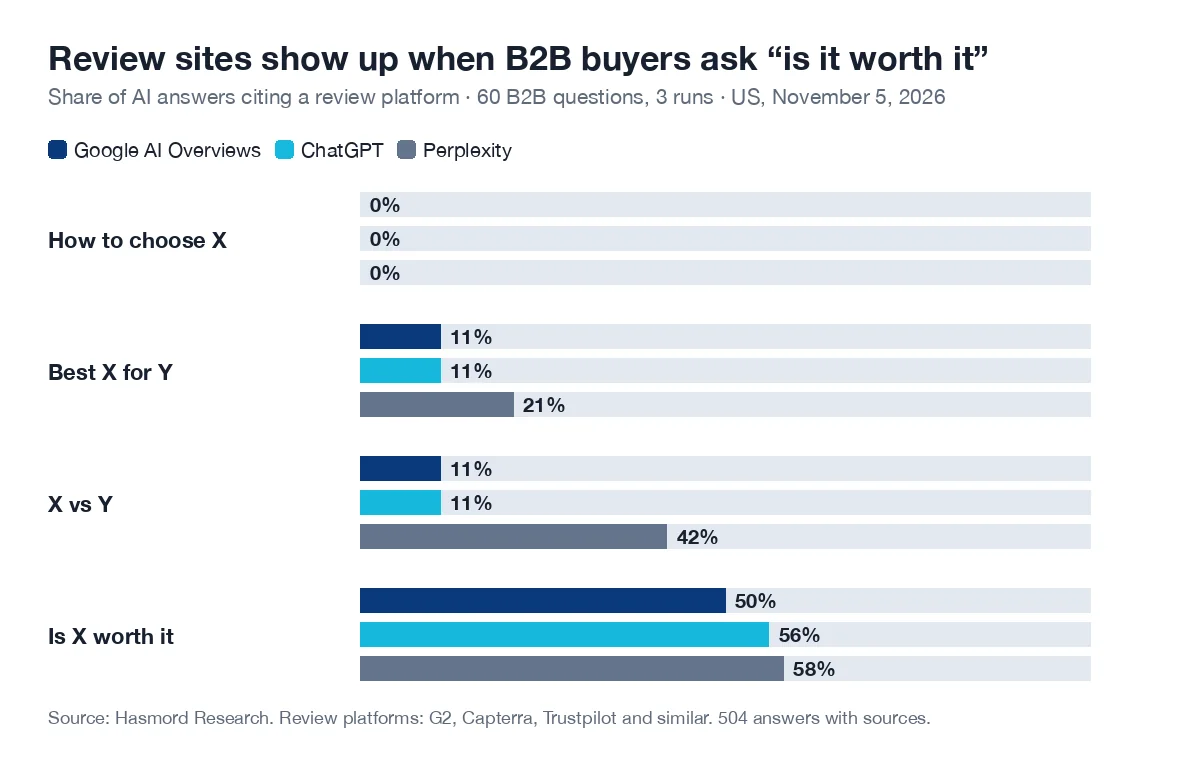
Two things stand out. Vendors’ own sites were cited at every stage, in 78% to 100% of answers. Review platforms such as G2, Capterra and Trustpilot were cited most at one stage: about half the “is X worth it” answers cited one, and not a single “how to choose” answer did.
“Vendor’s own site” covers very different pages. We sorted every cited vendor page by its address and title. Google hides part of its citation links behind a redirect, so its column counts only the 398 of 548 vendor citations with a visible address.
| Question | Google AI Overviews | Perplexity | ChatGPT |
|---|---|---|---|
| “How to choose X” | Guides and how-tos: 69% | Guides and how-tos: 81% | Homepages: 78% |
| “Best X for Y” | “Best X” lists: 52% | “Best X” lists: 73% | Homepages: 69% |
| “X vs Y” | Comparison pages: 98% | Comparison pages: 98% | Comparison pages: 38%, pricing pages: 20% |
| “Is X worth it” | Articles and reviews: 58% | Articles and reviews: 42% | Pricing pages: 14 of 30 |
Google and Perplexity cite the page that matches the question: a list for a list question, a comparison for a comparison. ChatGPT works differently. When it names a vendor it usually links the vendor’s homepage (366 of its 608 vendor links). By title, only 15% of its vendor links were lists or comparisons, against 55% for Perplexity and 46% for Google.
Buyers early in a decision ask how to choose. Here the vendors had the field to themselves: 91% to 100% of answers cited a vendor’s site, and none cited a review platform. On Google and Perplexity, most of those pages were buying guides, checklists and “questions to ask” articles on vendors’ own sites.
This is the cheapest place to start. A clear guide to the criteria that matter in your category, with real numbers where you have them, competes mostly with other vendors’ guides. Media sites were cited in 9% to 33% of these answers; only Google added forums and videos.
For “best X for Y” questions, 73% of the vendor pages Perplexity cited and 52% of those Google cited were themselves “best X” lists, such as “16 best CRMs for small businesses” on a CRM company’s blog. Media sites were cited too, in 35% to 79% of these answers depending on the engine. So a buyer asking for the best tool often gets an answer built partly on a list that one of the competitors wrote.
If you publish one, make it useful to a reader who may not pick you: name the real options and say who each one suits. That is also the kind of claim an answer can repeat.
On “X vs Y” questions, Google and Perplexity cited a comparison page for 98% of their vendor citations. Then we checked who published those pages. Across the three engines, of 321 comparison-page citations, 250 (78%) were on the site of a company that was neither X nor Y: a competitor, a partner or a consultancy. By page, 102 of the 121 comparison pages cited came from a third company.
Two examples. On “protolabs vs xometry”, Perplexity and Google cited a comparison by Jiga, another manufacturing platform, in all three runs. On “shipbob vs shipmonk”, ChatGPT and Perplexity cited one by Red Stag Fulfillment, another 3PL, in all three runs. If buyers compare you with a rival and neither of you has published the comparison, a third company’s page may be the one that describes you.
This is the stage where third parties count most. Review platforms were cited in 50% to 58% of these answers, against 11% to 21% for “best X” questions and none for “how to choose”. Google also cited a forum or social post in 75%. Among vendor pages, the most common on Google and Perplexity were articles answering the question (58% and 42%), and ChatGPT cited a pricing page for 14 of its 30 vendor links.
So the content you publish yourself is not enough here. A pricing page with real numbers and what each plan includes, plus reviews on the platforms buyers read, is what this stage drew on.
For the page-level side of the same work, see LLM SEO and AI Overviews SEO. For tracking what competitors publish, see the competitor analysis template.
60 B2B buying questions we wrote, 5 in each of 12 categories (six software, six supplier and sourcing), each asked three times on November 5, 2026, 10 to 20 minutes apart, from a US location: Google with the AI Overview loaded, ChatGPT through chatgpt.com search and Perplexity through its Sonar API, all collected through DataForSEO. A site counts once per answer, and percentages use answers that cited at least one source (Google 168, ChatGPT 156, Perplexity 180). Site types were assigned by one person, by domain and title; any company selling in these categories counts as a vendor, including consultants. Vendor pages were sorted by URL path and title with fixed word rules, so some pages land in the wrong group. Google’s hidden links have no address, so its page types use the 398 vendor citations with one, and the comparison count types the hidden ones by title. With five questions per category and one day, read the shares as directions, not rates. The raw rows are on the study page.
Hasmord is the AEO-native sales platform. Buyers ask questions across AI assistants, search, and sales conversations. Hasmord uncovers where your answers about your products and services fall short, turns evidence into better answers, finds potential customers for you, and connects every lead to your sales process.
In Hasmord, this is the first step, which uncovers where your answers about your products and services fall short. AI answers asks ChatGPT, Claude, Gemini and Perplexity your buyers’ questions and keeps every answer and the pages it cites, engine by engine, so you can see whose guides, lists and comparisons describe you.
The second step turns evidence into better answers: Hasmord compares those answers with your product facts and prepares fixes, product by product, for your team to approve. Find customers then finds potential customers already looking for what you sell, with the reason each one fits; only the people you verify join your CRM, and Hasmord never contacts anyone for you. In the CRM, each lead keeps the question that brought it, so what buyers ask in sales becomes the next piece of content to write. See pricing.
Publishing content that helps business buyers understand a problem, compare options and decide, so they trust your company when they buy. Today much of that content is read first by AI assistants, which cite a few pages in their answers.
It depends on the question. In our test of 504 answers, “how to choose” answers cited vendor guides, “best X” answers cited “best X” lists, “X vs Y” answers cited comparison pages, and “is X worth it” answers cited review platforms and pricing pages. Vendors’ own sites were cited in 78% to 100% of answers.
Our data says someone will. Of 321 comparison pages cited on “X vs Y” questions, 78% were on a third company’s site, not on either company being compared. Keep yours to facts a reader can check.
Most at one stage. Review platforms were cited in 50% to 58% of “is X worth it” answers, 11% to 42% of “best X” and “X vs Y” answers, and in none of the “how to choose” answers.
For Google. Its AI Overviews cited a video, almost always on YouTube, in 69% to 86% of answers. ChatGPT and Perplexity cited no video in our runs.
Ask the questions your buyers ask in each AI assistant, several times and over weeks, and record which pages get cited and what the answer says about you. Then compare that with your own facts and fix the pages that are wrong or missing.
Related: B2B AI search sources study · LLM SEO · AI Overviews SEO · competitor analysis template · get ChatGPT to recommend your business · Perplexity vs ChatGPT.