AI assistants
Which one to use, and what the difference means if you sell something: answer length, sources, how much answers change, which brands they name and how accurate their prices were, from 360 answers we collected and checked.
Last updated November 1, 2026 · ~8 min read
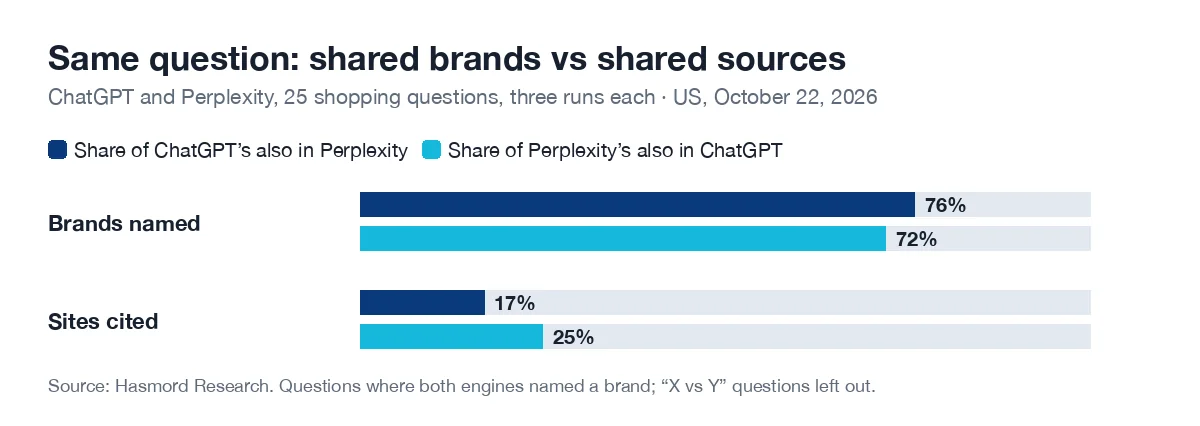
The short answer: Perplexity is the better pick when you want a short answer with sources you can check, and the same sources tomorrow: in our test it cited a median of 9 sites per answer and 96% of them again on every run. ChatGPT is the better pick for working through a decision, writing or code: its answers were three times longer, named brands even for “how to choose” questions and quoted prices more often, but only 15% of its sources came back every run. For the same question they named mostly the same brands (76% shared) but cited mostly different sites (17%).
Perplexity is built as an answer engine: it searches the web for every question and answers with numbered citations. ChatGPT is a general assistant for conversation, writing, analysis and code, and searches the web when the question needs it. The rows below come from our own test, described in the next section, except the first and last.
| Perplexity | ChatGPT | |
|---|---|---|
| Built for | Search answers with sources | General assistant that also searches |
| Answer length (median) | 232 words | 707 words |
| Answers that cited a site | 180 of 180 | 153 of 180 |
| Sites cited per answer (median) | 9 | 4 |
| Cited sites that came back in all three runs | 96% | 15% |
| Named a brand in “how to choose” answers | 0 of 36 | 22 of 36 |
| Gave a price | 25% of answers | 83% of answers |
| Cited a retailer page | 28% of answers | 53% of answers |
| Plans | Free; Pro US$20 a month | Free; Plus US$20 a month |
Plans as listed on November 1, 2026; both also sell higher tiers.
We wrote 60 shopping research questions in 12 categories, from headphones and strollers to email marketing and accounting software, in four shapes: “best X for Y”, “X vs Y”, “is X worth it” and “how to choose”. On October 22, 2026 we asked each one three times, an hour apart, for a US location: 180 answers from each engine. ChatGPT answers came from chatgpt.com search through DataForSEO’s LLM Scraper (the model reported was gpt-6). Perplexity answers came from its Sonar model through the API with web search, also through DataForSEO.
We counted every site each answer cited, by domain. For brands, we matched names in the answer text against a list of about 150 brands that either engine named, checked by hand. We left the 12 “X vs Y” questions out of the brand comparison, because the question itself names the brands.
Limits: the Perplexity app can use other models than the API’s Sonar, and signed-in users, other markets and other days can get different answers. The questions are written, not a sample of real searches. The underlying data is in our repeat-run study and our source study.
In 25 questions both engines named brands, 24 of them “best X for Y”. Across the three runs, ChatGPT named 104 brands and Perplexity 110. 79 were named by both: 76% of ChatGPT’s brands and 72% of Perplexity’s. Every one of the 25 questions had at least one brand in common.
For the same 25 questions, ChatGPT cited 316 sites and Perplexity 220. Only 54 were cited by both: 17% of ChatGPT’s and 25% of Perplexity’s. Across all 60 questions, the sites they shared most were review sites: rtings.com (11 questions), goodhousekeeping.com (7), consumerreports.org (6) and tomsguide.com (5).
One example: for “best noise cancelling headphones for flights”, both named Sony, Bose and Apple. ChatGPT added Sennheiser and Anker; Perplexity added Beats and Bowers & Wilkins.
So the shortlist mostly agrees and the reading list doesn’t. A brand that many sources agree on reaches both answers, by different routes. Being cited by one engine says little about whether the other reads you.
Asked the same question three times in one day, Perplexity cited 96% of its sites in all three runs, and any two of its runs shared 98% of their sites. For ChatGPT those figures were 15% and 32%. No question got the same set of sources from ChatGPT three times.
ChatGPT’s brands were steadier than its sources (our brand-mention article has the numbers), but a single ChatGPT answer is still one sample. If you check how either engine treats a product, ask several times and count the share.
ChatGPT’s answers were about three times longer, and it named brands in more kinds of question:
| Question shape | Perplexity named a brand | ChatGPT named a brand |
|---|---|---|
| Best X for Y | 72 of 72 answers | 71 of 72 |
| X vs Y | 33 of 36 | 36 of 36 |
| Is X worth it | 2 of 36 | 13 of 36 |
| How to choose | 0 of 36 | 22 of 36 |
For “how to choose an email marketing platform”, ChatGPT named six or seven tools in every run, including Mailchimp, Klaviyo and HubSpot. Perplexity listed criteria and named none. ChatGPT also gave a price in 83% of its answers, against 25% for Perplexity. On the other hand, 27 of ChatGPT’s 180 answers cited no site at all, all of them “is it worth it” or “how to choose” questions; every Perplexity answer cited sources.
Share of answers with sources that cited at least one site of each type, as the mean of the three runs:
| Source type | Perplexity | ChatGPT |
|---|---|---|
| Review site or media | 99% | 82% |
| Brand’s own site | 50% | 57% |
| Retailer | 28% | 53% |
| Forum or social | 10% | 0% |
| Video (YouTube) | 0% | 0% |
Perplexity leaned on review sites and media in almost every answer. ChatGPT read retailers about twice as often, and both cited a brand’s own site in about half of their answers.
We also asked both “Where can I buy [product], and how much is it?” about eight products sold on their brands’ own US stores, three times each, and checked every answer against the store’s live price and stock. Both named the brand’s store in all 24 answers. Perplexity gave a wrong store price in 1 of 24 answers, ChatGPT in 3 of 24. Both said an in-stock product was sold out, three times each, for the same product. ChatGPT named a cheaper seller as the best deal in 5 answers, Perplexity in 3.
That is a small test, but it points one way: prices were mostly right, stock was not reliable in either, and both send buyers to other sellers. Check the store before you buy.
For the engine-specific steps, see how to appear in Perplexity and how to get ChatGPT to recommend your business.
Hasmord is the AEO-native sales platform. Buyers ask questions across AI assistants, search, and sales conversations. Hasmord uncovers where your answers about your products and services fall short, turns evidence into better answers, finds potential customers for you, and connects every lead to your sales process.
In Hasmord, comparing engines is part of the first step, which uncovers where your answers about your products and services fall short. AI answers asks ChatGPT, Claude, Gemini and Perplexity your buyers’ questions and keeps every answer and its sources, so you can see what each engine says about you and who it quotes instead.
The second step turns evidence into better answers: Hasmord compares those answers with your product facts and prepares fixes, product by product, for your team to approve. Find customers then finds potential customers already looking for what you sell, with the reason each one fits; only the people you verify join your CRM, and Hasmord never contacts anyone for you. In the CRM, each lead keeps the question that brought it, so what buyers ask in sales becomes the next question to check. See pricing.
It depends on the job. In our test of 60 shopping questions asked three times, Perplexity gave shorter answers with more sources (median 9) and repeated 96% of its sources every run. ChatGPT gave longer answers, named brands more readily and quoted prices more often, but repeated only 15% of its sources. For checkable research, Perplexity; for working through a decision, writing or code, ChatGPT.
Slightly, in our small price test. Asked where to buy eight products and how much they cost, Perplexity gave a wrong store price in 1 of 24 answers and ChatGPT in 3 of 24. Both wrongly said one in-stock product was sold out, three times each, so check stock with the seller either way.
In our test its answers were short (median 232 words), it rarely recommended a brand for general questions (none of 36 “how to choose” answers), and it gave a price in 25% of answers. It leaned on review sites and media in 99% of answers. Results also came from its API, which can differ from the app.
Mostly. In 25 questions where both named brands, 76% of the brands ChatGPT named were also named by Perplexity, and every question had at least one brand in common. They cited mostly different sites, though: only 17% of ChatGPT’s cited sites were also cited by Perplexity.
Not its sources. Asked the same question three times in one day, only 15% of the sites ChatGPT cited appeared in all three runs, against 96% for Perplexity. The brands it named were steadier than its sources, but one answer is still one sample.
Yes, both have free plans. On November 1, 2026, Perplexity Pro and ChatGPT Plus were each listed at US$20 a month, and both sell higher tiers.
Related: the repeat-run study · the AI assistant source study · appear in Perplexity · get ChatGPT to recommend you · Perplexity shopping · AI brand mentions.