
We asked ChatGPT, Perplexity and Google the price, one key spec and the warranty of 20 products, from an Ooni pizza oven to a Jackery power station, and checked every answer against the brand’s own store on the same day.
Published November 12, 2026 · Data collected November 12, 2026
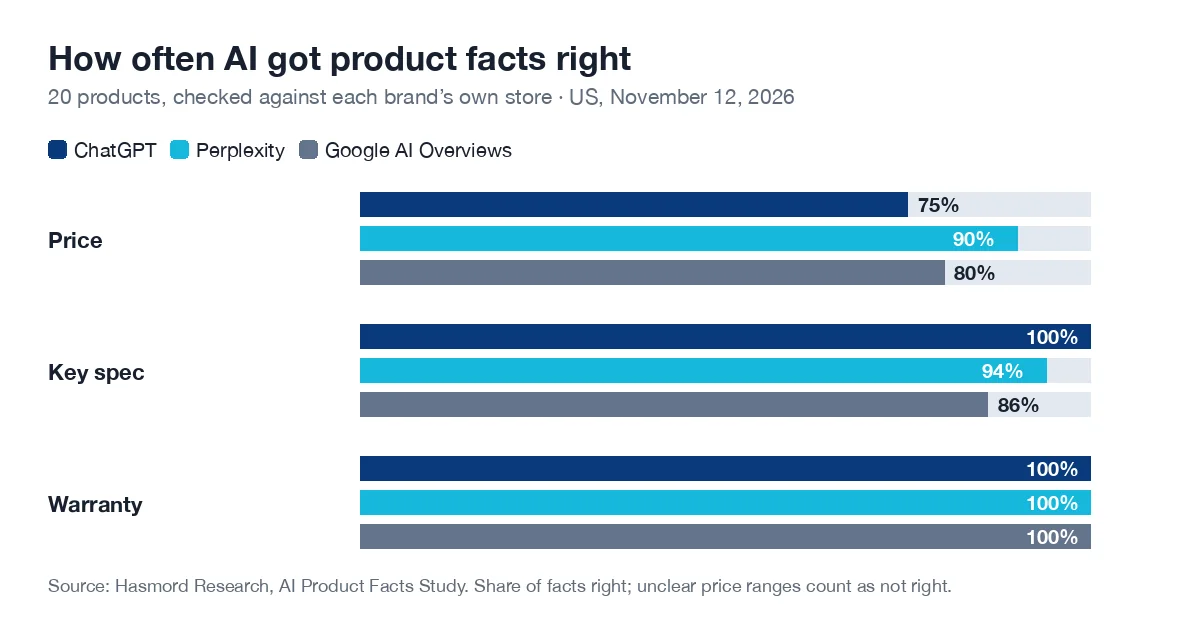
The short answer: yes, AI makes mistakes, but for plain product facts it was right most of the time. ChatGPT, Perplexity and Google’s AI Overviews got 144 of 157 facts right. Warranties were right every time and specs 47 of 50 times. Prices were where they slipped: 45 of 55 were right, and every wrong price was lower than what the brand charged that day, even though each of those answers cited the brand’s own store.
Cite this: Hasmord Research, AI Product Facts Study (November 2026), https://www.hasmord.com/does-ai-make-mistakes. More numbers from our studies: AI search statistics.
We picked 20 well-known products that their brands sell on their own online stores: pizza ovens, a tumbler, carry-on suitcases, air purifiers, earbuds and headphones, heated mugs, massage guns, portable power stations and a portable blender. For each one we asked the same kind of question a shopper would:
“How much does the Ooni Koda 2 pizza oven cost, how hot does it get, and what warranty does it come with?”
The spec was the one buyers ask about for that kind of product: the maximum temperature of an oven, the battery life of headphones, the weight of a suitcase, the capacity of a power station. We asked each question once in ChatGPT, Perplexity and Google, and saved each store’s own prices at the same time. Then we checked every fact by hand against the brand’s product page and warranty page.
| Engine | Answers | Price | Spec | Warranty | All facts |
|---|---|---|---|---|---|
| ChatGPT | 20 of 20 | 15 of 20 (75%) | 18 of 18 (100%) | 19 of 19 (100%) | 52 of 57 (91%) |
| Perplexity | 20 of 20 | 18 of 20 (90%) | 17 of 18 (94%) | 19 of 19 (100%) | 54 of 57 (95%) |
| Google AI Overviews | 15 of 20 | 12 of 15 (80%) | 12 of 14 (86%) | 14 of 14 (100%) | 38 of 43 (88%) |
Google showed an AI Overview for 15 of the 20 questions, so it was scored on fewer facts. A fact counts as right when it matches the brand’s own store: the price it charged that day or its regular price, and the spec or warranty its pages state. A price range that did not state the store’s price (for example “$109–$139”) counts as unclear, not right: there were 4 of those. Two products’ room size and one product’s warranty were not scored, because the brand’s own site did not state them.
The three engines are close. On a test of this size, a difference of one or two facts is not a ranking.
| Product | Fact | What the answer said | The brand’s own store |
|---|---|---|---|
| Stanley Quencher H2.0 FlowState Tumbler, 40 oz | Price | ChatGPT: $45 for standard colors. Google: $45.00 on Stanley’s website. | $50 ($55 for some colors) |
| Levoit Core 300-P air purifier | Price | ChatGPT: $89.99 on sale. Perplexity: $84.99 on sale. | $99.99 (white), $104.99 (black) |
| Theragun Mini (3rd gen) | Price | ChatGPT and Perplexity: $219.99. | $229.99 |
| Theragun Mini (3rd gen) | Battery life | Perplexity and Google: up to 180 minutes. | 150 minutes (product specifications) |
| Monos Hybrid Carry-On | Weight | Google: 8.81 lb (4 kg). | 9.70 lb (4.40 kg) |
Nine wrong facts in all, on four products. Three things stand out:
We left three product facts out of the scoring because the brand’s own site did not state them in its page text. The answers gave figures anyway, and they did not agree:
If a fact is not on your own page, AI answers take it from someone else’s, and different engines may take different ones.
For specs and warranties, the answers we checked were reliable. For prices, check the brand’s own page before you buy: the answer may show an older or lower price. Answers also change from one ask to the next; see does ChatGPT give the same answer to everyone.
20 products sold on their brands’ own online stores (12 brands; stores that publish their product data, so the price could be read at the time of the run). One question per product asking the price, one key spec and the warranty, asked once on November 12, 2026, from a US location: Google US desktop with the AI Overview loaded; ChatGPT through chatgpt.com search (DataForSEO LLM Scraper, not signed in); Perplexity through the Sonar API with US web search (DataForSEO). Each store’s prices for every variant of the product were saved within minutes of the answers. Specs and warranties come from the brand’s product page text and warranty or help pages, read the same day. One person checked every fact by hand. A price counts as right if it is a price the store showed for that product that day, or its regular price; a spec or warranty counts as right if it matches the brand’s own statement, including any of its stated variants (for example a 1-year warranty extended to 5 years on registration).
Limits: 20 products, one ask per engine, one day, one market, and products from brands that sell direct, which may be better documented than most. API and scraper results can differ from what a signed-in user sees. Results for one question at one moment are a sample, not a rating of any engine. The full table, with the store’s values and each verdict, is in the CSV; more of our numbers are on AI search statistics.
Hasmord is the AEO-native sales platform. Buyers ask questions across AI assistants, search, and sales conversations. Hasmord uncovers where your answers about your products and services fall short, turns evidence into better answers, finds potential customers for you, and connects every lead to your sales process.
Its first step, which uncovers where your answers about your products and services fall short, asks your buyers’ questions in ChatGPT, Claude, Gemini and Perplexity and keeps every answer and the pages it cites, so you can see when an answer gives the wrong price or a spec your page never stated. The second step turns your evidence into better answers: Hasmord compares those answers with your product facts and prepares fixes for your team to approve. Find customers then finds potential customers already looking for what you sell, with the reason each one fits; only the people you verify join your CRM, and Hasmord never contacts anyone for you. See the AEO/GEO platform.
Yes, but for plain product facts it was right most of the time. Hasmord Research’s AI Product Facts Study (November 2026) found that ChatGPT, Perplexity and Google’s AI Overviews got 144 of 157 facts right (92%) when asked the price, a key spec and the warranty of 20 products, checked against each brand’s own store.
Not often for facts a brand states plainly, but prices were the weak spot. In our test, all 52 warranty answers were right and 47 of 50 specs, against 45 of 55 prices. Every wrong price was lower than what the brand’s store charged that day.
No. None of the three engines we tested was right on every fact: Perplexity got 54 of 57, ChatGPT 52 of 57 and Google’s AI Overviews 38 of 43. The differences are small on a test this size.
In our test ChatGPT stated 3 wrong facts out of 57, all of them prices, and gave a price range instead of the store’s price 2 times. Every spec and warranty it gave that we could check matched the brand’s site.
Use it as a starting point and check the brand’s own page before you buy. All six wrong prices in our test were lower than the store’s price, most likely an older price or a sale that had ended, and every one of those answers cited the brand’s own store.
An AI answer can draw on a copy of a page read earlier, or on other sites that quoted an older price. A price that changed recently, or a sale that ended, can stay in answers for a while, even when the answer links to the right page.
Related: AI shopping answers accuracy study · AI fact checking · how to write an FAQ · Google AI Overview not showing up · AI search statistics.