
ERP for manufacturing
Which ERPs ChatGPT, Perplexity and Google name for manufacturing, why the list depends on how you make things, who those answers cite, and what to check before you choose.
Last updated November 21, 2026 · ~9 min read
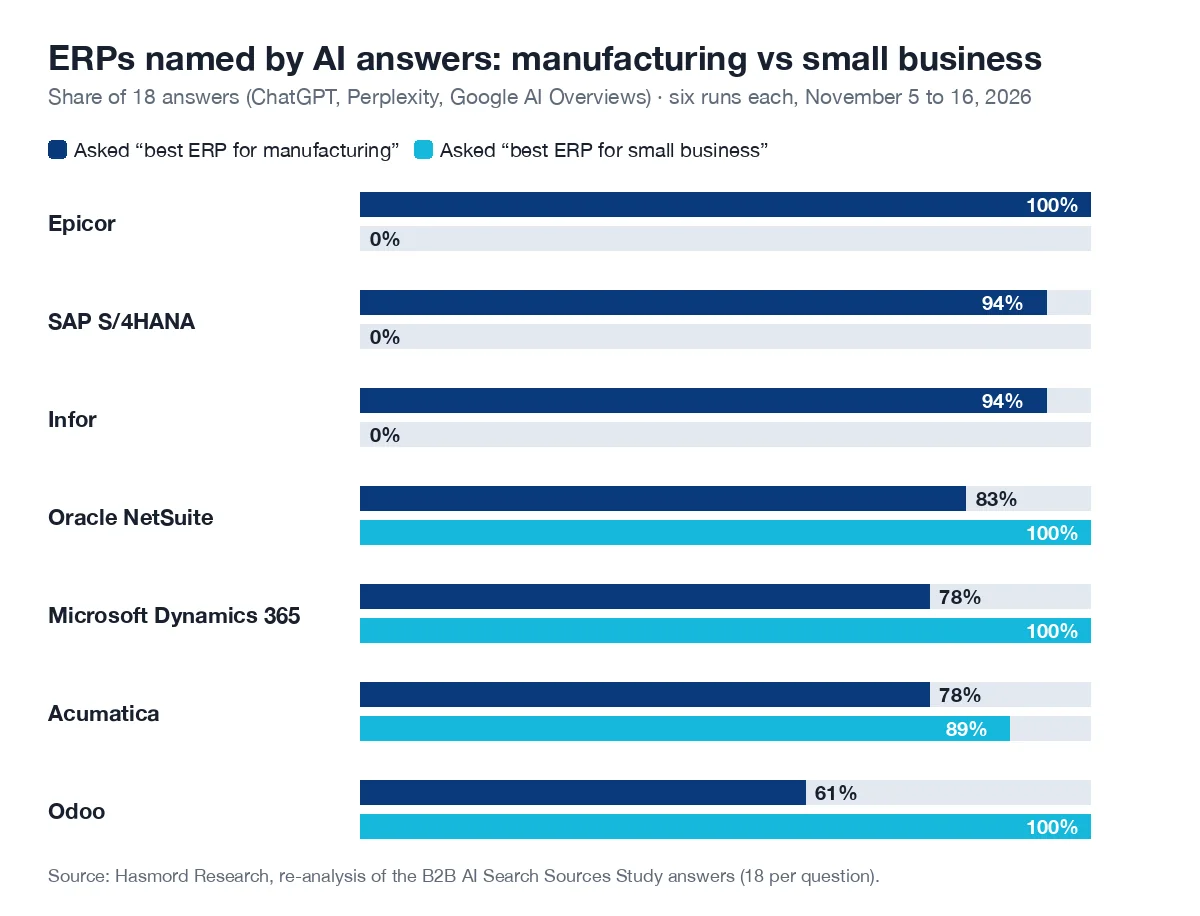
The short answer: There is no single best ERP for manufacturing: the right one depends on how you make things (discrete, process, made-to-order or job shop), your size and what you run today. When we asked ChatGPT, Perplexity and Google “best ERP for manufacturing” six times each in November 2026, all 18 answers named Epicor, and most named SAP S/4HANA, Infor, NetSuite, Microsoft Dynamics 365 and Acumatica; asked “best ERP for small business”, none named Epicor. Every manufacturing answer brought up types of manufacturing, and most matched their picks to them. Use an AI answer as a starting shortlist, then choose with demos of your own orders.
An ERP (enterprise resource planning) system runs a company’s core operations from one database: finance, purchasing, inventory, sales orders and, for a manufacturer, production. A manufacturing ERP adds the parts that turn materials into products:
Which ERP fits depends first on how you make things:
| Type of manufacturing | What it looks like | What the ERP must handle well |
|---|---|---|
| Discrete | Countable products assembled from parts: machinery, electronics, furniture | Multi-level bills of materials, routings, revisions |
| Process | Products made from formulas in batches: food, chemicals, cosmetics | Recipes, batch sizes, lot tracking, shelf life |
| Make-to-order and engineer-to-order | Products built or designed for each order | Quoting, product configurators, job or project costing |
| Job shop | Many small jobs for different customers, such as machining | Fast quotes, job costing, scheduling across machines |
| Mixed-mode | More than one of the above in the same company | Each mode without workarounds |
Many buyers now start by asking an AI assistant. As part of our B2B AI search sources study, we asked ChatGPT, Perplexity and Google “best ERP for manufacturing” six times each between November 5 and November 16, 2026, and counted which ERPs each answer named:
| Named in the answer to “best ERP for manufacturing” | ChatGPT | Perplexity | Google AI Overviews |
|---|---|---|---|
| Epicor (Kinetic) | 6 of 6 | 6 of 6 | 6 of 6 |
| SAP S/4HANA | 6 of 6 | 6 of 6 | 5 of 6 |
| Infor (CloudSuite Industrial, also called SyteLine) | 5 of 6 | 6 of 6 | 6 of 6 |
| Oracle NetSuite | 6 of 6 | 3 of 6 | 6 of 6 |
| Microsoft Dynamics 365 | 6 of 6 | 6 of 6 | 2 of 6 |
| Acumatica | 3 of 6 | 6 of 6 | 5 of 6 |
| Odoo | 5 of 6 | 4 of 6 | 2 of 6 |
| Deacom | 3 of 6 | 1 of 6 | 6 of 6 |
| BatchMaster | 1 of 6 | 3 of 6 | 6 of 6 |
| Plex | 3 of 6 | 3 of 6 | 3 of 6 |
| IFS Cloud | 0 | 6 of 6 | 0 |
| JobBOSS² | 0 | 0 | 5 of 6 |
On the same days we also asked “best ERP for small business”. The two lists barely overlap at the top:
A small manufacturer asking the small-business question gets a different shortlist from one asking the manufacturing question. Say both: what you make, how, and how big you are.
For each “best ERP for manufacturing” answer we also sorted the sites it cited:
| Share of cited sites | ChatGPT | Perplexity | Google AI Overviews |
|---|---|---|---|
| Companies that sell or implement ERP (vendors, partners, resellers) | 42% (11 of 26) | 55% (32 of 58) | 8% (2 of 26) |
| Review and software comparison sites | 42% | 19% | 19% |
| Forums, video and social (Reddit, YouTube) | 0% | 0% | 38% |
| Other software companies (inventory, demo and automation tools) | 15% | 14% | 0% |
| Publishers and others | 0% | 12% | 27% |
Being named and being cited were two different things. Epicor was named in all 18 answers, but its own website was cited in only 2 of them; its place came from lists other sites wrote, such as ERP comparison sites (one was cited in 12 of the 18 answers, another in 8). Cin7, which sells inventory software and a small-business ERP, was cited in five Perplexity answers and never named for manufacturing. Google’s AI Overviews leaned on Reddit and YouTube for more than a third of their references.
Three more questions show who writes what the answers read:
What this means if you are choosing an ERP: an AI answer is a fair starting shortlist, but much of what it read was written by companies that sell or implement ERP. Confirm on each vendor’s own site that it supports your type of manufacturing, read reviews from manufacturers like you, and remember that answers get details wrong at times; see how to fact-check an AI answer.
We also asked “how to choose an ERP system” six times in each engine. These are the points the 18 answers raised, and how often:
| What to check | Answers that raised it (of 18) |
|---|---|
| Write down your requirements and map your current processes first | 18 |
| Total cost of ownership, not just the licence | 18 |
| Fit for your industry | 18 |
| Demos, ideally scripted around your own processes | 18 |
| Moving your data over | 18 |
| Training and change management | 18 |
| Ease of use, so people actually use it | 17 |
| Cloud or on-premise | 17 |
| Integrations, room to grow, customization | 15 each |
| Reporting and analytics; references from similar companies | 14 each |
| The implementation partner and the vendor’s support | 13 |
| A selection team from several departments | 12 |
| Security and compliance | 11 |
| Mobile access | 6 |
| AI features | 0 (no answer mentioned AI at all) |
That is a sound general list. For a manufacturer, make it concrete:
The ERP answers are one example of how B2B buyers now meet suppliers. The same patterns are worth checking for your own products and services:
No new questions were asked for this page; we re-read answers collected for our B2B AI search sources study. Questions: “best erp for manufacturing”, “best erp for small business”, “netsuite vs sap business one”, “is netsuite worth it” and “how to choose an erp system”, each asked three times within about half an hour on November 5, 2026 and once each on November 9, 12 and 16, for a US location (18 answers per question). ChatGPT answers come from chatgpt.com search, not signed in; Perplexity through the Sonar API with US web search; Google is the AI Overview, which was shown in all 30 searches. An ERP is named when its name or product name appears in the answer text (image captions excluded). Cited sites are counted once per answer; we sorted them by hand from each site’s home page (“companies that sell or implement ERP” includes ERP vendors and their partners and resellers; independent ERP advisors and accounting firms are counted separately). “How to choose” points were matched by keyword, so read them as directions. One market, English only. This page was written by Hasmord, which does not sell an ERP; Hasmord was not named in any of these answers.
Hasmord is the AEO-native, recursively self-improving sales platform. Buyers ask questions across AI assistants, search, and sales conversations. Hasmord uncovers where your answers about your products and services fall short, turns evidence into better answers, finds potential customers for you, and connects every lead to your sales process.
Manufacturers’ own buyers now ask AI which supplier fits them, the way they ask which ERP fits. The first two steps work on those answers: AI answers asks your buyers’ questions in ChatGPT, Claude, Gemini and Perplexity and shows where the answers about your products and services fall short, and Hasmord turns your evidence, such as spec sheets, certifications and use cases, into better answers for your team to approve.
Find customers then finds potential customers already looking for what you make, with the reason each one fits. Only the people you verify join the CRM, where each lead keeps the question that brought it, is matched to its company and your products, and gets follow-ups. Hasmord never contacts anyone for you. See Hasmord for manufacturers and pricing.
It depends on how you make things (discrete, process, make-to-order, job shop or mixed), your size and what you run today. In Hasmord Research’s re-analysis of the B2B AI Search Sources Study (November 2026), all 18 answers to “best ERP for manufacturing” from ChatGPT, Perplexity and Google’s AI Overviews named Epicor; SAP S/4HANA and Infor were in 17, NetSuite in 15, Microsoft Dynamics 365 and Acumatica in 14.
In the same data, all 18 answers to “best ERP for small business” named Oracle NetSuite, Microsoft Dynamics 365 (mostly Business Central) and Odoo, then Acumatica (16) and Sage (13). Epicor, SAP S/4HANA and Infor, near the top for manufacturing, were named in none.
MRP (material requirements planning) works out what materials to buy and what to make, and when. An ERP includes that planning and also runs finance, purchasing, inventory, sales orders and, for manufacturers, production, quality and costing in one system.
ERPs are usually grouped by how they are deployed: on-premise, cloud (software as a service) and hybrid. Some guides group them by scope instead: general-purpose, industry-specific and small-business ERPs. For a manufacturer, support for its type of manufacturing matters more than either grouping.
SAP is a software company that sells both. SAP S/4HANA and SAP Business One are its ERP systems; it sells CRM separately, such as SAP Sales Cloud. In AI answers to “best ERP for manufacturing”, SAP S/4HANA was named in 17 of 18.
In Hasmord Research’s data (November 2026), 41% of the sites cited for “best ERP for manufacturing” belonged to companies that sell or implement ERP, and 25% were review or comparison sites. Google’s AI Overviews took 38% of their references from Reddit and YouTube. Epicor was named in all 18 answers but its own site was cited in only 2.
Related: best CRM for manufacturers · Hasmord for manufacturers · B2B CRM · B2B AI search sources study · AI fact-checking · B2B content marketing.