Contract manufacturing
Which contract manufacturers ChatGPT, Perplexity and Google name, where those names come from, and what to check before you choose one.
Last updated November 22, 2026 · ~10 min read
The short answer: There is no single best contract manufacturer: the right one depends on what you make, your volumes, the certifications you need and where you want it made. When we asked ChatGPT, Perplexity and Google “best contract manufacturing companies” six times each in November 2026, ChatGPT named the global giants every time (Jabil, Flex, Foxconn, Sanmina), Perplexity named smaller US firms such as Mack Molding, SEACOMP and MacroFab, mostly from directory pages, and some of the lists the answers read were published by manufacturers. Use an AI answer as a first list, check who wrote the pages behind it, and compare manufacturers on the same request for quote.
A contract manufacturer makes parts or finished products for another company, which sells them under its own name. The brand owns the design and the customer; the contract manufacturer brings the factory, the equipment, the certifications and often the supply chain. The best-known example is electronics: Foxconn (Hon Hai Precision Industry) assembles iPhones for Apple, and it is the largest electronics contract manufacturer by revenue.
“Contract manufacturing” covers very different businesses, so the first question is always which kind you need:
| Kind | What they make | Examples AI answers named |
|---|---|---|
| Electronics manufacturing services (EMS) | Circuit board assembly, cables, finished devices (“box build”) | Jabil, Flex, Sanmina, Celestica, Foxconn, Plexus; for small runs, MacroFab and Screaming Circuits |
| Pharmaceutical and biotech (CDMOs) | Drug development and manufacturing, from clinical batches to commercial scale | Lonza, Thermo Fisher Scientific (Patheon), Catalent, Samsung Biologics |
| Medical devices | Devices and components under medical quality rules | Integer Holdings, Phillips-Medisize |
| Plastics, metal and machining | Molded, machined and fabricated parts, enclosures, assemblies | Mack Molding, Fabcon; online services such as Protolabs and Xometry |
| Consumer goods (private label, co-packing) | Cosmetics, supplements, food and drink made to your formula or theirs | KDC/ONE, Voyant Beauty, NutraScience Labs |
Many buyers now start by asking an AI assistant. As part of our B2B AI search sources study, we asked ChatGPT, Perplexity and Google “best contract manufacturing companies” six times each between November 5 and November 16, 2026, and counted which companies each answer named. Google showed an AI Overview in five of the six runs.
| Named in the answer to “best contract manufacturing companies” | ChatGPT (of 6) | Perplexity (of 6) | Google AI Overviews (of 5) |
|---|---|---|---|
| Jabil | 6 | 3 | 5 |
| Flex | 6 | 2 | 5 |
| Sanmina | 6 | 3 | 4 |
| Foxconn | 6 | 0 | 4 |
| Celestica, Plexus, Benchmark Electronics | 6 each | 2–3 | 0–1 |
| Lonza, Thermo Fisher Scientific (Patheon) | 6 each | 1 | 4 |
| Mack Molding | 2 | 5 | 0 |
| SEACOMP, Inertia, MacroFab, Screaming Circuits, Detail Mold | 0 | 5 each | 0 |
| Fabcon | 0 | 5 | 1 |
| Pegatron, Quanta Computer | 0 | 0 | 4 each |
| Elcan Industries | 0 | 0 | 4 |
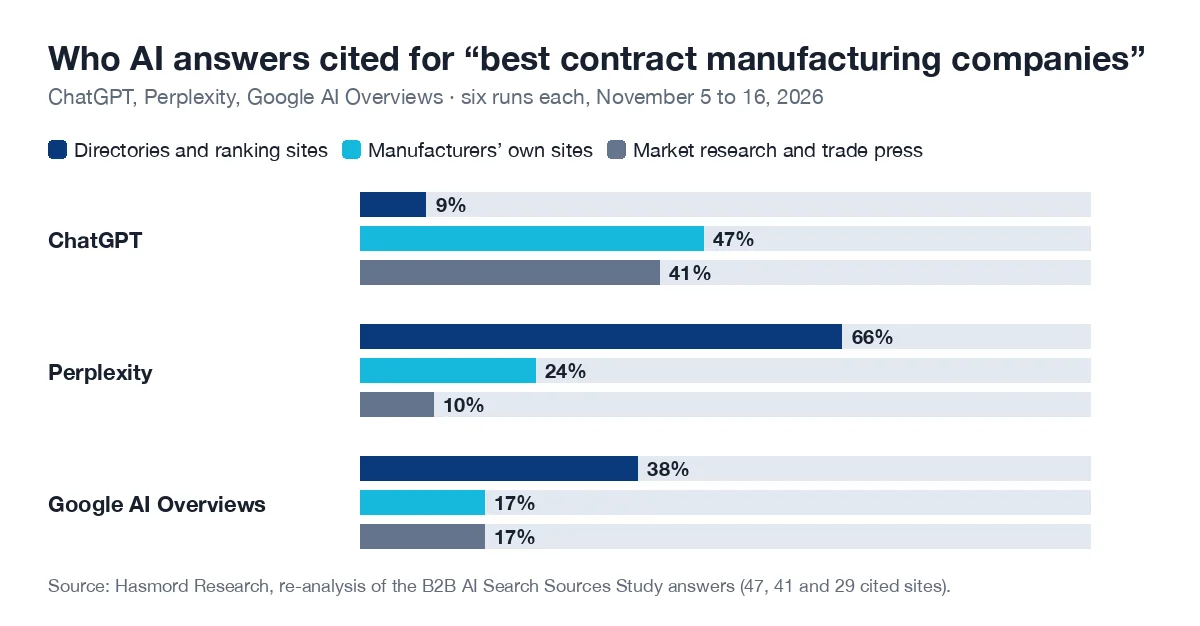
For each answer we also sorted the sites it cited:
| Share of cited sites, “best contract manufacturing companies” | ChatGPT | Perplexity | Google AI Overviews |
|---|---|---|---|
| Directories and ranking sites (Clutch, The Manifest, Thomasnet and others) | 9% | 66% | 38% |
| Manufacturers’ own sites | 47% | 24% | 17% |
| Market research firms and trade press | 41% | 10% | 17% |
| Forums, video and social (LinkedIn, YouTube) | 0% | 0% | 28% |
Each engine’s list follows its sources. ChatGPT read market-size reports and the giants’ own home pages, so it named the giants. Perplexity cited Clutch, The Manifest and Superb Companies in all six answers; when it gave a source for one of the smaller US firms it named, 30 of 38 citations pointed to company directories.
Some of the lists the answers read were written by manufacturers themselves:
What this means if you are choosing a manufacturer: an AI answer is a fair first list, but look at who wrote the pages behind it. A directory ranking, a market report and a manufacturer’s own “top 10” are different kinds of evidence. Check certifications and capabilities on each company’s own site, ask for proof, and remember that answers get details wrong at times; see how to fact-check an AI answer.
We also asked “best CNC machining services” six times in each engine:
80% of all 87 sites cited for this question belonged to machine shops and manufacturing services. For CNC work, say where you are and what you need in the question itself, or the answer will decide for you.
Two more questions show who writes what buyers read about a named company:
We also asked “how to choose a contract manufacturer” six times in each engine (Google showed an AI Overview in 5). These are the points the 17 answers raised, and how often:
| What to check | Answers that raised it (of 17) |
|---|---|
| Capabilities and processes that fit your product | 17 |
| Experience with similar products or your industry | 17 |
| Certifications (ISO 9001, ISO 13485, AS9100, FDA, GMP, ITAR) | 17 |
| Quality system, inspection and traceability | 17 |
| Communication and responsiveness | 17 |
| Write down your requirements first | 16 |
| Total landed cost, not just the unit price | 16 |
| Visit or audit the facility | 16 |
| Lead times | 16 |
| Capacity to grow with you; references and track record | 15 each |
| Protecting your IP (NDA, who owns the tooling) | 14 |
| Design-for-manufacturing support; a pilot run first; contract terms | 13 each |
| Regulatory compliance | 12 |
| Supply chain and component sourcing | 11 |
| Location: domestic, nearshore or offshore | 10 |
| Minimum order quantities; financial stability | 9 each |
| AI features | 0 |
Who wrote the advice: ChatGPT cited nothing for this question. 68% of Perplexity’s citations were contract manufacturers’ own guides, and five sites were cited in all six of its answers, four of them manufacturers. Google cited manufacturers for 44% and forums and video for 28%.
That is a sound list. Make it concrete:
Is contract manufacturing risky? The common risks are quality drift, leaks of your designs, depending on one supplier, and costs that grow after the first quote. The steps above are how most buyers reduce them: clear specifications, a written quality agreement, tooling you own, a pilot run, and a second source for critical parts once volume justifies it.
Your buyers ask the same questions. The answers above show what decides whether you appear:
No new questions were asked for this page; we re-read answers collected for our B2B AI search sources study. Questions: “best contract manufacturing companies”, “best cnc machining services”, “protolabs vs xometry”, “is xometry legit” and “how to choose a contract manufacturer”, each asked three times within about half an hour on November 5, 2026 and once each on November 9, 12 and 16, for a US location. ChatGPT answers come from chatgpt.com search, not signed in; Perplexity from its API with web search; Google from the AI Overview on a US desktop results page, when one was shown (4 to 6 of 6 runs per question). A company counts as named when its name appears in the answer text; cited sites count once per answer and were sorted by kind from each site’s home page. The “how to choose” points are keyword matches, one count per answer. ChatGPT’s city answers depend on the location it assumed, which we did not set. These are counts from one set of questions in one country, not a ranking of manufacturers, and we did not check whether any company’s claims are true.
Hasmord is the AEO-native, recursively self-improving sales platform. Buyers ask questions across AI assistants, search, and sales conversations. Hasmord uncovers where your answers about your products and services fall short, turns evidence into better answers, finds potential customers for you, and connects every lead to your sales process.
Contract manufacturers’ buyers now ask AI which supplier fits them, as in the answers above. The first two steps work on those answers: AI answers asks your buyers’ questions in ChatGPT, Claude, Gemini and Perplexity and shows where the answers about your capabilities fall short, and Hasmord turns your evidence, such as certifications, equipment lists, spec sheets and case studies, into better answers for your team to approve.
Find customers then finds potential customers already looking for what you make, with the reason each one fits. Only the people you verify join the CRM, where each lead keeps the question that brought it, is matched to its company and your capabilities, and gets follow-ups. Hasmord never contacts anyone for you. See Hasmord for manufacturers and pricing.
A company that makes parts or finished products for another company, which sells them under its own name. The brand owns the design and the customers; the contract manufacturer provides the factory, equipment, certifications and often the supply chain. Common kinds are electronics manufacturing services, pharmaceutical CDMOs, medical device manufacturers, plastics and metal shops, and private-label consumer goods makers.
Foxconn (Hon Hai Precision Industry) assembles iPhones for Apple and is the largest electronics contract manufacturer by revenue. Other well-known examples are Jabil, Flex and Sanmina in electronics, and Lonza and Thermo Fisher Scientific (Patheon) in pharmaceuticals.
In Hasmord Research’s re-analysis of the B2B AI Search Sources Study (November 2026), all six ChatGPT answers to “best contract manufacturing companies” named Jabil, Flex, Sanmina, Foxconn, Celestica, Plexus, Benchmark Electronics, Lonza and Thermo Fisher. Perplexity named smaller US firms instead, such as Mack Molding, SEACOMP, MacroFab and Fabcon (5 of 6 each). Google’s AI Overviews named Jabil and Flex in all 5.
In Hasmord Research’s data (November 2026), 66% of the sites Perplexity cited for “best contract manufacturing companies” were directories and ranking sites such as Clutch and The Manifest. ChatGPT cited manufacturers’ own sites (47%) and market research and trade press (41%). Google’s AI Overviews cited directories (38%) and LinkedIn and YouTube (28%).
It can be. The common risks are quality drift, leaks of your designs, depending on one supplier, and costs that grow after the first quote. Buyers reduce them with clear specifications, an NDA and a written quality agreement, owning their tooling, a pilot run before volume, checking certifications at the source, and a second source for critical parts.
In Hasmord Research’s data (November 2026), all 18 answers from ChatGPT, Perplexity and Google’s AI Overviews said yes, and 17 mentioned that Xometry is publicly traded. All 12 Perplexity and Google answers added that quality can vary because partner shops make the parts. Perplexity leaned on review sites (59% of its citations) and Google on Reddit, YouTube and forums (61%).
Related: best ERP for manufacturing · best CRM for manufacturers · Hasmord for manufacturers · B2B AI search sources study · third-party reviews · AI fact-checking.