
We asked 60 B2B buying questions, from “best CRM for small business” to “how to choose a PCB manufacturer”, three times in one day in Google, ChatGPT and Perplexity, and sorted every cited site by type. Then we compared the results with the same engines’ answers to shopping questions.
Published November 5, 2026 · Data collected November 5, 2026 (three runs, 10 to 20 minutes apart)
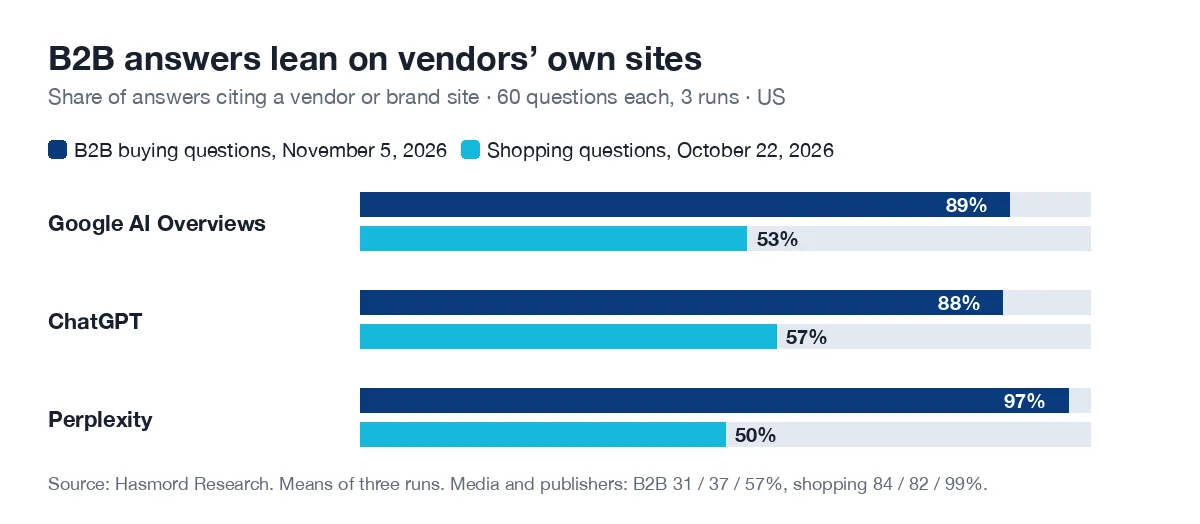
Share of answers that cited at least one site of each type, as the mean of the three runs with the lowest and highest run in brackets. Google’s column covers searches that showed an AI Overview (55, 56 and 57 of 60 in the three runs).
| Source type | Google AI Overviews | ChatGPT | Perplexity |
|---|---|---|---|
| Vendor’s own site | 89% (88–91) | 88% (84–92) | 97% (97–97) |
| Review platform (G2, Capterra, Trustpilot…) | 17% (16–18) | 17% (15–21) | 28% (28–28) |
| Media and publishers | 31% (27–33) | 37% (33–40) | 57% (57–57) |
| Independent blogs | 26% (25–27) | 31% (23–35) | 42% (42–42) |
| Directory or marketplace | 13% (9–16) | 18% (17–19) | 27% (27–27) |
| Forum or social | 64% (62–67) | 4% (4–6) | 5% (5–5) |
| Video (YouTube) | 77% (74–79) | 0% (0–0) | 0% (0–0) |
The same engines and settings on 60 shopping questions on October 22 (our shopping study), next to the B2B results. In the shopping study, G2 and Capterra counted as publishers; here they are review platforms, so the B2B media share leaves them out.
| Engine | Vendor or brand site | Media and publishers | Forum or social | Video |
|---|---|---|---|---|
| Google AI Overviews | 89% shopping: 53% | 31% shopping: 84% | 64% shopping: 67% | 77% shopping: 83% |
| ChatGPT | 88% shopping: 57% | 37% shopping: 82% | 4% shopping: 0% | 0% shopping: 0% |
| Perplexity | 97% shopping: 50% | 57% shopping: 99% | 5% shopping: 10% | 0% shopping: 0% |
All three engines and runs pooled, share of answers citing each type. Six software categories, six supplier and sourcing categories, five questions each.
| Category | Vendor site | Review platform | Media | Forum or social | Directory | |
|---|---|---|---|---|---|---|
| crm software (established control) | 100% | 27% | 53% | 24% | 18% | 7% |
| sales prospecting | 98% | 14% | 25% | 32% | 20% | 9% |
| security compliance (young) | 87% | 16% | 36% | 16% | 16% | 7% |
| developer infrastructure (young) | 93% | 20% | 27% | 7% | 4% | 0% |
| erp | 82% | 43% | 68% | 14% | 7% | 18% |
| hr & payroll | 100% | 20% | 69% | 22% | 20% | 0% |
| contract manufacturing | 98% | 22% | 49% | 27% | 20% | 32% |
| packaging suppliers | 97% | 19% | 43% | 14% | 8% | 3% |
| industrial supply & equipment | 69% | 17% | 43% | 43% | 34% | 31% |
| wholesale sourcing | 86% | 21% | 24% | 33% | 26% | 81% |
| logistics & 3pl | 100% | 14% | 51% | 27% | 22% | 24% |
| electronics & pcb | 86% | 20% | 18% | 41% | 36% | 27% |
A reader of an earlier study suggested that young software categories pull from forums because review publishers don’t cover them yet, with CRM as an established control. We tested it with two young categories, security compliance and developer infrastructure. It did not hold: 11% of their answers cited a forum or social site, against 24% for CRM. Review platforms showed up in 18% and 27%. With five questions a category, read these as directions, not rates.
We sorted the vendor pages each engine cited by title. A page counts as a roundup or comparison if its title says so (“best”, “top 10”, “vs”, “alternatives”, “compared”). On the 12 “X vs Y” questions we also checked whether the answer cited both companies’ own sites.
| Engine | Vendor pages that are roundups or comparisons | “X vs Y” answers citing both companies’ sites |
|---|---|---|
| Google AI Overviews | 253 of 548 (46%) | 6 of 36 |
| ChatGPT | Not measured: its source titles often read only “Official website” | 25 of 36 |
| Perplexity | 518 of 979 (53%) | 12 of 36 |
In practice, a B2B buyer who asks for the best tool often gets an answer built partly on a competitor’s list. That list names the competitor first, and the answer cites it as a source.
In this run, 951 of 3,138 AI Overview citation links (30%) pointed to a google.com redirect with an encrypted address, not to the cited page. On October 22, 0 of 2,333 did. Each wrapped link still shows the site’s name, so we matched names to the sites’ addresses from the direct links we had; the few we couldn’t match we typed by name. Anyone who tracks AI Overview citations by URL should check for this.
A reader of our shopping study pointed out that runs an hour apart mostly measure caching, and asked whether the sources hold after the engines update. We asked the same 60 shopping questions again on November 5, three times in the same runs, and compared the sites each answer cited with October 22.
| Engine | Same sites an hour later (Oct 22) | Same sites 10–20 minutes later (Nov 5) | Same sites two weeks later |
|---|---|---|---|
| Google AI Overviews | 77% | 82% | 57% |
| ChatGPT | 48% | 53% | 37% |
| Perplexity | 99% | 98% | 62% |
Each figure is the share of one run’s cited sites that also appear in another run of the same question, averaged over all pairs of runs: runs on the same day for the first two columns, October 22 against November 5 for the last.
60 B2B buying questions we wrote, 5 in each of 12 categories (CRM, sales prospecting data, security compliance, developer infrastructure, ERP, HR and payroll; contract manufacturing, packaging suppliers, industrial supply and equipment, wholesale sourcing, logistics and 3PL, electronics and PCBs): two “best” questions, one “X vs Y”, one “is X worth it” and one “how to choose”. 46 of the 60 have measurable US search volume in DataForSEO. Asked three times on November 5, 2026, between 3:15 and 3:50 pm Pacific time (10 to 20 minutes apart, closer than the hour in our shopping study), from a US location: Google US desktop with the AI Overview loaded; ChatGPT through chatgpt.com search (DataForSEO LLM Scraper); Perplexity through the Sonar API with US web search (DataForSEO). Citations are counted as in our earlier studies: a site counts once per answer. Site types were assigned by one person, by domain and page title; any company selling in these categories counts as a vendor, including consultants and agencies. Percentages use answers that cited at least one source.
Limits: one day, one market, written questions rather than a sample of real searches, five questions per category. The shopping comparison uses October 22 data with a slightly different type scheme, as noted above. API and scraper results can differ from what a signed-in user sees. Perplexity’s API returned at most ten sources per answer. The raw rows are in the CSV.
Hasmord is the AEO-native sales platform. Buyers ask questions across AI assistants, search, and sales conversations. Hasmord uncovers where your answers about your products and services fall short, turns evidence into better answers, finds potential customers for you, and connects every lead to your sales process.
It asks your buyers’ questions in ChatGPT, Claude, Gemini and Perplexity and keeps every answer and the pages it cites, so you can see which vendor pages, comparisons and reviews describe you. It then helps your team fix the facts on your own pages with evidence, finds potential customers already looking for what you sell, and keeps each lead in a CRM with the question that brought it. See the AEO/GEO platform.
Mostly vendors’ own sites. In our test, 88–97% of answers cited at least one vendor’s site, depending on the engine, against 50–57% for brand sites on shopping questions. Media and publishers were cited in 31–57% of B2B answers, far less than for shopping.
Sometimes. Review platforms such as G2, Capterra and Trustpilot appeared in 17% of ChatGPT answers and 28% of Perplexity answers, and in 17% of Google AI Overviews.
In Google AI Overviews, yes: 64% of overviews cited a forum or social site. ChatGPT and Perplexity rarely did (4% and 5%). Supplier and sourcing questions drew more forum citations (31% of answers) than software questions (19%).
Since our October run, Google has started wrapping some AI Overview citation links in a google.com redirect that hides the address of the cited page. On November 5, 30% of the links were wrapped; on October 22, none were. Each link still shows the site’s name.
They drift. For the same 60 shopping questions, Perplexity cited 99% of the same sites an hour later but 62% two weeks later; ChatGPT 48% and 37%; Google AI Overviews 77% and 57%.
Related: shopping answers over three runs · who ChatGPT and Perplexity cite · who Google’s AI Overviews cite · LLM SEO · best CRM for manufacturers.